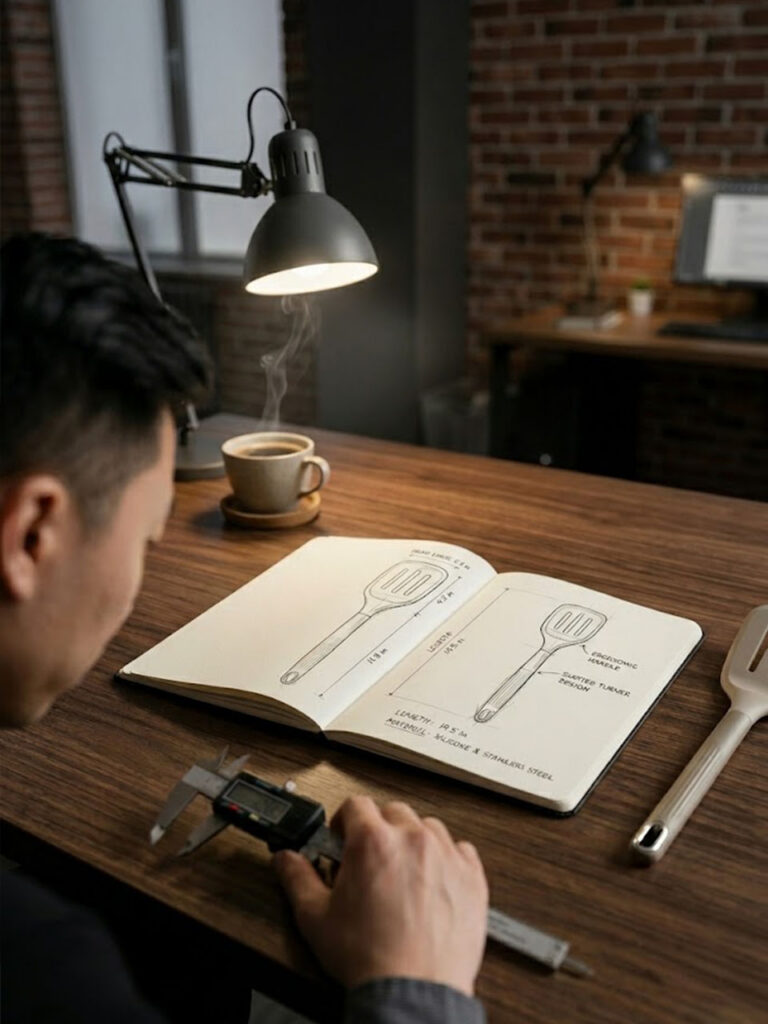
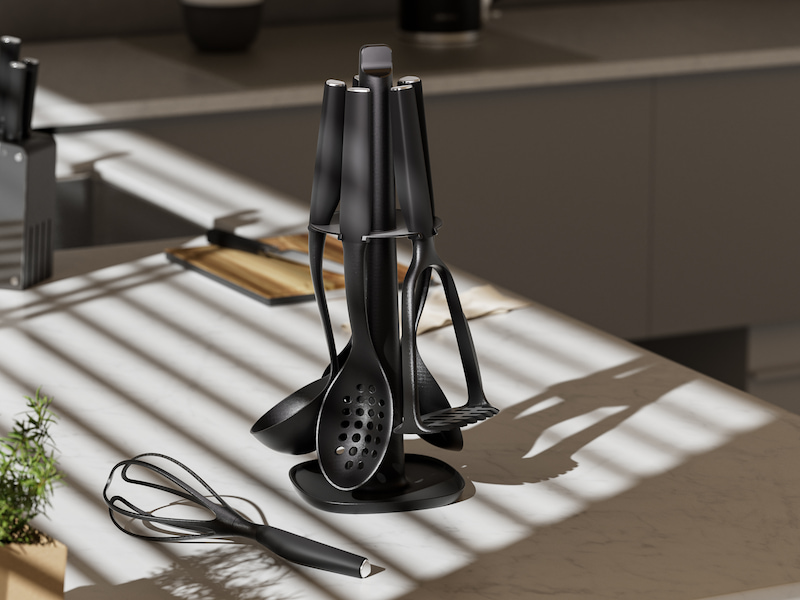
A kitchen utensil may have an attractive colour, a comfortable first touch and a retail-ready appearance. But appearance alone cannot show how the product will behave during cooking or whether production can reproduce the approved sample consistently.
For brands, retailers and sourcing teams, the more useful question is: Does this product complete its intended task under realistic conditions?
In our product development work, we have found that many weaknesses remain hidden until a utensil meets real cooking movements, repeated use or trial production.
This guide examines how cooking habits, functional testing and production consistency influence commercial readiness, together with cleaning, storage, product-line planning and online presentation.
The objective is not to predict sales from a sample. It is to identify avoidable product weaknesses before mass production and give buyers a more practical basis for product decisions.
Products That Fit Real Cooking Habits
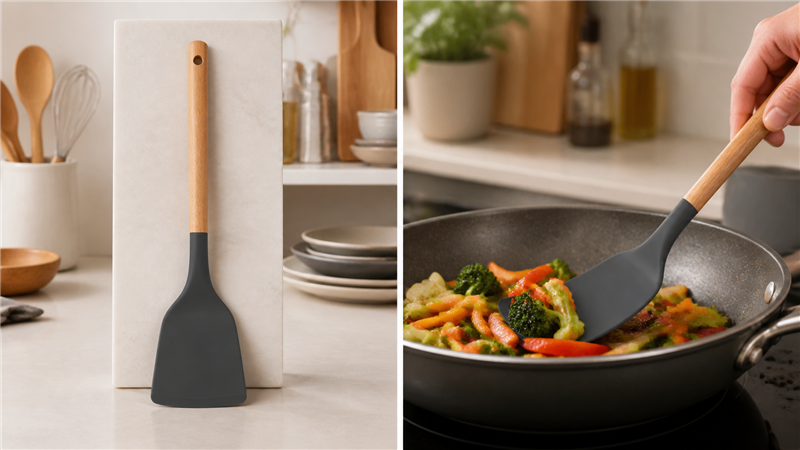
Kitchen utensils are used through repeated physical actions: stirring, lifting, turning, gripping and scraping. A commercially promising product must first fit the cooking movement it is designed to support.
A brief sample inspection may not reveal this. A handle can feel comfortable for a few seconds, while a soft utensil head may appear cookware-friendly without providing enough control during actual cooking.
We encountered this issue while evaluating a silicone spatula. The sample appeared well balanced, and its flexible head supported the intended non-scratch positioning.
The limitation became clear during a stir-frying evaluation. When the spatula met resistance from loose ingredients, the head flexed excessively and its edge curled, pushing the food around the pan instead of lifting and turning it.
Because the same difficulty appeared during independent use evaluations, we treated it as a failure of the intended cooking function, rather than an individual preference about hand feel.
The head was redesigned with a firmer internal core and a softer outer edge. The core provided the force required for turning food, while the softer contact area continued to follow the surface of coated cookware.
The answer was not to make the entire spatula harder. It was to give different parts of the head the material properties required by their individual functions.
This experience led us to establish a practical development rule: utensils designed to turn, lift, grip or scrape must be tested while performing those exact actions. Static flexibility checks remain useful, but they cannot confirm whether a tool completes its basic task.
When developing a kitchen utensil collection, buyers should therefore define the intended cooking action before approving material hardness, head thickness or edge geometry. Terms such as “flexible” and “comfortable” have limited value unless the team knows what resistance the utensil will meet and how much control the user needs.
Repeated use can also reveal balance, grip and fatigue problems that remain invisible during a short review. Our analysis of long-term kitchen tool usability explains why first-touch comfort should not be treated as complete ergonomic validation.
Testing and Iteration Before Scaling
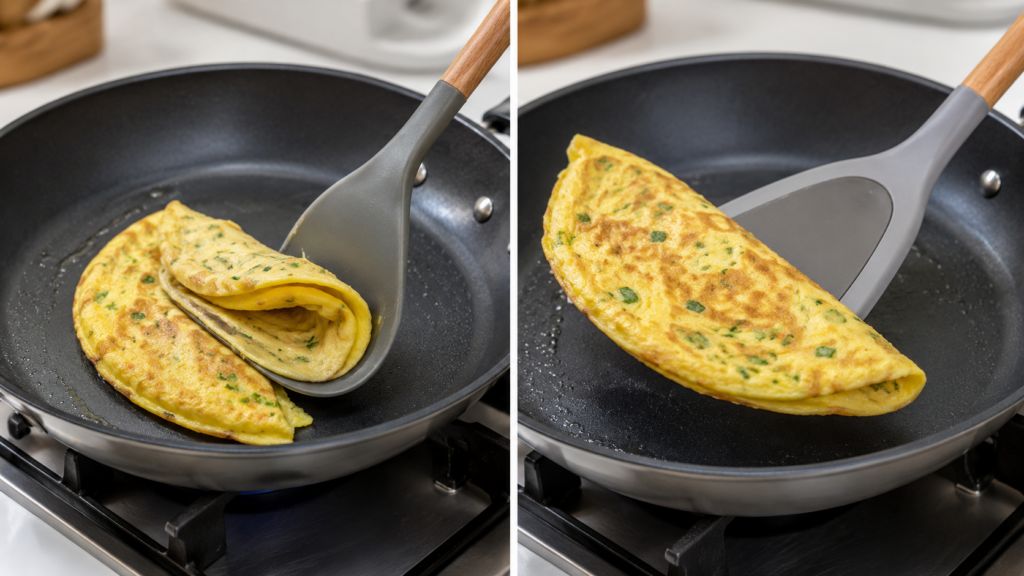
An approved sample proves that one acceptable unit can be produced. It does not prove that the same construction, appearance and performance can be repeated reliably during mass production.
For B2B buyers, this distinction matters. A visually perfect sample may still hide forming stress, unstable joints, material variation or finishing problems that become visible only when multiple units are produced.
Product teams should therefore evaluate patterns across trial production rather than relying on the best-looking unit. Particular attention should go to connection points, formed curves and areas that repeatedly carry load.
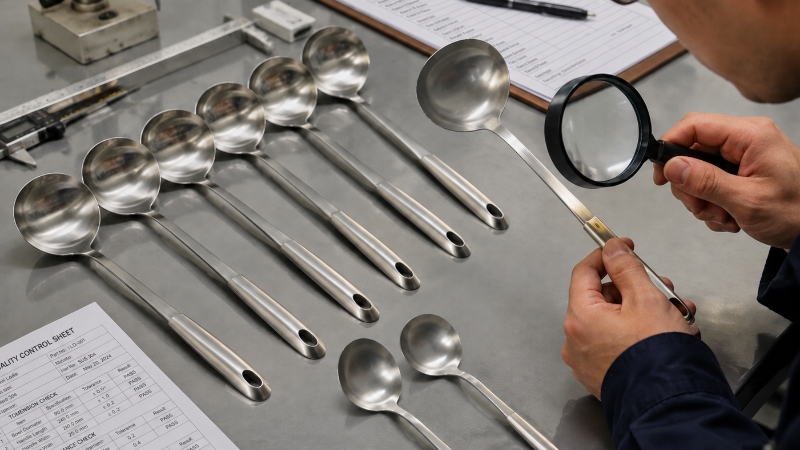
We encountered this issue during the development of a stainless steel ladle. The proposed one-piece handle created a clean, seamless appearance, and the initial sample suggested that the construction was technically possible.
During trial production, however, fine cracks appeared around a high-stress curve in the handle. Some were visible immediately, while others became noticeable only after further finishing or storage, indicating a structural consistency problem rather than an isolated surface defect.
We did not treat the cracks as cosmetic imperfections. A weakness in this area could worsen under repeated loading, creating an unacceptable risk when the utensil is carrying hot food or liquid.
The design was changed to use a separately formed handle joined to the ladle body and carefully finished afterward. This gave up a small degree of visual simplicity but provided more stable production and more predictable structural performance.
The broader lesson is that sample feasibility is not the same as production readiness. If a feature depends on difficult forming, tight tolerances or concentrated stress, buyers should confirm that the process remains stable across trial production before approving it.
Our guide to what buyers should examine during kitchenware sampling explains how hand feel, balance, alignment and packaging fit contribute to a more complete sample review.
Small inconsistencies can also signal larger risks when production scales. Reviewing manufacturing details that may create bigger product problems can help sourcing teams identify which details deserve closer attention before final approval.
Cleaning and Storage Are Part of Product Performance
A kitchen tool is not finished with its job when cooking ends. Users still need to wash, dry and store it, and problems during these stages can influence how they judge the entire product.
We learned this while reviewing feedback on a garlic-processing tool. The tool produced a consistent result during use, but some users later reported mold appearing after the product had been stored.
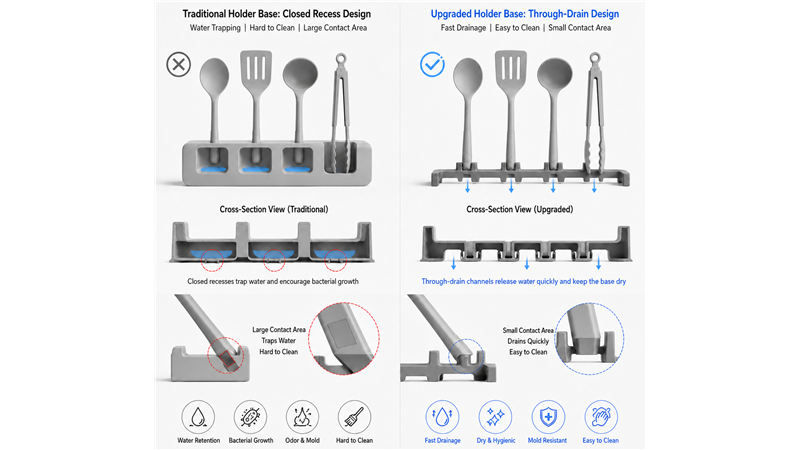
Further investigation showed that the functional tool was not the source. Moisture was collecting inside a recessed area of the storage base when users returned the tool before every surface had dried completely.
From the user’s perspective, that distinction did not matter. Because the base belonged to the set, mold or odor anywhere in the assembly was interpreted as a failure of the whole product.
The base was redesigned with an open drainage path and fewer moisture-trapping contact areas. Clearer cleaning and drying guidance was also added to the product information.
The underlying principle is well established: the U.S. Environmental Protection Agency explains that mold requires moisture to grow. For kitchen tool development, this means trapped water should be treated as a foreseeable design risk, not only a care-instruction issue.
Products supplied with holders, stands or storage bases should therefore be evaluated under wet-storage conditions. The review should consider:
- Drainage: Can water leave the lowest part of the structure?
- Drying: Can air reach the surfaces that remain in contact?
- Cleaning access: Can the user reach corners, grooves and joints?
- Reassembly: Could the product be stored incorrectly while still wet?
- Odor and residue: Do hidden areas retain moisture or food particles?
Following this experience, wet-storage evaluation became a regular consideration for products with bases or holders. The purpose is not to reproduce every possible household habit, but to identify predictable conditions created by the product’s own structure.
This also changes how brands define quality. Material compliance and cooking performance remain important, but they cannot compensate for a design that creates an avoidable moisture trap after washing.
Packaging Must Be Evaluated as a Product System
Packaging is another stage where a functional utensil can lose perceived value. A box or insert must control movement, protect exposed areas and communicate essential product information throughout the intended distribution route.
The International Safe Transit Association’s testing guidance distinguishes between early screening tests and procedures that simulate transport hazards. This reinforces an important point for buyers: the test method should match the product, package and expected distribution environment.
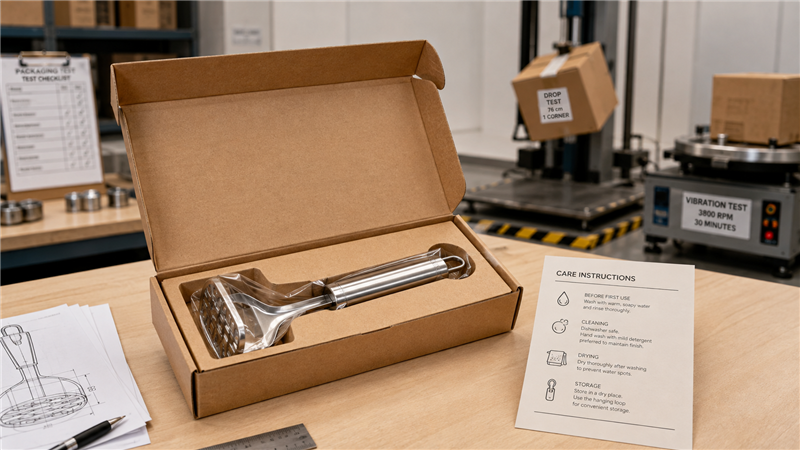
For kitchen utensils, a packaging review should consider whether handles can move inside the box, whether polished surfaces can rub against other components and whether an insert keeps the product aligned. Care instructions should also remain visible, readable and consistent with the actual product construction.
Packaging should therefore be reviewed with the product inside it, rather than approved as a separate graphic design. The product and package form one delivered system, and a change to the insert, material or product dimensions may justify another fit or transport check.
Our article on how packaging decisions affect kitchenware products provides additional considerations for insert fit, protection, labeling and retail presentation.
Building a Cohesive Product Line
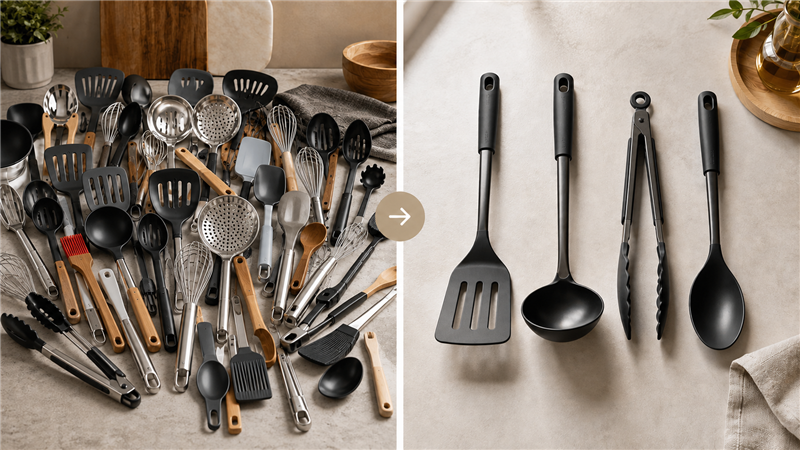
A cohesive product line is not simply a group of utensils that share the same color. The products should also follow a consistent functional purpose, price position and usage scenario.
For example, an everyday cooking range might include a turner, spoon, ladle and tongs because each tool supports a frequent cooking action. Adding unrelated specialty tools only to increase the piece count can make the assortment harder to understand and position.
Buyers should review whether two products perform almost the same task, whether every piece fits the intended kitchen and whether the materials and handle proportions feel consistent across the range. Packaging should then explain why these particular products belong together.
The strongest assortment is not necessarily the one with the most SKUs. Our discussion of why focused kitchen tool sets may work better than larger assortments explains how clearer usage logic can make a product range easier to understand.
Before finalizing a range, buyers can ask:
- Function: Does every utensil have a clear role?
- Overlap: Are two products solving almost the same problem?
- Storage: Can the set fit naturally into the intended kitchen?
- Consistency: Do the materials, colors and finishes feel related?
- Positioning: Can the purpose of the collection be explained quickly?
Online Presentation Should Explain the Product
Online presentation cannot correct weak product performance. However, unclear images can prevent buyers and consumers from understanding a well-designed product’s real function and proportions.
Product images should answer practical questions. How large is the utensil in a hand? How deep is the ladle bowl? Does the spatula edge follow the cookware surface? Can the storage base drain after washing?
This is especially important when customers cannot physically inspect the product. Baymard Institute’s product-page testing found that 42% of users tried to understand product size through images, showing why at least one in-scale image can be more useful than another isolated studio view.
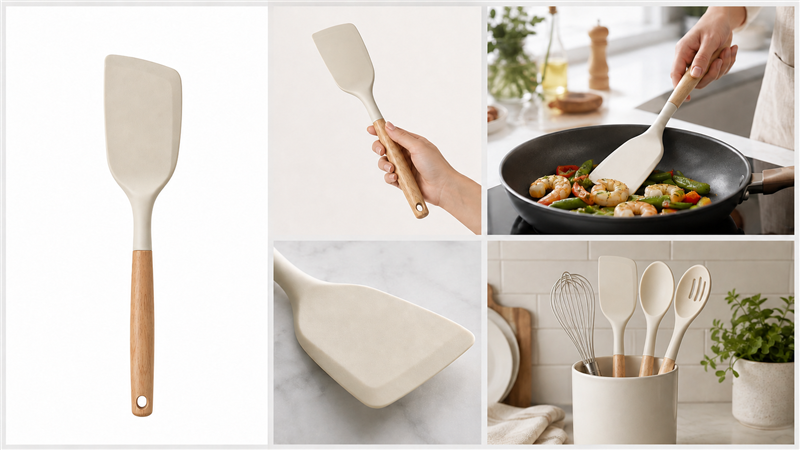
For kitchen utensils, a complete image sequence may include:
- Clean product view: Shows the complete shape and finish
- In-scale image: Places the tool in a hand, pan, bowl or storage area
- Action image: Demonstrates turning, lifting, scraping or gripping
- Detail image: Shows edges, joints, texture or drainage features
- Set overview: Explains how the products work together
- Cleaning or storage view: Clarifies care and post-use handling
The images should match the supplied product specification. Dimensions, material descriptions, care instructions and functional claims must remain consistent across the packaging and product page.
A polished lifestyle image can attract attention, but it should not replace evidence of use. Effective presentation helps customers understand what the product does, how it fits and what they should expect after purchase.
Building Value Beyond First Impressions
Kitchen utensils are more likely to build lasting commercial value when they fit real cooking habits, perform their intended actions and remain consistent in production. Buyers should also evaluate what happens during washing, storage, delivery and online presentation, because product quality is judged across the complete user experience—not only during the first sample review.
Appearance can create initial interest, but validated function, repeatable manufacturing and clear product communication give a kitchen utensil a stronger foundation for retail.
From Product Brief to Production-Ready Range
If you are developing a new utensil, refining an existing design or planning a coordinated product range, L-Tools can help review function, materials, production feasibility, packaging and assortment logic. Send us your product brief or inquiry to discuss how the concept can be developed into a practical, production-ready kitchenware program.