
Project Background
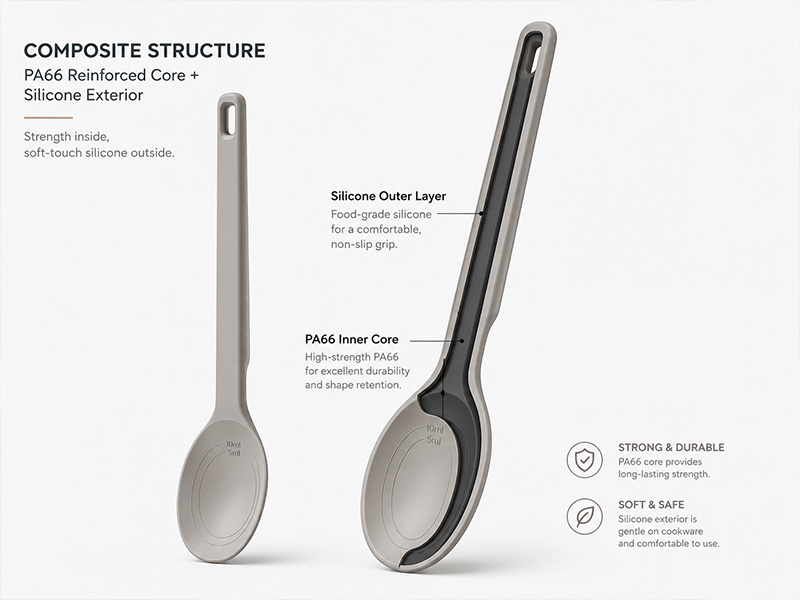
A kitchenware buyer was evaluating a silicone utensil built around a PA66 internal core. The product needed to meet food-contact requirements while remaining stable during high-temperature cooking.
The buyer already had access to basic material documentation, but those files did not show how the complete silicone-over-PA66 structure would behave in hot cooking oil or during prolonged high-temperature use.
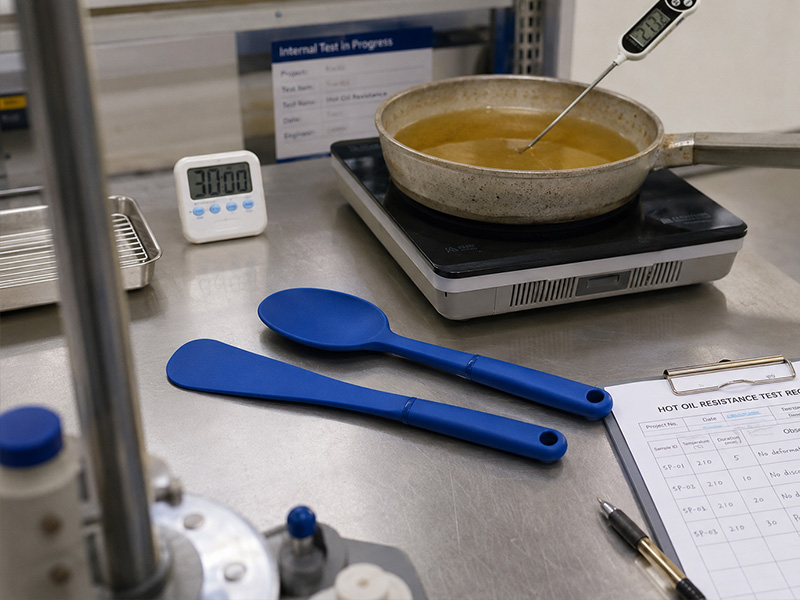
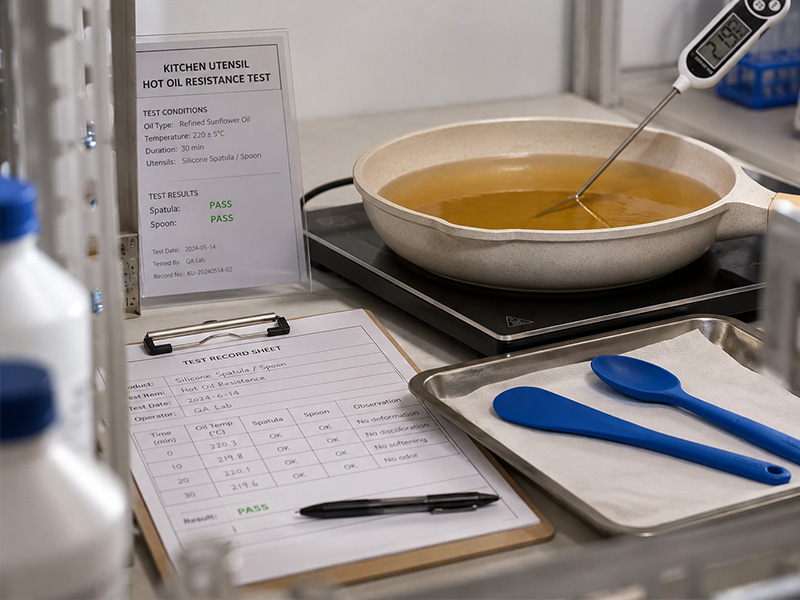
The project therefore focused on a defined internal simulation condition: cooking oil at 400°F, approximately 204°C, for 10 minutes. The goal was to create a clearer technical basis for product approval, packaging claims, supplier evaluation, and mass-production control.
Core Challenges
- Food-contact compliance did not prove that the finished-product structure would remain stable under heat.
- The silicone surface could blister, swell, crack, burn, or show visible colour change.
- The PA66 or nylon internal core could soften or deform after prolonged heating.
- The interface between silicone and the internal core could separate or become unstable.
- The handle-to-head transition and overmoulding edges could loosen or create cleaning risks.
- A successful sample result might not be reproduced consistently during mass production.
Solution
- Separate food-contact compliance from heat-performance validation
The team treated material compliance and finished-product performance as two connected but different workstreams. Food-contact documentation answered whether the material met applicable safety requirements. Heat validation answered whether the complete product structure could remain stable under a defined temperature, medium, duration, and contact method.
- Define the exact validation condition
Instead of relying on a general heat-resistance claim, the project defined the temperature, oil medium, exposure time, and product areas that needed to be observed. This made the test more useful for product development and buyer evaluation.
- Review the complete composite structure
l-tools reviewed the silicone grade, PA66 core, overmoulding thickness, material interface, head geometry, and handle connection as one product system. The review also considered whether small gaps or separations could create cleaning and hygiene concerns.
- Conduct internal simulation testing
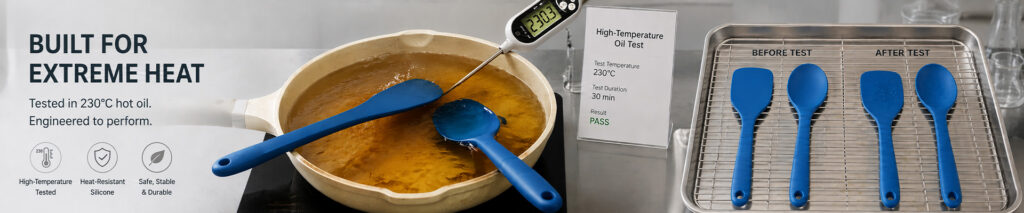
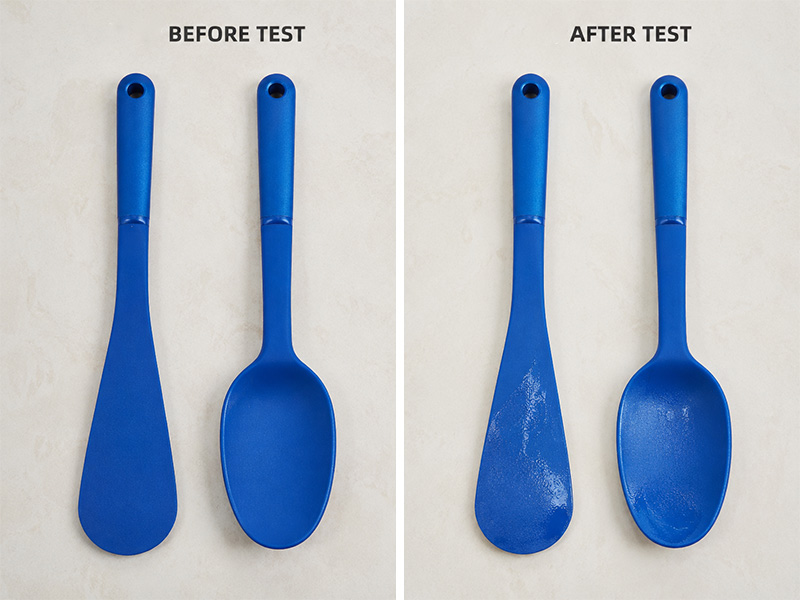
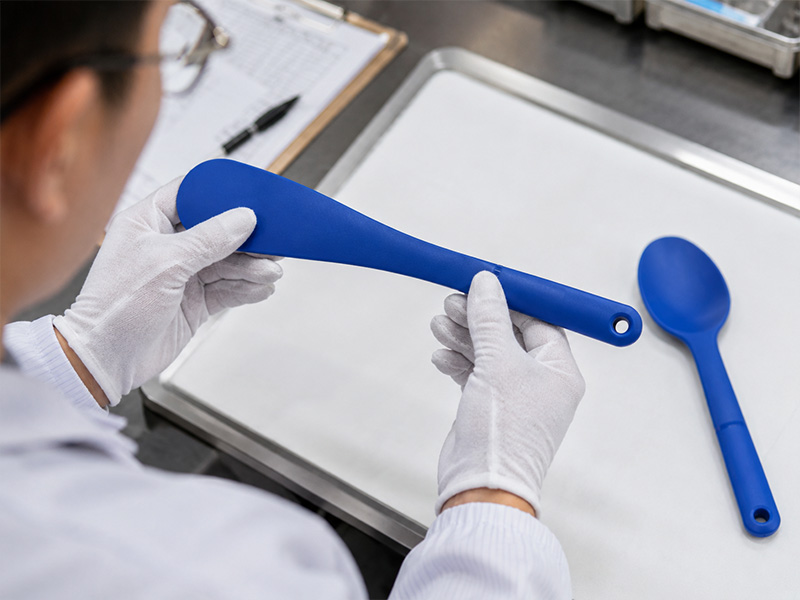
A fully overmoulded slotted turner and a fully overmoulded solid turner were exposed to cooking oil at 400°F, approximately 204°C, for 10 minutes. Before and after testing, the team checked deformation, melting, burning, blistering, swelling, cracking, silicone separation, structural detachment, visible colour change, and connection stability.
- Convert test evidence into production controls
The findings were used to support decisions about the internal core, silicone grade, overmoulding thickness, connection structure, and final sample configuration. They also helped define inspection points for core position, interface quality, colour, appearance, and structural consistency. Packaging claims and instructions were reviewed against the product’s verified performance boundaries.
Project Results
- Neither sample showed visible deformation, melting, burning, blistering, cracking, silicone separation, or structural detachment under the defined internal simulation conditions.
- The buyer gained an initial technical basis for design refinement, sampling, and product evaluation.
- The project established clearer inspection points for later mass-production control.
- Performance validation and food-contact compliance were managed separately, reducing the risk of relying only on material documents.
- The internal result remained a development reference and did not replace the buyer’s official protocol or an accredited third-party laboratory report.
Case Value
This project shifted the buyer’s decision from a broad question about material compliance to a more useful question about finished-product stability under a clearly defined real-use condition.
l-tools’ role was not limited to providing documents or producing another sample. It was to connect compliance, structural risk, testing, packaging claims, and production control before the buyer committed further resources to tooling and mass production.