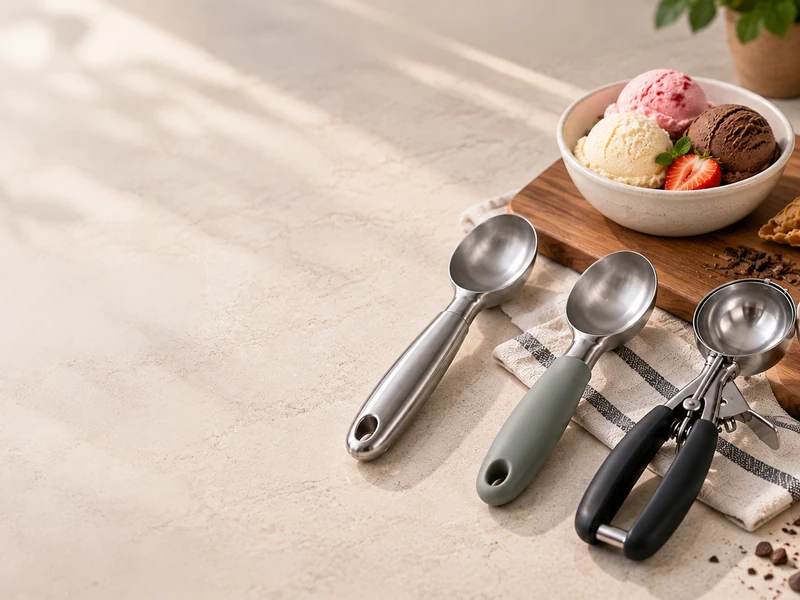
An ice cream scoop looks simple, but differences in the bowl, handle, material, and balance can change its performance. For buyers, it combines everyday usability with retail positioning.
Brands, retailers, importers, and OEM/ODM teams need more than a product that looks good in a catalog. They need a scoop that fits the target price, works under realistic conditions, and supports defensible product claims.
This guide explains how to compare designs, test samples, and prepare production requirements. It also shows where practical evaluation can reveal risks that specifications miss.
Start with the Intended User and Selling Channel
Before selecting a material or handle, define who will use the scoop and where it will be sold. A lightweight household model, a premium retail product, and a high-frequency commercial scoop should not share the same priorities.
Within a broader kitchen utensils range, the scoop should match the collection’s price level, visual language, packaging, and expected lifespan. Buyers should decide whether it is a standalone item, part of a baking range, or one element in a coordinated collection.
The intended ice cream condition matters as well. A scoop used with freshly churned ice cream faces a different task from one expected to enter a deeply frozen tub, so “best” only has meaning after the use scenario is defined.
Compare the Features That Affect Real Performance
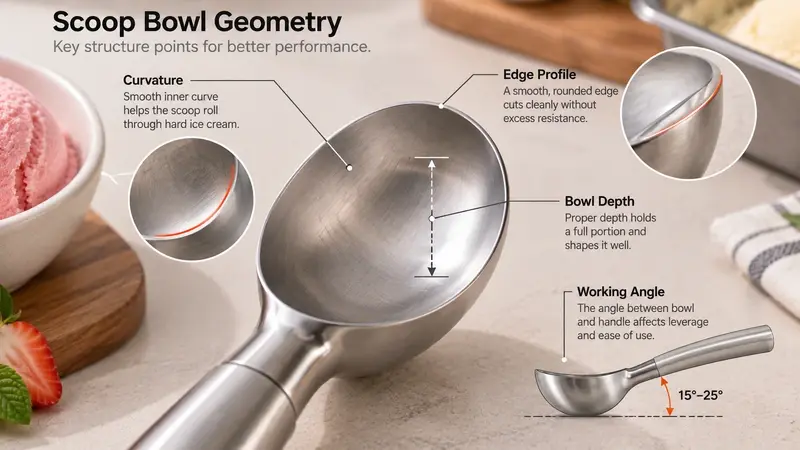
Start with the scoop bowl. Its curvature, depth, edge profile, and working angle influence how easily it enters the product, forms a portion, and releases it without excessive twisting.
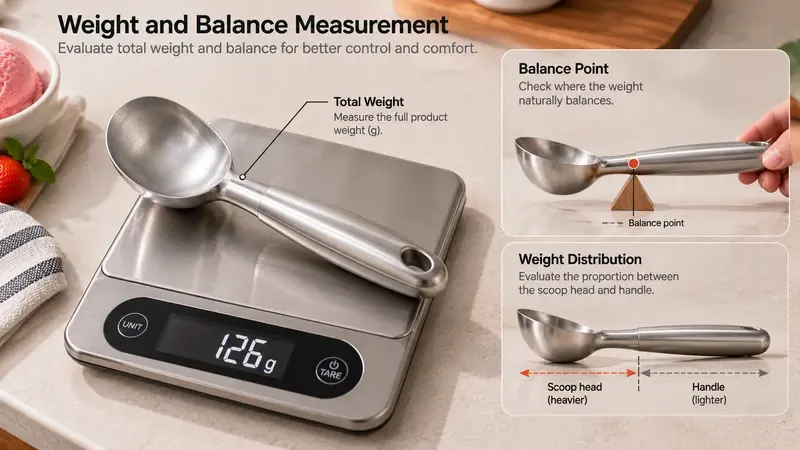
Assess capacity, total weight, and balance together. A heavier scoop may feel substantial, but poor balance can increase wrist effort; a lighter design may be easier to control, but only if the neck and bowl resist bending.
Handle shape and surface also require practical testing. Buyers should check grip security with dry, wet, and cold hands while noting pressure points, slipping, and the effort needed during repeated scooping.
Test More Than One Ice Cream Hardness
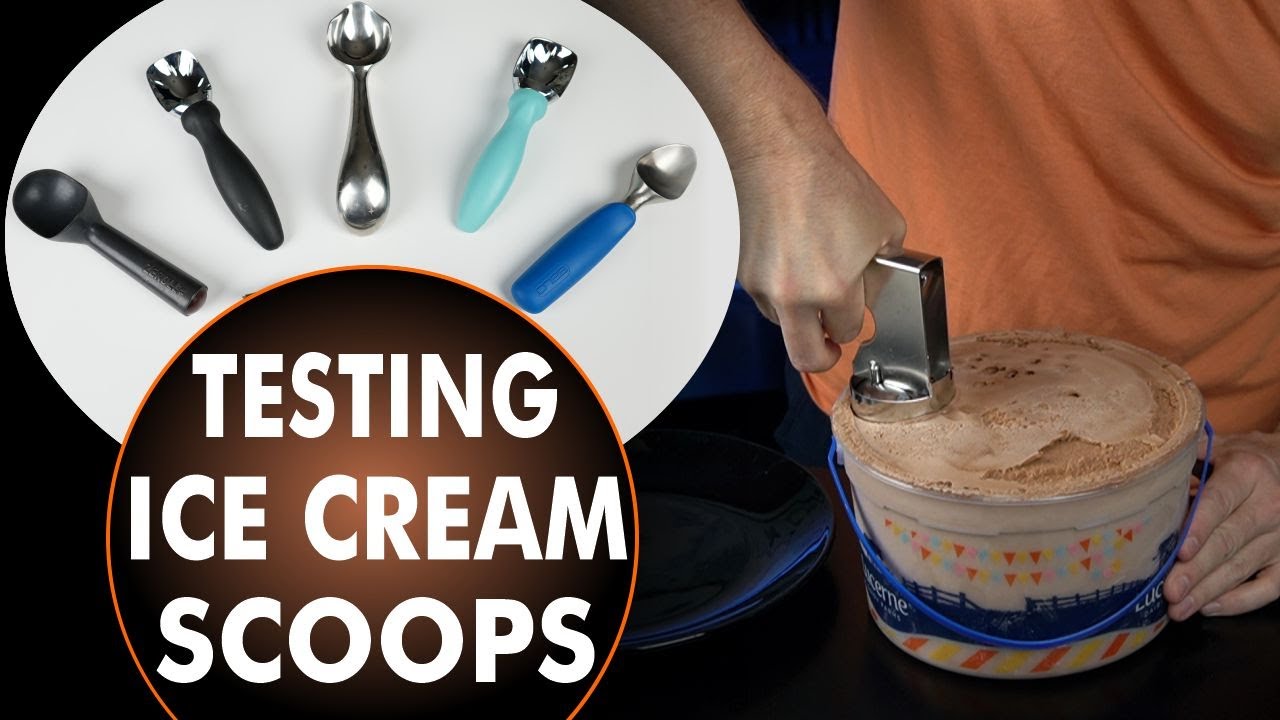
In our sample evaluations, we do not judge performance from appearance or weight alone. Before testing, we may let the the best ice cream sit at room temperature for about five minutes to make it easier to scoop; even the best ice cream scoop works more smoothly when the product reaches the right softened consistency to scoop ice cream and compare different samples more consistently. We use ice cream at different hardness levels and compare bowl curvature, edge design, bowl angle, overall weight, and balance.
A suitable ice cream scoop should handle ice cream and different hardness conditions consistently, form a more rounded consistent portion, and feel controlled in the hand, rather than being judged mainly by appearance or weight. If it slips, requires excessive force, or begins to deform, the buyer should determine whether the cause is the material, geometry, handle, or test condition before approving the sample.
Choose the Material According to the Product Role
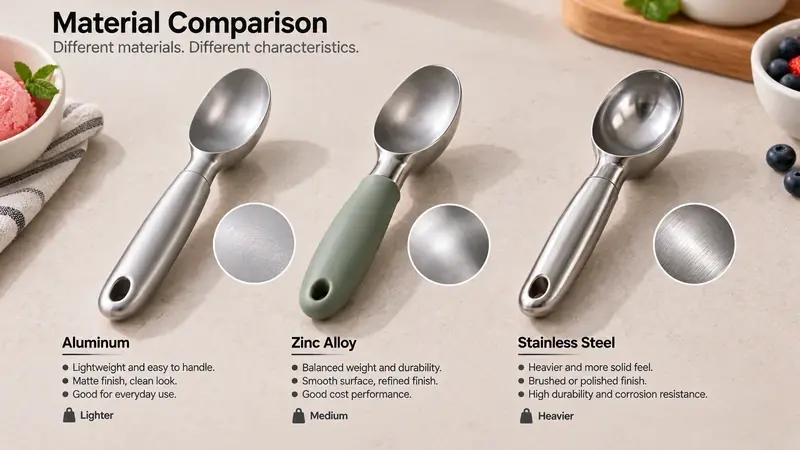
Material affects more than appearance. It changes weight, structural feel, surface-treatment options, cleaning limitations, and cost, so buyers should begin with the intended market position rather than asking which material is universally best.
In our sourcing discussions, we first ask how the customer ranks cost, weight, durability, appearance, and retail positioning. This helps turn a broad material comparison into a specific product decision.
Aluminum for Lightweight, Price-Sensitive Ranges
Aluminum can suit a lightweight household scoop or a cost-sensitive range. Buyers should still examine wall thickness, bowl strength, surface treatment, and care instructions, because these details influence bending resistance and long-term appearance.
An aluminum body should not automatically be described as dishwasher safe. The alloy, coating, finish, and complete construction must be considered before making a cleaning claim.
Zinc Alloy for Shape and Visual Impact
Zinc alloy can support detailed shapes and a heavier, more substantial hand feel. It may be suitable when appearance and molded form are central to the product concept.
However, buyers should examine the plating or coating rather than evaluating the base metal alone. Poor surface control can lead to discoloration, loss of gloss, corrosion, or coating damage during use and cleaning.
Stainless Steel for Durable or Premium Positioning
Stainless steel is often considered for durable, premium, or frequently used products. Its suitability still depends on the steel grade, material thickness, bowl geometry, joints, and handle construction.
A thin or poorly balanced stainless steel scoop may not outperform a well-designed alternative. Buyers should compare complete samples instead of using the material name as a shortcut for quality.
Measure Weight and Balance Together
Record total weight with a calibrated scale and compare scoops with similar capacities. Then identify the balance point and observe whether the bowl or handle feels disproportionately heavy during repeated use.
Weight can support cutting momentum, but unnecessary weight may increase wrist effort. The acceptable result depends on the user, scoop geometry, and intended frequency of use rather than a single ideal number.
Verify Dishwasher-Safe Claims Through Testing
We have evaluated plated, coated, hollow, and mechanically assembled products that developed discoloration, reduced gloss, coating damage, water ingress, or mechanism jamming after repeated machine washing. These risks may not be visible during the initial sample review.
For this reason, we do not judge dishwasher suitability from the main material alone. A more reliable review includes repeated wash cycles followed by appearance, function, joint, handle, and internal-structure inspections. For example, an OXO ice cream scoop is dishwasher-safe, which makes cleaning easy to manage in daily use.
The test record should identify the washing conditions, inspection intervals, observed changes, and pass-or-fail criteria. A dishwasher-safe claim should only be used when the production construction matches the tested product. By contrast, the Zeroll scoop uses a heat-conductive structure in which the handle contains heat-conductive fluid, so body warmth can improve scooping performance; that same construction is also why it is not suitable for dishwasher cleaning. To reduce stress on the structure and surface, clean it with warm water rather than hot water, and hand washing can help it last for decades.

Evaluate Handle Design Under Real Conditions
A handle that looks comfortable in a product image may behave differently when it becomes cold or wet. Buyers should evaluate shape, thickness, surface texture, balance, and pressure distribution while the scoop is performing its intended task.
Compare One-Piece and Soft-Coated Handles
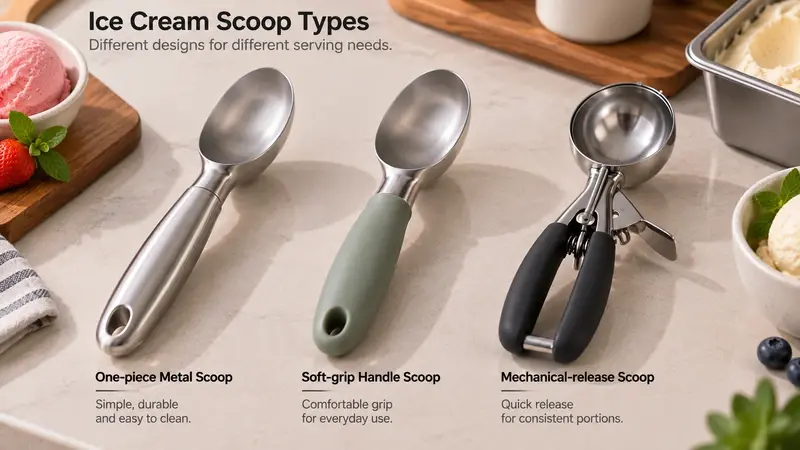
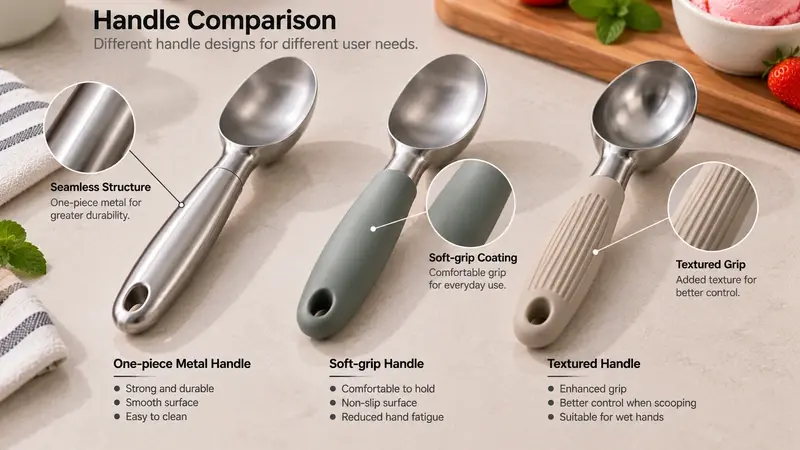
A one-piece handle can simplify construction and cleaning, but a bare metal surface may feel cold or slippery to some users. Check whether the edges, transitions, and handle width are truly comfortable to hold, and whether a shorter, curved profile is more comfortable to hold and friendlier for users with smaller hands when force is applied.
A soft-coated handle can improve cushioning and grip, making the scoop easier to use in repeated scooping while feeling more secure in the hand, although the added material introduces other checkpoints. Buyers should examine coating adhesion, odor, discoloration, seam quality, and water retention before approving the construction.
Test Texture Without Assuming More Is Better
Pronounced textured patterns, sometimes marketed as “gorilla grip” designs, can improve control with wet hands. However, an aggressive pattern may create pressure points or discomfort during repeated scooping, especially when substantial force is required.
Compare textured and smooth handles with dry, wet, and cold hands. The test should record slipping, grip adjustment, finger pressure, and fatigue rather than relying on a general statement such as “ergonomic.”
Include Different Hands and Grip Strengths
A release lever, bowl angle, or handle contour may favor one hand even when the product appears symmetrical. Test the scoop with left- and right-handed users before describing it as suitable for both.
Older participants or users with reduced grip strength can reveal effort and control issues that other testers may overlook. Their feedback can guide design decisions, but it should not be turned into a medical or accessibility claim without appropriate evidence.
Standardize the Performance Test
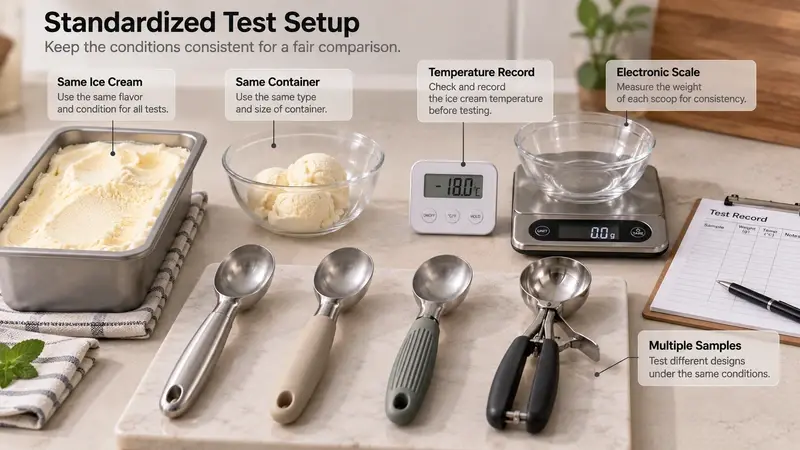
Define the ice cream type, storage condition, conditioning time, container, and number of repetitions before comparing samples. Without the same test conditions, differences in ice cream hardness may be mistaken for differences in scoop performance.
If the goal includes commercial use, set repetitions and serving pace to reflect the high-volume output common in ice cream shops. Use samples from the same ice cream batch whenever possible and record any deviations. Household testing should reflect a domestic freezer and normal serving behavior.
Commercial testing should examine repeated use, portion consistency, grip stability, hand fatigue, and mechanism reliability over a longer session, including whether the scoop can handle ice cream with a harder texture or mix-ins while still maintaining stable portions and efficient service.
Record Results That Buyers Can Compare
For cutting performance, record the test condition and the force needed to enter the ice cream. If instruments are available, use the same setup and unit for every sample; otherwise, use a defined scoring scale and multiple evaluators.
For portion consistency, weigh repeated scoops and record the variation. Photograph each portion from the same angle so the buyer can compare whether it forms cleaner spheres, as well as weight consistency and visual shape separately.
Release performance should be recorded as complete, partial, or failed release, together with the amount of residue left in the bowl. Inspect the scoop after testing for slipping, deformation, loose joints, or mechanism resistance.
Match the Scoop to Its Actual Applications
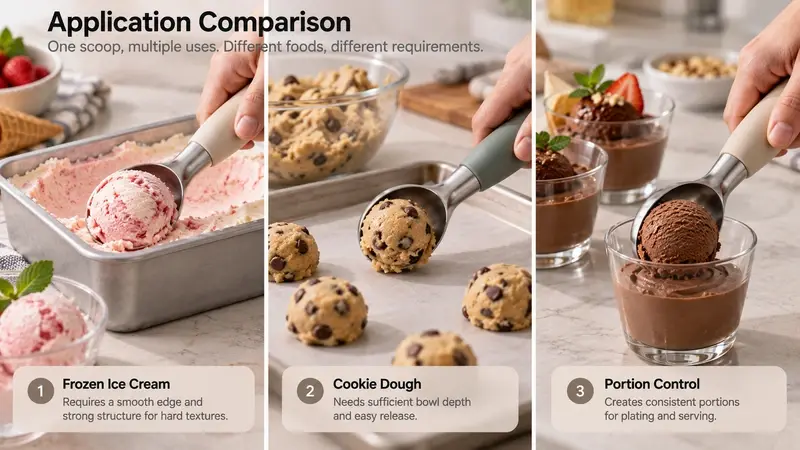
A scoop intended for freshly churned ice cream does not face the same resistance as one used with a deeply frozen retail tub. Buyers should test the product with the textures and serving conditions that customers are likely to encounter.
Ice Cream Makers, Baking, and Portioning
Fresh ice cream from a household machine is often softer before hardening in a freezer. Fresh or vanilla ice cream is often easier to use as a baseline test sample, while harder products or ice creams with mix ins should be checked separately. A shallower bowl or lighter construction may work well at this stage, but it should not be assumed to perform equally well with hard-frozen ice cream. Scooping ice cream out of a pint container is often harder than working from a shallow pan, so that condition should be tested separately.
Ice cream scoops may also be considered for cookie dough, batter, dessert plating, or portion control. This type of tool may also be used to portion other desserts, but ice creams with mix ins still need separate checks for release and durability. Buyers should confirm whether the capacity, bowl geometry, and release method deliver consistent servings for each task instead of marketing every design as universally multifunctional.
A solid scoop may provide the strength needed for hard ice cream, while a trigger-style portion scoop with a trigger mechanism can simplify repeated release. The better option depends on the food texture, portion target, cleaning process, and expected frequency of use, and a round scoop can also affect how neatly scoops of ice cream hold their shape for ice cream cones or a bowl. Different tools can also change how easily users scoop ice cream into a cleaner round shape for cone service versus bowl presentation.
Compare Competitors on Equivalent Information
A useful comparison should cover products from similar price levels and intended uses. Record material, dimensions, weight, capacity, handle construction, release mechanism, care claims, warranty, and retail price in the same market and during the same research period. For example, capacity can vary sharply by model: this scoop may form portions above 2.5 ounces in the case of Zyliss Right Scoop, while Zeroll is closer to 2 ounces. In the same comparison window, you can also reference public review patterns and product availability on Amazon, but those marketplace comments should not be treated as experimental data.
If Gorilla Grip is included as a public benchmark, compare the verified product specification rather than the brand reputation alone. Separate repeated user-feedback patterns from isolated complaints, and do not present marketplace comments as laboratory evidence.
The comparison should identify the reason behind each difference. A higher price may reflect material, construction, packaging, distribution, or brand positioning, so buyers should avoid attributing it to performance alone without supporting evidence. A classic reputation can influence a buyer’s pick, but Zeroll has been on the market for nearly 90 years, so its long history should be evaluated separately from current, verifiable specifications.
Turn the Findings into an OEM/ODM Specification
Use the evaluation results to define material, dimensions, weight range, capacity, handle texture, finish, color, logo method, packaging, and required tests. Each feature should connect to a target user, price point, or measurable performance requirement.
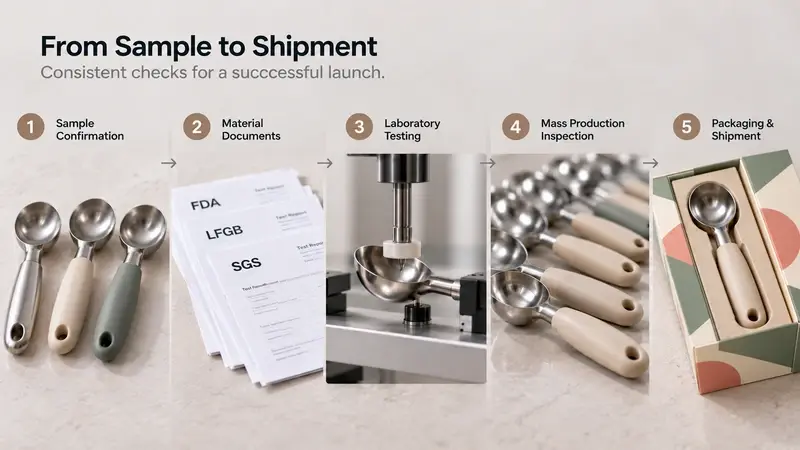
During the OEM/ODM ordering process, review initial samples against the written specification and record every approved revision. Keep a final reference or golden sample for comparison during mass production.
Production acceptance should cover dimensions, weight, color, finish, assembly, release function, and packaging. Define tolerances and pass-or-fail criteria before production begins so that inspection does not depend on subjective judgments at the shipment stage.
Verify Compliance and Supply-Chain Readiness
Food-contact requirements depend on the destination market and intended use, as well as materials, coatings, and contact conditions. For the United States, review the FDA guidance on food-contact substances; for Europe, begin with the EU food-contact materials framework and confirm any material-specific or national requirements.
Do not treat FDA, LFGB, or KFDA/MFDS as interchangeable product certificates. Buyers should define the market, food-contact components, test scope, and supporting documents before arranging laboratory work.
For commercial-use products, the FDA Food Code provides a useful benchmark for multiuse utensils that are durable, corrosion-resistant, nonabsorbent, and able to withstand repeated warewashing. Its application still depends on the relevant jurisdiction and sales channel.
Supplier files should identify the base material, coating, pigment, adhesive, and soft-touch components where applicable. Keep test reports, material declarations, approved specifications, batch records, and change-control records connected to the production lot.
Packaging approval should cover barcode accuracy, country-of-origin information, care instructions, claims, warnings, and shipping protection before artwork is released for printing. A product that passes functional testing can still face delays if the labeling or shipment documents do not match the destination market.
Pricing should separate features that improve function from purely cosmetic upgrades. Compare landed cost, packaging, channel margin, and retail benchmarks instead of assigning a premium price from weight or surface appearance alone.
Before launch, compare production samples with the golden sample and finalize product images, specifications, and care information. Use early quality and customer feedback to decide whether additional colors, capacities, or coordinated tools are justified.
Questions to Resolve Before Production
How should dishwasher safety be confirmed? Test the complete construction through defined wash cycles, then inspect appearance, water ingress, joints, coatings, and function against written acceptance criteria.
Which material is best? There is no universal answer; compare cost, weight, geometry, finish, durability, cleaning method, and target price before selecting aluminum, zinc alloy, or stainless steel.
What should be approved before mass production? Confirm the specification, golden sample, tolerances, test requirements, packaging artwork, inspection plan, and handling process for nonconforming goods.
Make the Final Purchasing Decision
The right ice cream scoop is not selected by material, weight, or appearance alone. A reliable decision connects the target user and price position with bowl geometry, handle comfort, realistic performance tests, cleaning durability, compliance evidence, and production controls.
Develop the Right Scoop for Your Product Line
l-tools supports brands and retailers with product evaluation and customization, and this article focuses on helping buyers choose the right option through testing, materials, and production requirements, as well as sampling, production, packaging, and quality coordination. Explore our kitchenware manufacturing capabilities or contact our team with your target market, preferred design, quantity, and testing requirements to discuss a suitable development path for an ice cream scoop within broader kitchen tools line development.