
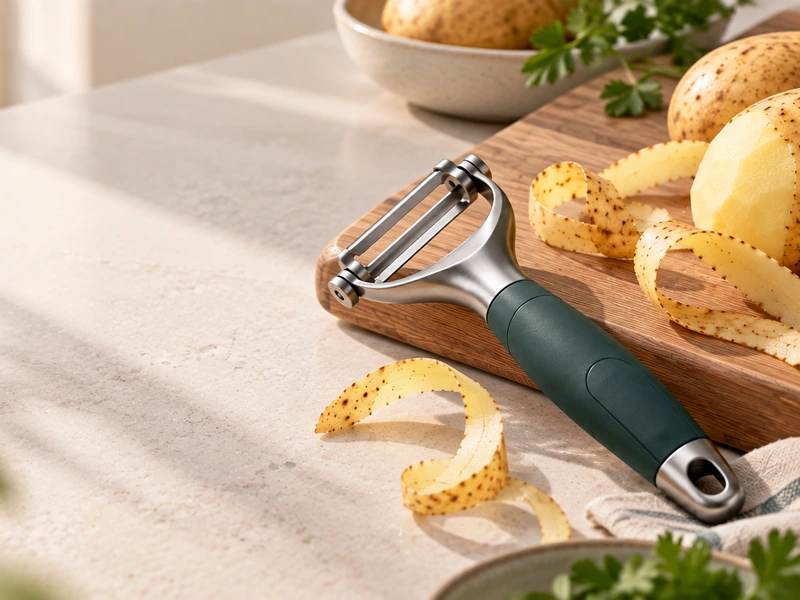
A Y peeler may appear simple, but small structural differences can change its cutting depth, peel discharge, and handling. Two samples with a similar appearance may perform differently when tested on curved, firm, or fibrous ingredients.
For buyers, the right product is not automatically the sharpest or most expensive option. It is the Y peeler whose blade, frame, handle, and assembly match the intended user, retail position, test ingredients, and care expectations.
This guide focuses on Y peeler selection, structural testing, sample revision, and OEM production approval. For a broader explanation of peeler types, general materials, compliance, and sourcing, see our vegetable peeler OEM/ODM guide.
Quick Selection: Define the Y Peeler Before Sampling
Before requesting samples, buyers should define what the product needs to do. A clear brief prevents the team from comparing peelers designed for different users, ingredients, and price levels.
Identify the Target User and Test Ingredients
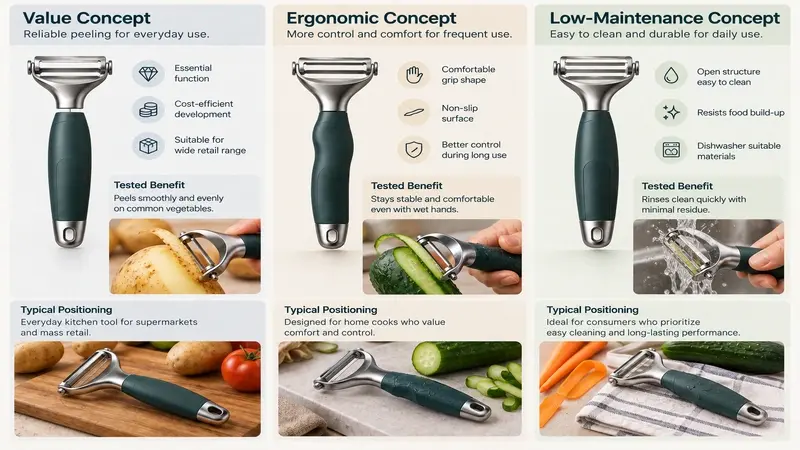
Start with the intended user and sales channel. A Y peeler for an entry-level supermarket program may need a simple structure and controlled cost, while a premium retail model may require better grip, smoother blade movement, or improved corrosion resistance.
The main test ingredients should also be agreed in advance. Potatoes can reveal peel thickness and food waste, ginger can expose control problems on irregular surfaces, and squash can show whether the blade bites, stalls, or requires excessive pressure.
Care expectations belong in the same brief. A product positioned around convenient everyday use may require different blade and handle materials from one whose packaging specifies hand washing and immediate drying.
Choose the Required Retail Position
| Retail direction | Main priority | Development focus |
|---|---|---|
| Entry level | Reliable basic function | Secure blade, simple assembly, controlled packaging cost |
| Mainstream | Comfort and easy care | Stable movement, practical handle, dependable materials |
| Premium | A benefit users can feel | Grip, finish, cleaning, corrosion resistance, or cutting control |
The retail position should guide development from the beginning. A premium appearance cannot compensate for unstable blade movement or uncomfortable handling, while an entry-level price does not justify inconsistent cutting or weak assembly.
Decide Between an Existing Model and Custom Development
An existing model may be suitable when its blade, frame, and handle already meet the performance brief. The project can then focus on color, logo, finish, or packaging without changing the cutting structure.
A modified model is more appropriate when the proven blade and head can remain, but the handle requires a different width, curvature, texture, or visual identity. This can create differentiation while limiting unnecessary tooling changes.
A new mold becomes relevant when the existing product cannot provide the required grip, blade position, frame clearance, cleaning access, or eye-remover design. These projects need time for functional testing and structural revision, not only visual approval.
Confirm That the Y Format Fits the Intended Use
A Y peeler uses a blade positioned across the handle and commonly works with a pulling or sweeping motion. This y shaped layout gives broader visibility, and y peelers are especially useful to peel potatoes, apples, cucumbers, and hard-skinned samples like butternut squash.
A straight peeler may feel more familiar on narrow ingredients. In sample checks, Y formats are often better to get through tougher skins, which helps home cooks judge whether the tool is easy to use. The purpose of this brief comparison is only to confirm the format; the final decision should come from the intended foods, target users, and sample tests.
Once the Y format is confirmed, the next step is to examine the blade movement, working angle, frame gap, and handle geometry that control its performance.
How Y Peeler Structure Controls Peeling Performance
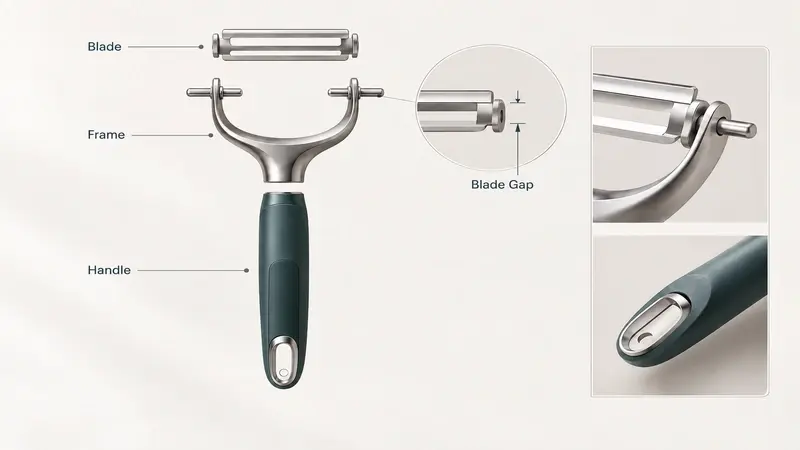
A Y peeler should be evaluated as a complete cutting system. The blade type, working angle, frame gap, support structure, and handle position influence one another during every peeling stroke.
Fixed Blade or Swivelling Blade
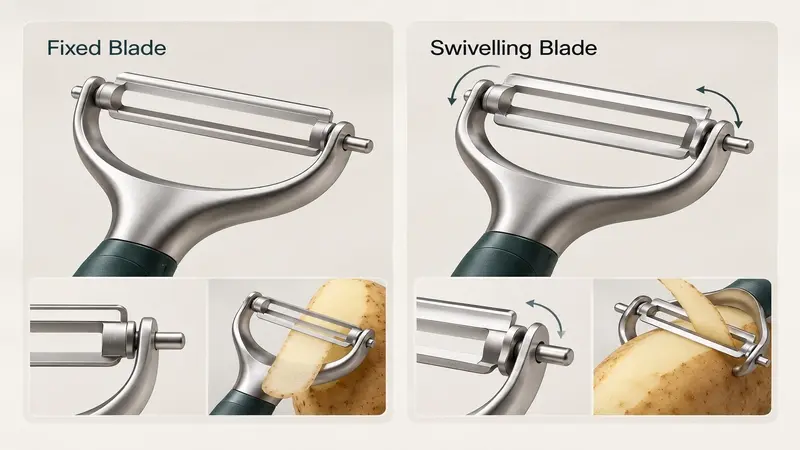
A fixed blade keeps the cutting edge in a defined structural position. It can provide predictable blade movement, but the working angle must suit the intended ingredients and the way users naturally hold the handle.
In common product categories, a swivel peeler relies on a swivelling blade to follow curved produce more easily than a fixed-blade design. However, excessive movement, loose assembly, or inconsistent resistance may make the blade feel unstable, so buyers should evaluate movement range and assembly fit, not simply confirm that the blade can rotate.
Blade Angle and Blade Exposure
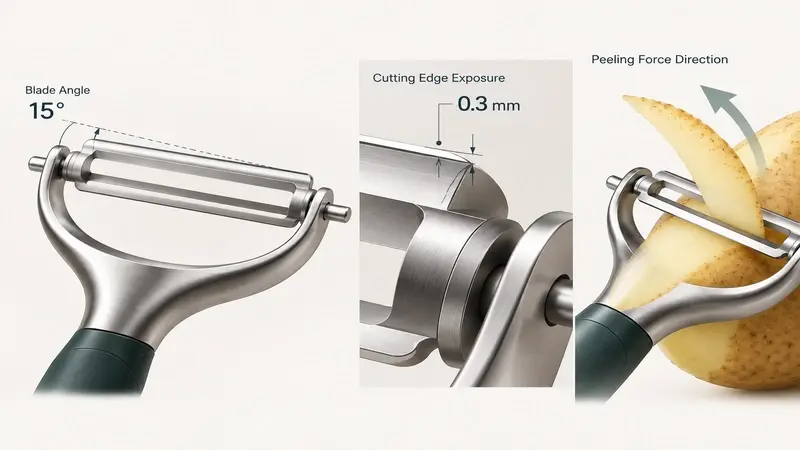
The blade angle affects how readily the cutting edge enters the skin. If the angle is too aggressive, the peeler may remove excessive flesh; if it is too shallow, the blade may slide, skip, or require additional pressure.
Blade exposure, meaning how far the cutting edge sits beyond the supporting structure, also affects peel thickness. Angle and exposure should be tested together because handle position and user pressure can change the result.
Blade-to-Frame Gap and Peel Discharge
The opening between the blade and frame must allow the removed peel to pass through. A narrow opening may trap wet, thick, or fibrous peel, interrupting the stroke and increasing cleaning time.
A larger gap is not automatically better. The frame still needs to support the blade, limit unwanted movement, and maintain a consistent cutting position under normal hand pressure.
Buyers should observe whether peel leaves the head cleanly or folds back around the blade. Repeated clogging may be related to the gap, blade angle, peel texture, or residue rather than sharpness alone.
Frame Rigidity and Blade Movement
The frame should resist noticeable deformation during normal use. If the support structure flexes or the blade moves laterally, the effective cutting depth may change from one stroke to the next, even when the cutting edge remains sharp.
Handle Design and Functional Details
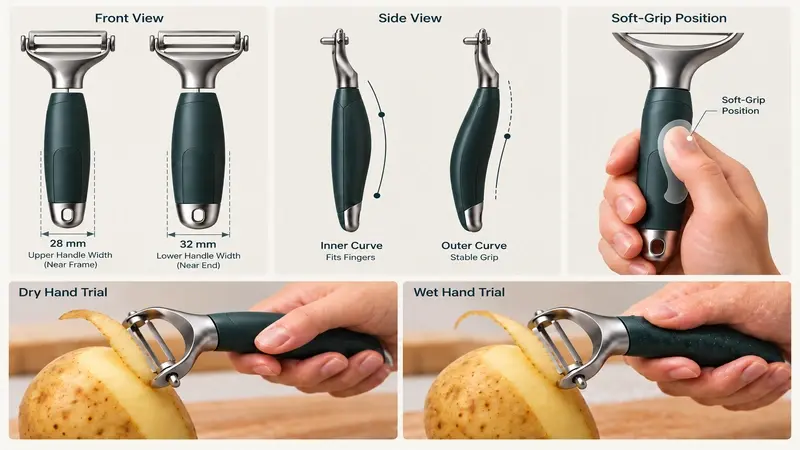
The handle determines how the user transfers force to the blade. Its width, curvature, weight, surface, and angle should support the intended peeling movement without requiring excessive gripping pressure.
Handle Width, Curvature, and Working Angle
A thick handle may look substantial but can feel awkward for smaller hands. A very slim handle may require more pinching, particularly when the product is wet or used for repeated peeling.
OSHA’s hand-tool handle design guidance highlights neutral wrist positions, suitable handle dimensions, and non-slip surfaces. For a consumer Y peeler, these principles must still be translated into the product’s size, weight, and intended task.
Wet-Hand Grip and Soft-Grip Placement
Wet-hand testing should check whether the handle rotates, slides, or requires noticeably more force. Soft material is most useful when it is positioned where the user naturally applies finger and palm pressure.
In our development work, buyers sometimes begin by prioritizing appearance, low cost, or a solid-looking handle. Practical trials often show that slip resistance, grip angle, and handle width have a greater effect on control.
We then use the trial feedback to adjust the handle dimensions, curvature, and soft-grip area before confirming the design. This allows the final structure to reflect actual peeling behaviour rather than appearance alone.
Potato Eye Remover Design
A potato eye remover, often also referred to at retail as a potato eyer, should be positioned where it can be controlled without creating a sharp pressure point in the gripping area. If a project uses a silicone handle or other soft-touch area, the priority is wet-hand grip and whether it feels comfortable to hold, not the material name itself. Buyers should also check cleaning access and left- and right-handed use before approving the detail.
After these structural elements have been reviewed individually, the complete sample must be tested under comparable conditions. Practical trials often show that handle comfort matters as much as blade layout; OXO Good Grips Y is a useful reference because its handle design supports long periods of use. The next section explains how to build a Y peeler structural test protocol and record the results.
Structural Sample Testing for a Y Peeler
A visual sample can confirm shape, color, and branding, but it cannot prove consistent performance. Structural testing should examine how the complete Y peeler behaves across different ingredients, repeated strokes, wet-hand use, and cleaning.
What the First Sample Should Prove
The first functional sample should confirm whether the blade, frame, handle, and assembly work together. It is not the final sales sample; its purpose is to expose problems with cutting depth, blade movement, peel discharge, grip, and cleaning access.
Visual and functional approval should remain separate. A color or logo may be approved while the blade angle, frame gap, or assembly fit still requires revision.
Build a Test Food Matrix
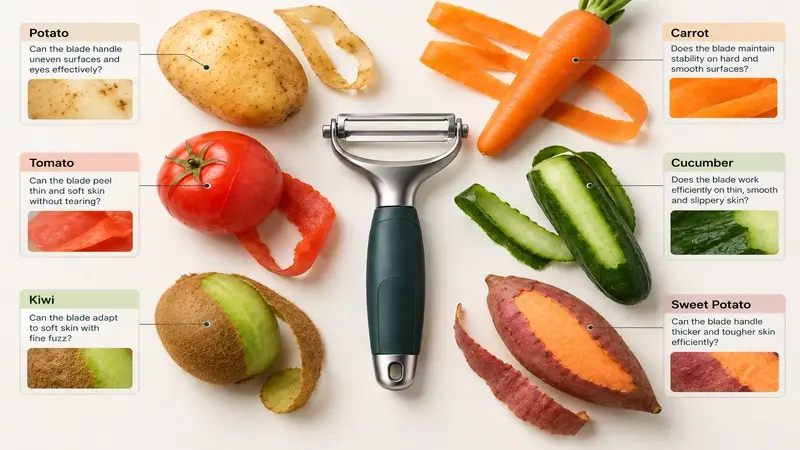
Different ingredients reveal different structural problems. Buyers should select test foods according to the product’s intended use instead of relying on one successful potato test.
| Test ingredient | Main structural question | What to observe |
|---|---|---|
| Potato | Does the blade remove a controlled layer? | Peel thickness, food waste, stroke consistency |
| Ginger | Can the blade follow irregular surfaces? | Skipping, access around curves, hand control |
| Squash | Can the blade enter firmer skin? | Initial force, biting, stalling |
| Apple or cucumber | Is the blade stable during longer strokes? | Surface damage, movement, peel continuity; in apple tests, whether the apple peel stays continuous and even in thickness |
| Cheese | Can the blade make fine shavings when intended? | Shaving thickness, clogging, stability; if the retail use includes decorative thin slicing, also check whether chocolate shavings stay consistent |
Cheese should only be included when the blade design and retail positioning support that use. If the design includes or is compatible with a julienne blade, test fine-strip cutting separately as well. Every ingredient in the test should answer a defined structural question. For citrus, if a model claims to handle lemon peel or lemon rind, check whether it removes a thin layer with as little white pith as possible. Also note whether lemon peels come off neatly or break easily.
Keep the Test Conditions Comparable
Use ingredients with similar size and condition when comparing samples. Testers should follow the same peeling direction, approximate stroke length, and agreed number of strokes.
Where possible, test more than one unit and repeat selected checks after cleaning. This helps separate a structural issue from individual sample variation or temporary residue.
Record More Than Sharpness
A useful test record should capture observations that can guide the next revision:
- Peel thickness and consistency
- Edible material left on the peel
- Initial cutting force
- Smoothness over repeated strokes
- Interrupted strokes and clogging
- Lateral blade movement and frame flex
- Wet-hand grip
- Residue after cleaning
The project does not need invented universal limits. It needs an agreed test method and approved reference result that can be reused for revised samples and production units.
Diagnose Common Structural Problems
When a problem appears, buyers should inspect the complete cutting system rather than immediately requesting a sharper blade.
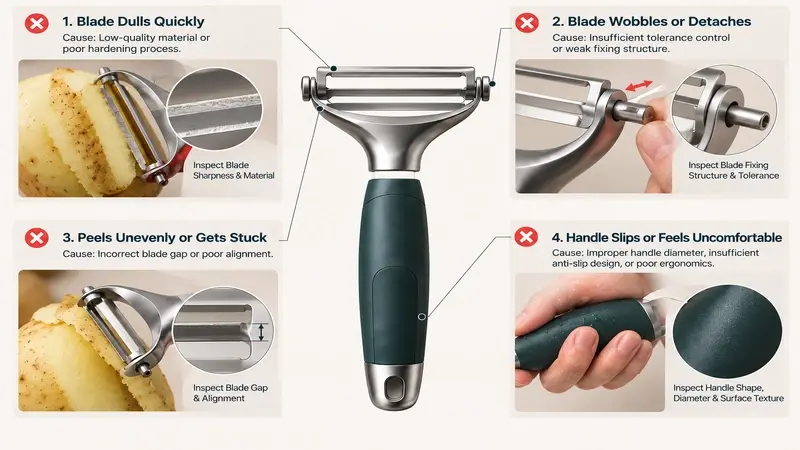
- Excessive food removal: Check blade exposure, working angle, frame position, and user pressure.
- Sliding without cutting: Check edge condition, angle, exposure, and handle position.
- Trapped peel: Check the frame gap, peel texture, residue, and discharge direction.
- Jumping or chattering: Check frame rigidity, blade movement, and assembly fit.
- Handle rotation: Check handle width, curvature, surface texture, and wet-hand grip.
- Residue after rinsing: Check access around the blade support, joints, and eye remover.
Why Y Peeler Samples Often Need Revision
In our projects, the most frequent adjustments involve the blade angle, blade-to-frame clearance, and assembly fit. These details may look acceptable on a drawing but behave differently on curved, firm, or fibrous ingredients.
We use the first version mainly for practical peeling tests. Feedback on sharpness, smoothness, peel thickness, and discharge guides each adjustment before the structure is approved.
Changes should be introduced in a controlled way. If the blade, frame, and handle all change simultaneously, it becomes difficult to identify which modification improved or weakened performance.
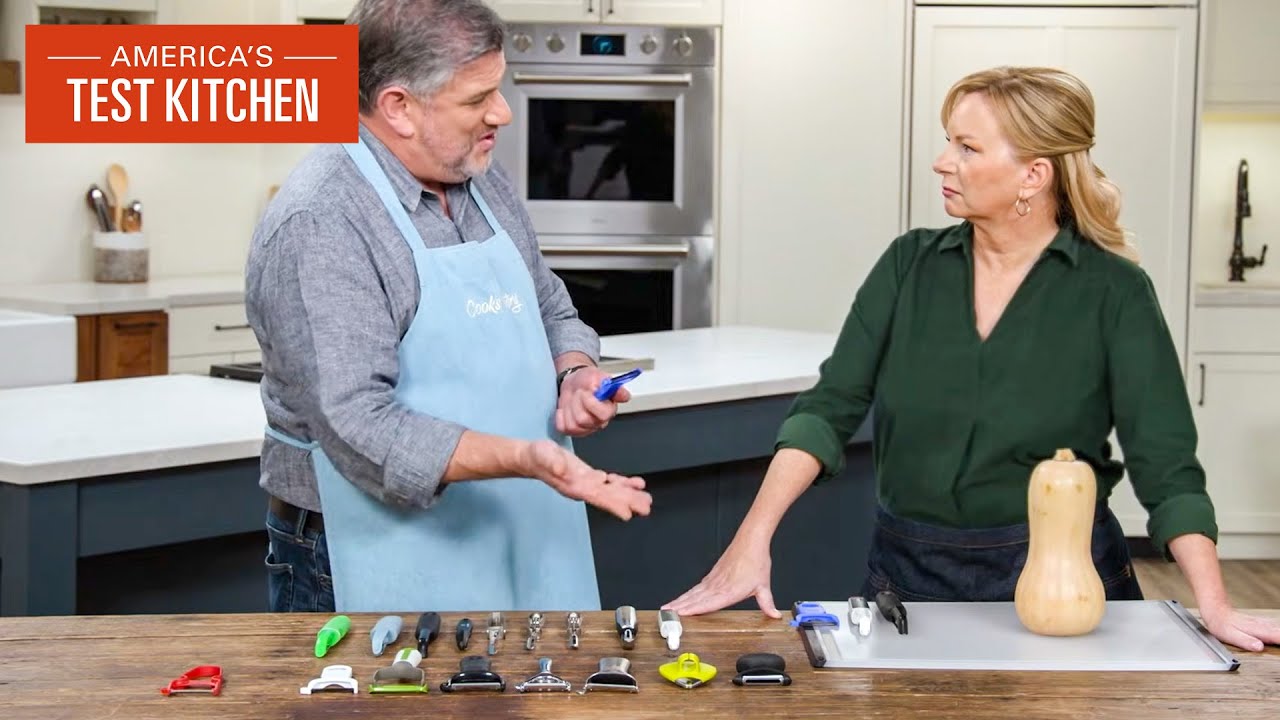
Control Every Sample Revision
Each sample should have a version number and written change record. The record should identify the changed component, reason for the change, test method, and observed result.
Revised samples should be tested with the same core ingredients and conditions. This prevents the team from approving a new version based on different or easier tests.
Once performance is confirmed, the approved golden sample becomes the production reference for the structure, materials, assembly, color, logo position, and functional result.
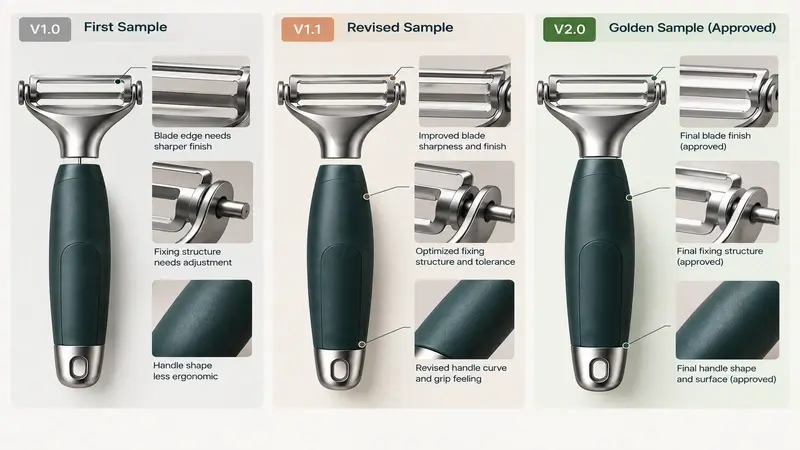
The next stage is to convert these results into measurable OEM specifications, approval gates, and production checks.
From Test Results to an OEM Production Specification
A test becomes useful when its findings turn into measurable production requirements. Comments such as “make it smoother” should become approved dimensions, tolerances, materials, and test methods.
Record the blade angle, exposed cutting edge, blade-to-frame clearance, head width, handle dimensions, product weight, and acceptable blade movement. The specification should state which reference foods and test conditions production samples must pass.
Choose Materials for the Target Market
Material selection should balance sharpness, corrosion resistance, cost, and target retail price. Many vegetable peelers in the market use stainless steel blades because of corrosion resistance. The most expensive material is not automatically the most suitable choice.
In our projects, buyers sometimes request a premium blade material before defining the retail position and care instructions. We first review the destination market, expected use, cleaning habits, packaging claims, and target price; a mid-market product may benefit more from dependable corrosion resistance than maximum initial sharpness. Carbon steel is also common in higher-end chef’s knives, but it requires different care expectations from stainless steel.
A higher-positioned Y peeler may justify better corrosion resistance, while a value model needs a controlled balance between cutting performance and landed cost. When stronger rust resistance is a retail priority, stainless steel blades are typically the preferred choice.
Retain a Proven Head or Develop New Tooling?
If an existing Y-peeler head passes the required food tests, modifying the handle, color, logo, or packaging can reduce risk and development cost. This route suits projects needing faster validation and a lower tooling commitment.
A new mold becomes reasonable when the target grip, head geometry, blade gap, or product identity cannot be achieved with an existing platform. Before approving tooling, buyers should confirm the functional sample and review the supplier’s manufacturing capabilities for prototyping, material control, and repeatable production.
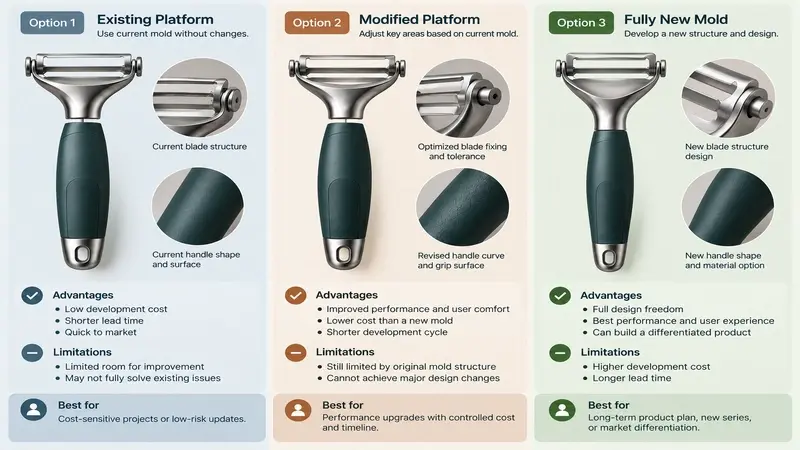
Control Private-Label and Tooling Costs
Separate essential functional changes from cosmetic requests. Logo application, custom color, and packaging usually require less investment than a new head structure or handle mold.
Ask for a cost breakdown covering tooling, unit price, packaging, testing, and minimum order quantity by color. This shows whether a feature improves the retail proposition enough to justify its cost.
Manage Sample Rounds and Delivery Commitments
Set a purpose for every sample round. The first functional sample should verify peeling behavior; later samples can confirm color, logo, surface finish, packaging fit, and production consistency.
The schedule should show approval gates rather than one optimistic completion date. Changes to blade geometry or tooling affect timing differently from a packaging artwork correction, so each revision needs its own deadline.
Lock the Golden Sample and Production Checks
After structure and appearance approval, keep a signed golden sample with a dated specification. Buyer and supplier should use the same reference for pre-production and final inspection.
Production checks should cover blade security, head alignment, permitted blade movement, handle defects, logo position, packaging contents, and a repeatable peeling test. Version records prevent an earlier sample from returning to production.
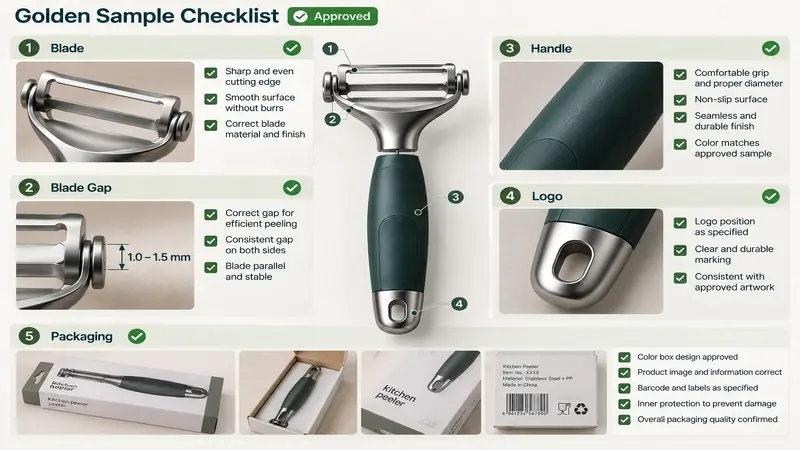
Match Compliance and Claims to Intended Use
Compliance planning starts with the materials, destination market, and intended contact conditions. The FDA food-contact overview explains that food-contact substances must follow applicable authorizations and use limitations; it is more accurate than treating “FDA” as a universal product certificate.
For EU sales, review the European Commission’s food-contact materials legislation, including documentation, traceability, and material-specific rules. Depending on the construction and market, testing may include migration, corrosion resistance, coating adhesion, or material verification.
Finally, connect retail claims to evidence. Terms such as rust-resistant, dishwasher-safe, or long-lasting sharpness should appear only when the selected material and test conditions support them.
Use Kuhn Rikon as a Benchmark, Not a Blueprint
In many reviews, the Kuhn Rikon Original Swiss Peeler is often treated as one of the best y peelers, so it works well as a benchmark because its design is measurable. Its official product specification lists a carbon-steel blade, an about-$5 price point, 0.032-pound weight, 4.25-inch length, integrated potato-eye remover, and hand-wash care. The Kuhn Rikon peeler uses a carbon-steel blade that can stay sharp for years when cared for properly. After washing, dry the blade promptly and lightly wipe it with food-grade mineral oil to help maintain sharpness.
Test a purchased reference sample with the same potatoes, ginger, squash, cheese, stroke count, and scoring method used for the OEM sample.
| Benchmark area | What to compare | Buyer decision |
|---|---|---|
| Cutting | Force and peel thickness | Sharp without excessive waste? |
| Control | Movement and tracking | Stable on flat and curved foods? |
| Discharge | Residue around the gap | Smooth through repeated strokes? |
| Grip | Dry- and wet-hand comfort | Suitable for the target user? |
| Care | Cleaning and drying | Appropriate for the retail audience? |
| Durability | Repeated-cycle result | Still within the approved limit? |
The goal is not to copy the benchmark. Use it to set a performance level, then differentiate through grip, cleaning, corrosion resistance, packaging, or price.
Build a Clear Retail Position
Choose one or two benefits users can feel immediately. A wider non-slip handle, cleaner peel discharge, or lower-maintenance blade is clearer than a long list of minor features.
Packaging and product-page content should reflect test evidence. Show the peeling motion, name suitable ingredients, explain care requirements, and make comparisons only when the test method supports them.
Frequently Asked Questions
How Can Buyers Tell If the Blade Gap Is Too Narrow?
Frequent clogging or interrupted blade movement is a warning sign. Confirm it through repeated-stroke testing, not appearance alone.
Is a Swivelling Blade Always Better?
No. It can follow curved produce, but excessive movement reduces control; the correct range depends on the foods and head geometry.
Why Can a Sharp Blade Remove Too Much Food?
Sharpness is only one factor. Blade exposure, angle, and frame support also determine peeling depth.
How Many Sample Rounds Does a Y Peeler Need?
There is no fixed number. Continue until the structure passes the agreed tests and the approved specification is reproducible.
What Must Be Approved Before Mass Production?
Approve the golden sample, materials, dimensions, blade movement, appearance, packaging, test method, acceptance limits, and specification version.
Conclusion
Selecting a Y peeler requires connecting the target user and retail position with head geometry, handle design, food testing, material care, and production control.
A clear test brief and golden sample turn subjective feedback into repeatable requirements, reducing late changes, unsupported claims, and quality disputes.
Explore l-tools Y Peeler OEM/ODM Development
If you are evaluating an existing platform or developing a new Y peeler, explore the peeling and cutting kitchen tools in the New Neutral collection and contact l-tools to discuss your target market, test foods, specification, packaging, and order volume.