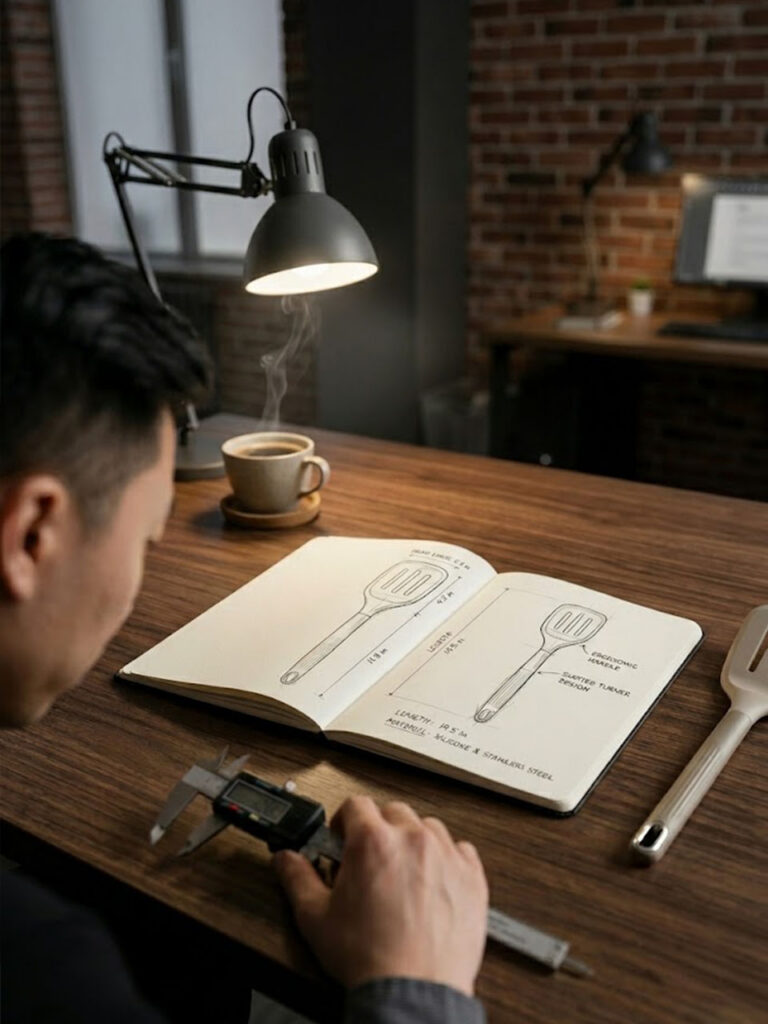
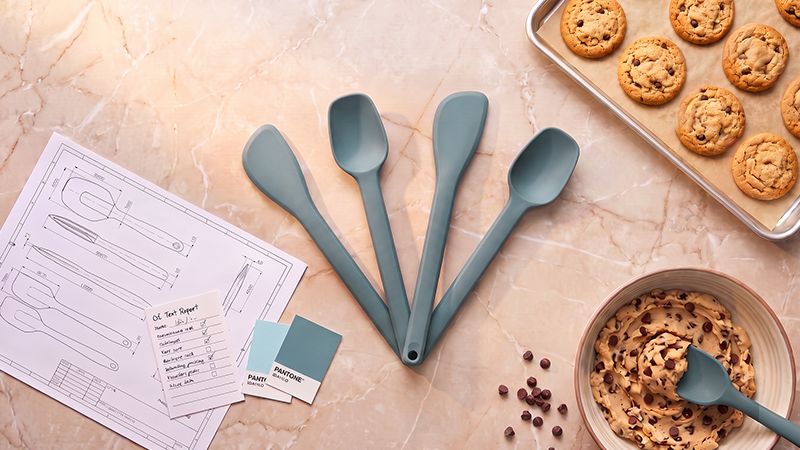
Silicone spatulas may look simple, but similar materials do not guarantee similar performance. For an OEM buyer, the key question is not only which shape looks suitable, but what action the tool must perform and under what conditions.
A baking spatula needs controlled flexibility for scraping bowls, folding batter, and transferring mixtures. A cooking spatula needs more support for turning food, scraping cookware, and working around heat. Treating both as the same product can lead to poor sample performance and unclear specifications.
This guide explains how to classify silicone spatulas, define their structure, evaluate materials and testing, and prepare a purchase-ready specification. It also shares practical product-development lessons that can help buyers identify problems before mass production.
Understanding the OEM Silicone Spatula Category
For retailers, importers, distributors, and kitchenware brands, a silicone spatula range can cover baking, cooking, or multi-purpose applications. Each direction requires a different balance of head shape, edge design, hardness, neck support, and internal reinforcement. In general use, it is also an instrument for lifting or moving material.
The application should therefore come before color, packaging, or quotation comparison. A clear category gives suppliers a better basis for sampling and helps product managers build commercially useful SKUs rather than products with overlapping functions. In modern business, the term can also be used metaphorically for tool- or technology-support offerings.

Baking vs. Cooking Silicone Spatulas
Baking Silicone Spatulas for Baking Sheet Applications
Baking designs are used for mixing, folding, scraping bowls, spreading cream or smoothing frosting, and transferring batter across common baking tasks, with both straight and offset styles used depending on the job. Their heads are generally smaller and thicker, with soft edges that follow the bowl wall and enough center support to move heavier mixtures, while different sizes suit different containers and baking motions. When spreading cream or smoothing frosting, an offset design is better for frosting work and for transferring delicate baked goods.
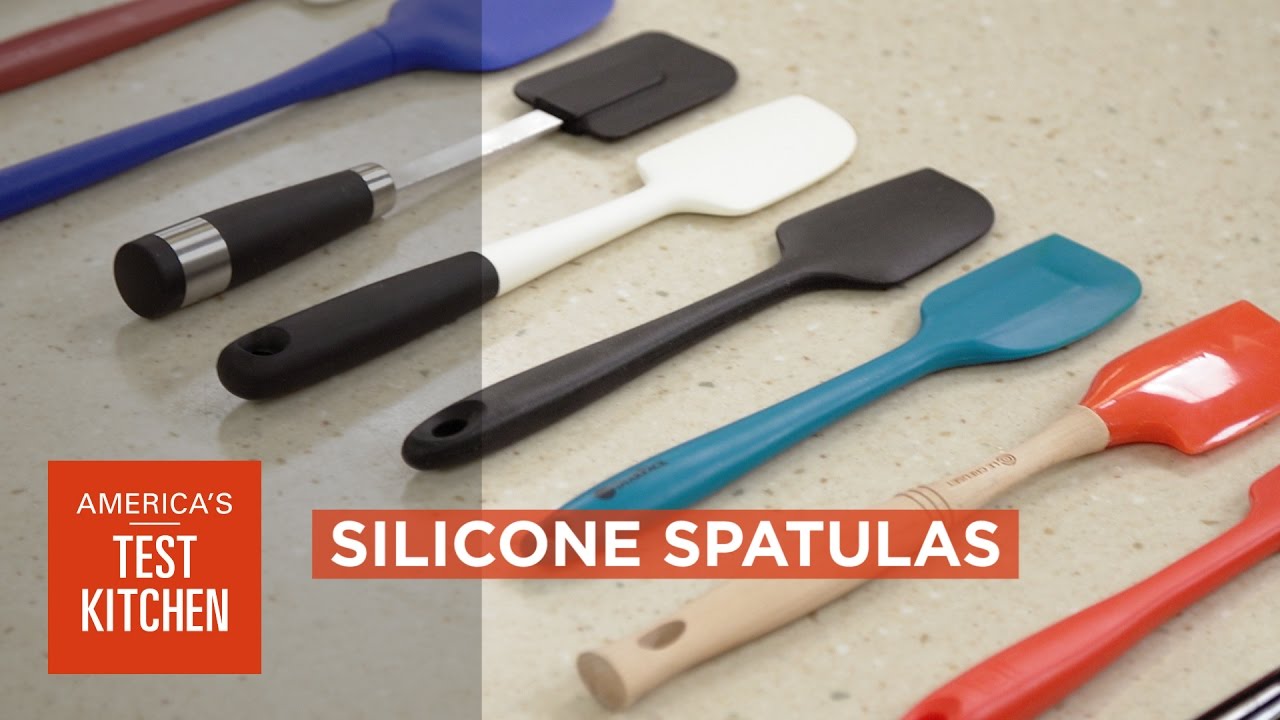
Common options include the classic spatula with one straight and one curved edge, the concave spoonula, the narrow jar spatula, and the mini spatula for smaller containers, cookies, or small-batch dessert cups. For cake finishing, palette knives are also common in a baker’s toolkit, and models with an offset blade are often chosen in lengths from 4.5 to 9 inches. Buyers should select them according to the container and mixing action, not simply to increase the SKU count. A rubber scraper or rubber spatula is often grouped into the same buying discussion, but selection should still follow the specific container and motion.
Cooking Silicone Spatulas
Cooking designs are used for sautéing, lifting, turning, and scraping cookware. They normally need wider, flatter heads and stronger reinforcement, while the front edge should remain thin enough to slide underneath foods.
Typical designs include solid turners, slotted turners, fish turners, wok spatulas, and sauté spatulas, while a wood spatula is a material contrast rather than the same type of silicone tool. A multi-purpose model may scrape, scoop, and stir, but cannot always replace a thin turner, fish spatula, or flexible baking tool. Buyers should define its primary function and limitations.
What Our Product Development Experience Shows
In our development work, we divide silicone spatulas into baking and cooking categories before discussing appearance. Even when they use similar silicone materials, the usage movement, head structure, hardness, temperature requirement, and internal frame can differ.
This classification prevents a common sourcing mistake: approving a sample because it looks correct is not enough, and that is the kind of mistake that is a visual check only but misses whether performance is the real requirement. Before requesting a quotation, buyers should define the application, expected movement, contact temperature, and required support.
Understanding Hybrid and Multi-Purpose Spatulas for Frosting Cakes
Some designs sit between baking and cooking tools. Sauté spatulas, scraping spoons, and spoonulas may combine a curved scraping edge, a straight working edge, and a shallow concave center. This provides several functions in one SKU, including stirring, scraping, scooping, and moving sauces.
Versatility should not be confused with specialization. A hybrid design rarely replaces a thin turner, fish spatula, and soft baking scraper equally well. Product managers should define its primary use and performance limits before adding it to a cooking-utensil set.

Defining the Product Specification Before Quotation
Application and Head Requirements
A useful specification begins with the expected movement: scraping, folding, stirring, lifting, or turning. Buyers should identify the food type, cookware, contact temperature, and expected load. These details give the factory a functional target, rather than only a reference photo.
The head specification should cover length, width, thickness, edge geometry, hardness, and recovery after bending. If one side must follow a bowl and the other must level batter, describe both functions; for example, note whether it is for cake batter or for leveling the top of a cake, and write the size of a blade, the edge form with a tapered tip, or the offset on a handle clearly. Measurable requirements reduce comments such as “make it softer” or “improve the feel.”
Handle and Internal Structure
Handle length, grip shape, surface texture, and balance affect the tool in use. The specification should state whether the product is one-piece, overmolded, or assembled, because construction can change tooling, cleaning, durability, and cost. In metal spatula designs, the blade is often stainless steel to provide some flexibility.
Buyers should also confirm the handle material, whether wood, plastic, or composite, along with reinforcement material, length, thickness, position, and connection with the handle, since the transition angle between the head and neck can affect support. In many designs, force starts from the neck or the junction with the handle. A wide cooking head may need stronger reinforcement, while a baking head needs controlled flex, especially in formats influenced by a knife-like profile. The goal is support in the correct area, not maximum rigidity.
Preparing a Clear RFQ
A clear RFQ should include drawings, dimensions, tolerances, materials, color references, logo method, testing, packaging, and order quantity. It should identify the target market so suppliers can review food-contact and labeling requirements early.
When comparing quotations, check whether every supplier has priced the same structure and test scope. A lower price may reflect shorter reinforcement, different hardness, existing tooling, or excluded tests. Comparable quotations require comparable specifications.

Designing the Right Flexibility and Support
In our development experience, a baking spatula is not better simply because it feels softer. Its edge needs flexibility to follow the bowl wall, but the center needs enough resistance to move dense mixtures, including cookie dough, so the working edge can still handle heavy mixes with ease.
The neck also requires support. If it bends too easily, the user loses control while folding ingredients or transferring batter. A practical structure combines soft edges, a firmer center, and a supported neck, with each zone serving a different purpose, from the support of the head to the control of the blade and the contact points along the edges.
Buyers should evaluate this balance through application tests rather than hand-feel alone. Scraping a curved bowl, folding a light mixture, moving dense dough, and transferring batter reveal whether a sample has controlled flexibility or uncontrolled bending.
Selecting Silicone and Internal Reinforcement Materials
Silicone Material Considerations
Silicone selection should begin with the application, not a “food-grade” description. Buyers need to define hardness, flexibility, recovery, color, odor, staining resistance, and surface finish alongside food-contact requirements.
The approved sample should match the production material and color. Changes in compound, pigment, or processing may affect performance, so the specification should include material traceability and change control.
Common Internal Reinforcement Materials: Stainless Steel Options
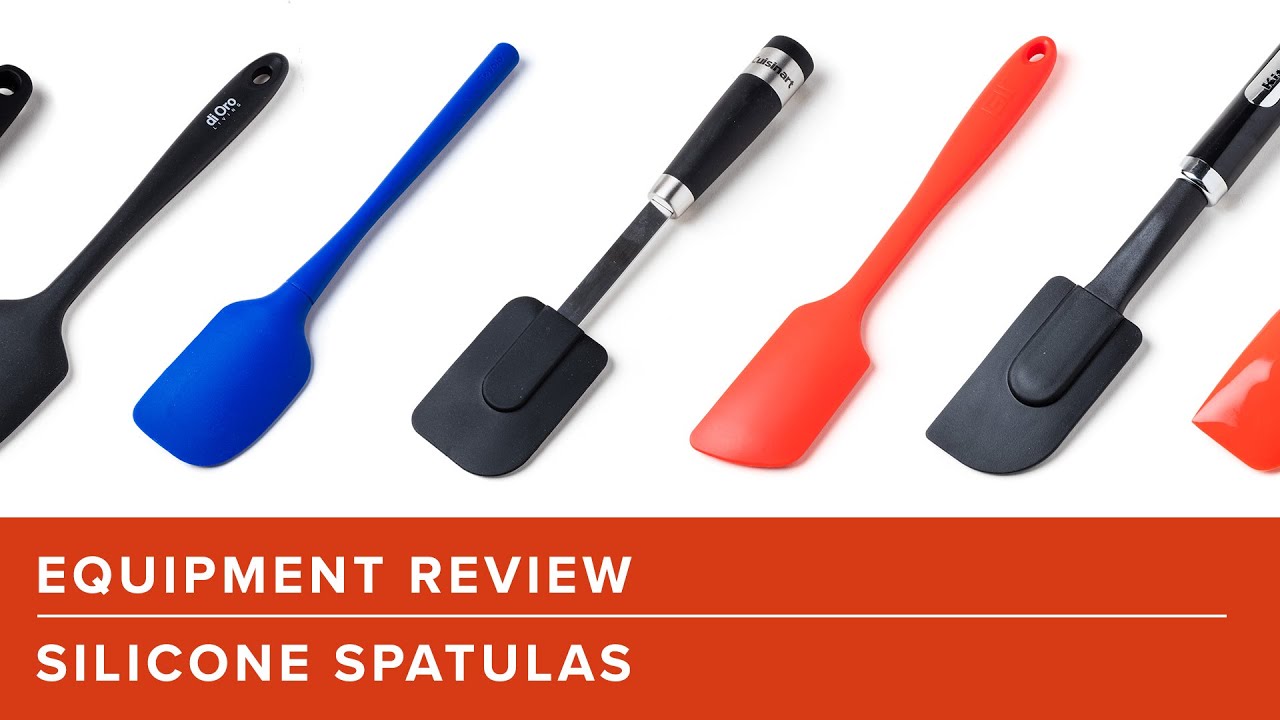
Common options include high-strength nylon, PBT, stainless steel sheet, stainless steel rod, and plastic-metal composite structures; different reinforcement choices also affect how stable the working blades or head sections feel in use, and these are practical examples of hidden components that change performance. Each creates a different balance of flexibility, strength, weight, cost, and heat performance.
Reinforcement should not be treated as an interchangeable hidden component. Buyers should record its material, dimensions, position, and connection method, and its definition should be stated clearly in the BOM or specification rather than treated generically. This makes the approved internal structure easier to verify during production.
Matching Reinforcement to the Application
A baking spatula may need controlled bending through the head while retaining support at the center and neck, especially if the sample is also used to portion batter or lightly level cake layers, where control across each layer becomes more important. A wide cooking spatula needs greater load-bearing support when lifting or turning food, and this kind of repeated-use load can happen a lot.
A frame that ends too early may leave the neck unstable, while a rigid insert may reduce flexibility. The design provides support where force is concentrated without making the head unnecessarily stiff.
Evaluating Heat-Resistance Claims
What Does the Temperature Rating Mean?
When a supplier states 250°C, 280°C, or another temperature, buyers should ask what the number represents. It may refer to raw-material resistance, short-term finished-product exposure, continuous use, or a marketing claim with unspecified conditions.
A useful temperature statement should identify the tested product, exposure time, test method, and acceptance criteria. Without this context, similar ratings may describe different levels of finished-product performance.
Test the Complete Spatula
Heat testing should cover the silicone head, reinforcement, handle, neck, and connection areas. After exposure, inspectors should check for deformation, discoloration, odor, cracking, separation, and loss of support.
Testing should reflect the application. A contact test may not represent a cooking spatula kept near a hot pan or baking sheet, while a baking scraper used at room temperature may need a different protocol. Application-specific conditions produce more useful results.

What Our Development Experience Shows
In a structure, the silicone exterior may tolerate more heat than the plastic reinforcement inside it. If the frame uses ordinary PP, long-term performance may be limited by the PP, not by the silicone.
We therefore do not recommend approving a spatula only from its silicone data sheet. Buyers should verify the internal material and test the construction under realistic conditions. The lowest-performing component may determine the practical limit.
Food-Contact Compliance and Documentation
Compliance should be planned by destination market and final construction. For the United States, buyers may need to assess the finished rubber article against applicable provisions such as 21 CFR 177.2600. “FDA compliant” is not a complete specification unless the material, intended use, and supporting test scope are identified.
For EU sales, Regulation (EC) No 1935/2004 provides the general food-contact framework. German-market projects commonly review silicone against BfR Recommendation XV as part of an LFGB-based test plan. Buyers should confirm which requirements and test conditions apply with an accredited laboratory.
For South Korea, use the latest MFDS standards for utensils, containers, and packages. The file set should connect the tested sample to the production material, color, reinforcement, and supplier.
Map every component before commissioning tests, including the silicone head, exposed reinforcement, handle materials, pigments, coatings, printing inks, and adhesives. Compliance files should link every declaration to identifiable material sources. This prevents the compliance review from covering only the most visible material while missing a secondary food-contact risk.
Request material declarations, bills of materials, technical data, colorant information, and test reports. A report for another color or formulation may not support the selected product. Control substitutions in writing before production begins.

Sample Development and Application Testing
Baking Application Tests
Test scraping against a curved bowl, folding light mixtures, moving dense dough, and transferring batter when frosting cakes or portioning a sheet cake. Record edge contact, center resistance, neck control, smoothing control on the sides, and recovery after bending, and if the tool is intended for decorating, note whether it can create controlled swoops in frosting. These observations turn subjective hand-feel into repeatable approval criteria.
Cooking Application Tests
Test scraping, lifting, turning, and front-edge entry with representative cookware and loads. Heat exposure should reflect the intended use, followed by checks for deformation, odor, separation, or reduced support. Application testing complements laboratory testing rather than replacing it.
Document every revision with measurements, photos, test conditions, and results. Once performance, materials, color, and construction are accepted, retain a signed reference sample and freeze the approved product specification.

Manufacturing and Quality Control
A typical process covers incoming-material verification, reinforcement preparation, silicone molding, handle assembly, finishing, cleaning, and packaging. Inspection should occur during production, because final inspection alone may not reveal an incorrect internal frame.
Critical controls include silicone hardness, head dimensions, edge consistency, reinforcement material and position, neck strength, color, odor, surface defects, and cleanliness. Define tolerances and defect classifications used to judge each production run so the factory and buyer use the same acceptance standard.
Link production batches to raw materials, inspection records, and the approved sample. If a material, pigment, reinforcement, or process changes, require review before use. Traceability and change control help prevent an approved sample from becoming an unapproved mass-production structure.
Packaging and Product-Line Planning
Build the assortment around applications rather than small shape or color changes. Baking, cooking, and hybrid spatulas should provide distinct reasons for purchase, while each additional SKU should justify its tooling, packaging, and inventory cost.
Packaging should state the primary use, material, verified temperature claim, care information, and required market details. It must protect thin edges and long handles without excessive carton volume. Accurate claims and efficient pack dimensions support retail communication and landed-cost control.

Evaluating an OEM Silicone Spatula Supplier
A capable supplier should control silicone hardness, reinforcement dimensions, molding, assembly, and traceability. Ask how the factory verifies internal components that cannot be seen during final inspection and prevents unapproved substitutions.
Sampling also reveals supplier capability. Review whether feedback becomes updated drawings, specifications, and test records, not just verbal feedback passed by hands or informally between teams. The supplier should demonstrate that mass production can match the approved sample in structure, function, color, and finish.
Purchase Planning and Project Timeline
Begin with product positioning and a detailed RFQ, followed by supplier review, material selection, reinforcement confirmation, and sampling. Application testing, heat validation, food-contact testing, and packaging approval should occur before freezing the production specification.
Next, approve a sealed pre-production sample and written inspection criteria. Production, final inspection, corrective work, and shipment should follow an agreed schedule. Allow extra time for new tooling, sample revisions, laboratory testing, custom colors, and peak-season capacity.

Conclusion: Building a Purchase-Ready Spatula Program
A reliable silicone spatula program starts by separating baking, cooking, and hybrid applications. Head shape, edge softness, center resistance, neck support, reinforcement, and finished-product heat performance must work as one connected product system.
Buyers can reduce risk by converting expectations into measurable specifications, testing realistic actions, linking compliance files to the final construction, and controlling production changes. The next step is to define the application and critical structure before requesting quotations or approving samples.
Develop Your OEM Silicone Spatula Program
If you are developing a baking, cooking, or multi-purpose silicone spatula range, our team can support head-shape selection, hardness and reinforcement development, color and logo customization, private-label packaging, sample evaluation, testing coordination, and production quality control.
Send us your target market, application, reference dimensions, estimated quantity, compliance needs, and packaging requirements. We can review the project and identify a practical sample plan and OEM quotation route for your product range.