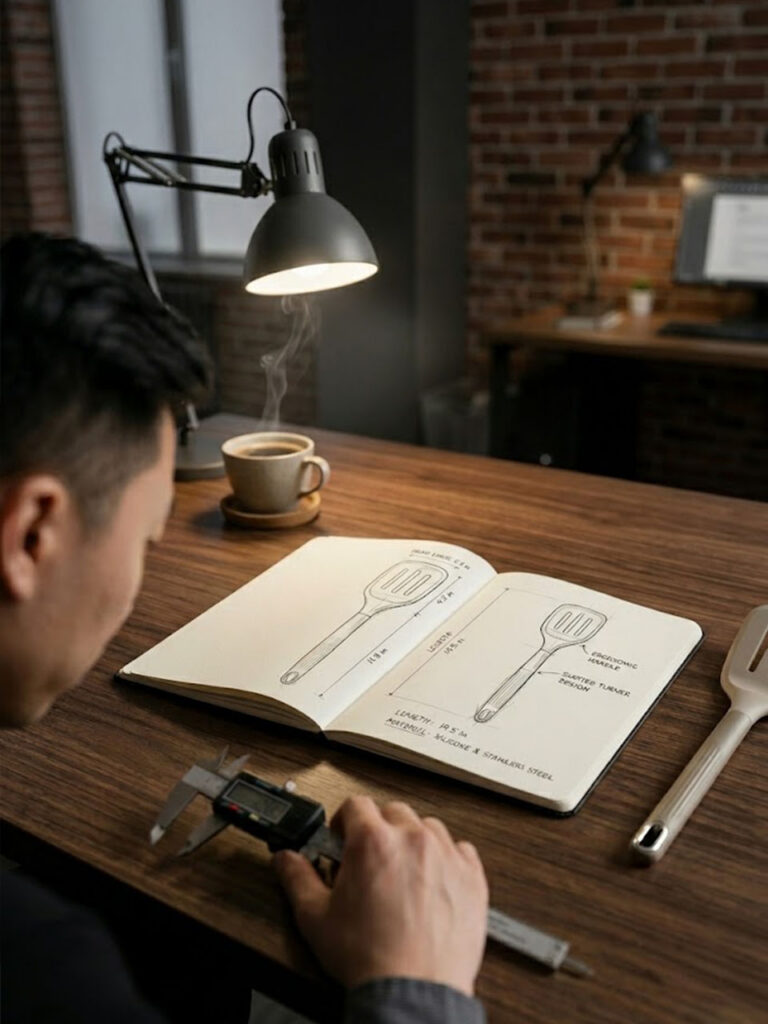

Why Kitchen Tongs Sourcing Needs Scenario-Based Specifications
Kitchen tongs sourcing often starts with a catalog image, sample, and target price. Brands, retailers, and importers must also judge whether a model suits the cookware, food, heat, and sales channel. The use scenario should guide specifications before price comparison.
This B2B guide helps buyers evaluate kitchen tongs manufacturers, private-label options, and OEM/ODM projects. It compares materials, head shapes, sizes, locks, production risks, compliance, and packaging, using frontline product-development experience to identify decisions required before sampling and bulk ordering.
Kitchen Tongs Categories for Private Label and Retail
Product Categories
The main categories include general kitchen tongs, silicone-tipped cooking tongs, stainless steel grilling tongs, baking or precision tongs, salad tongs, and table-service tongs. Although these products may share a similar spring-body structure, their materials, lengths, head shapes, and gripping forces should reflect different handling tasks.
A compact 9-inch model may suit everyday stovetop cooking, table service, or handling cut fruit, while 12-inch and 14-inch tongs offer greater distance from heat during grilling. Precision bakery tongs need controlled pressure for delicate food. Product size should follow use conditions, not simply current catalog availability.
Target Buyers and Sales Channels
Private-label brands may prioritize design and coordinated ranges. Retailers need clear good-better-best levels, while importers and food-service distributors may value durability, batch consistency, and replacement efficiency. E-commerce programs also require easy-to-explain functional differences in images, specifications, and demonstrations.
When comparing kitchen tongs suppliers, buyers should look beyond styling because many products share similar structures. Stronger differentiation connects head geometry, material, size, and locking behavior to a defined use case and measurable acceptance criteria.
Match Tong Materials to Cookware and Target Use
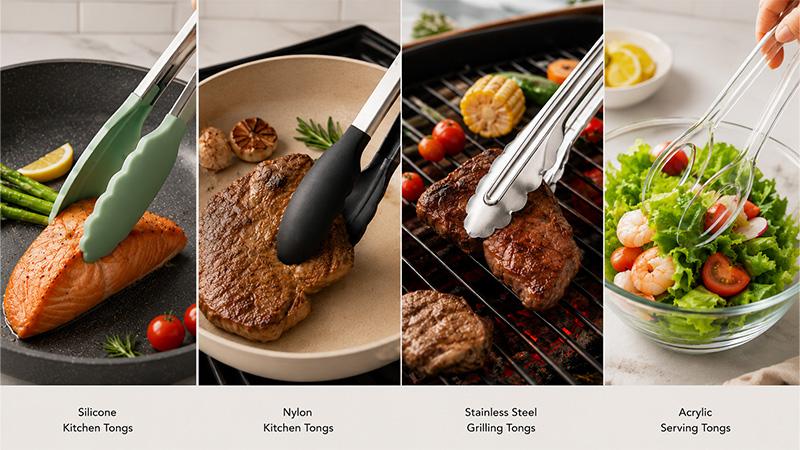
From our development experience, the cookware surface is normally the first selection factor. Tongs intended for nonstick or coated cookware generally need silicone or nylon contact surfaces that reduce scratching risk. Products for uncoated cookware or open-grill use can use stainless steel heads when strength and direct food control matter more.
For salad bars, buffets, or table service without cooking heat, acrylic can provide a more economical option. However, selecting material by cost alone can create the wrong product. Buyers should first define whether the tongs will contact heat, coatings, oil, heavy food, or delicate food.
First-Hand Development Insight
After confirming the material, we normally define the tong-head shape around the food. Pasta, steak, pastries, salad, and food served with a small amount of liquid need different contact areas. This sequence helps turn a broad request for “kitchen tongs” into a testable product specification before industrial design begins.
Compare Tongs for Grilling, Baking, and Serving
Choosing between grilling, baking, and serving tongs is not only a matter of length. Each task places different demands on heat distance, gripping pressure, head shape, and control. A useful comparison should start with the food and working environment, then translate those conditions into measurable specifications.
Functional Requirements at a Glance
| Application | Main Priority | Common Size | Typical Head Design | Grip Requirement |
|---|---|---|---|---|
| Grilling | Heat distance and strength | 12 or 14 inches | Stainless steel or heat-resistant tipped head | Strong and non-slip |
| Baking | Precision and food protection | Around 9 inches | Narrow, flat, or precision head | Light and controlled |
| Serving | Presentation and repeated handling | Around 9 inches | Acrylic, stainless steel, or shaped serving head | Smooth and moderate |
Match Tong-Head Shapes to Food
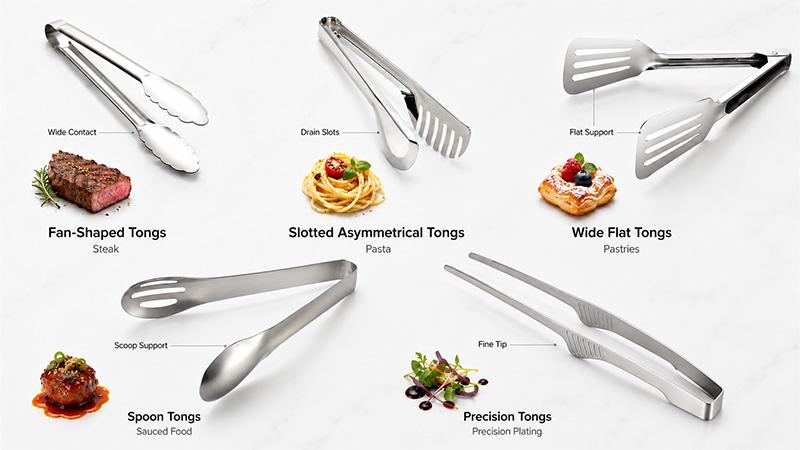
For pasta, a fan-shaped or slotted asymmetrical head can improve contact while allowing water or sauce to drain. Steak and larger grilled food need a wider, flatter gripping area that supports weight during lifting and turning. A narrow contact point may feel precise but provide insufficient stability.
Spoon-shaped heads can collect food together with a small amount of liquid, while fine pointed heads suit plating, garnishes, and small bakery items. The design question is not which shape looks more distinctive. It is whether the contact area matches the food’s weight, texture, and surface condition.
Select the Right Size and Handle Grip
A 9-inch pair of tongs is compact and easy to control for stovetop cooking, baking, or table service. Longer 12-inch and 14-inch models provide more distance from heat during grilling. However, additional length also increases leverage, so steel thickness and spring force may need adjustment to prevent twisting.
Handle grip should be evaluated with dry, wet, and oily hands. Soft-touch or silicone inserts can improve control, but their seams must remain easy to clean. The handle also needs enough internal clearance so it does not flatten or pinch the user’s hand when the heads close.
Compare Common Locking Mechanisms
The most familiar design uses a rear pull ring that also serves as a hanging loop. Other options include a side sliding lock, a gravity-activated lock, and a rear rotary switch. Each system creates a different balance between one-handed convenience, storage efficiency, assembly complexity, and cost.
A premium mechanism is not automatically the right choice. Entry-level retail programs may benefit from a simple pull-ring structure, while design-led ranges may justify smoother or more distinctive operation. Buyers should test lock resistance, accidental release, and repeated-cycle consistency before approving the final sample.
Convert Use Scenarios Into Product Specifications
The practical sequence is straightforward: define the cookware, food, working distance, and retail position first. If you set the use scenario first, then selecting the head material, shape, length, handle, and lock becomes clearer. This approach gives suppliers clear testing criteria and helps buyers compare samples on performance instead of appearance alone.
Design Materials for Durability and Cleaning
Control Steel Thickness and Spring Performance
Stainless steel thickness should match tong length, head weight, and required gripping force. Thin steel may twist or stay deformed, while excess weight increases cost and hand fatigue. Buyers should evaluate strength and spring recovery on finished samples, not only on a material sheet.
Surface quality affects appearance and safe handling. Brushed or polished finishes should remain consistent across the body, edges, rivet area, and internal channels. Specifications should define deburring, edge rounding, and corrosion expectations so acceptable-looking samples do not hide sharp or unfinished areas.
Design for Easier Cleaning
Food residue can collect around pivots, locks, deep stamped grooves, and silicone overmolding seams. Before tooling approval, you can check these gaps, overmolding boundaries, and grooves to judge how easy the part will be to clean. A cleaner design uses controlled gaps and smooth transitions while preserving enough clearance for the mechanism to move freely after repeated washing.
Evaluate Kitchen Tongs Manufacturer Quality
First-Hand Quality-Control Experience
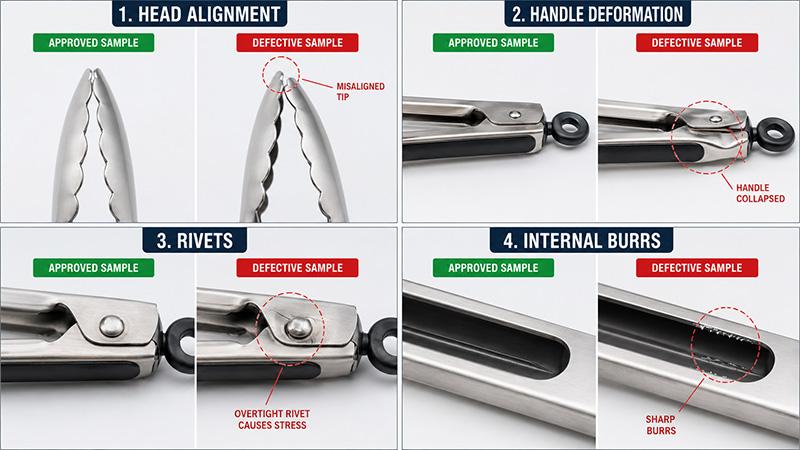
In our factory experience, tong-head symmetry is one of the most important acceptance points because it directly determines whether the product can grip food accurately. When the tongs close, both heads should meet at the intended contact area without twisting, crossing, or leaving an uncontrolled gap.
Handle deformation is another functional warning. If the stainless steel arms flatten significantly when the heads close, the structure may feel weak and reduce hand clearance. Inspectors should therefore check closed-handle shape, spring recovery, and lateral movement instead of testing the opening action only once.
The lock and pivot require careful control. A lock should move smoothly without releasing accidentally, while a rivet must remain secure without restricting operation. The internal stamped channel also needs a dedicated burr inspection, since an overlooked sharp edge can scratch the user’s hand even when the exterior looks finished.
Process Controls and Inspection Methods
Useful countermeasures include forming fixtures for head alignment, go/no-go gauges for closed gaps, defined rivet-setting pressure, and first-piece confirmation for critical dimensions. Inspectors can compare results with an approved golden sample, but functional limits should also be recorded numerically to reduce subjective decisions between production batches.
Verify Real-Use Performance Before Bulk Ordering
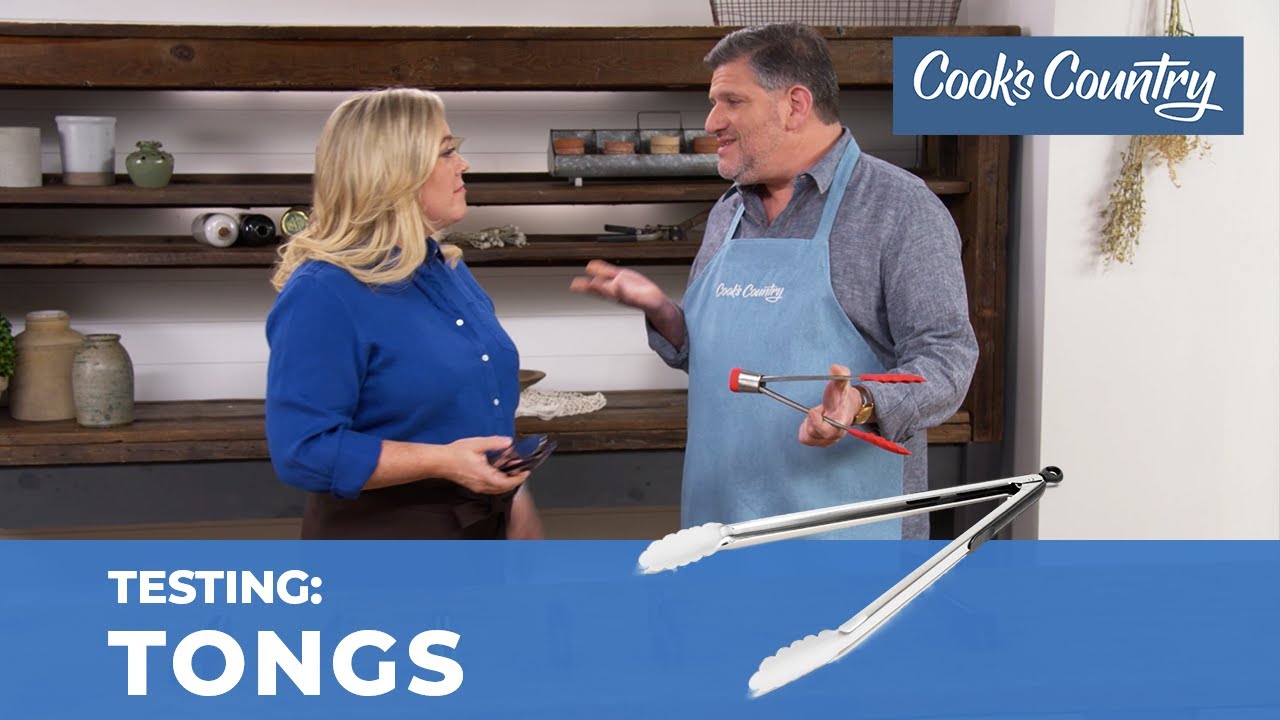
Grip tests should cover pasta, steak, vegetables, pastries, and wet or oily food when relevant. Repeated opening and closing can reveal changes in spring force, pivot movement, or lock consistency. Testing should focus on the intended food and environment, not an identical generic checklist for every model.
Heat exposure, hand washing, and dishwasher cycles should be added when supported by the intended claims. After testing, inspect alignment, finish, corrosion, overmolded parts, and lock operation again. This sequence shows whether performance remains stable after use, rather than proving only that a new sample works.
The final inspection standard should connect each test to a clear acceptance limit and sampling method. That gives buyers and suppliers a shared definition of acceptable quality and makes corrective action easier when a result falls outside the approved range.
Confirm Food-Contact Compliance Before Sample Approval
Build Requirements Around the Destination Market
“Food-grade” is not a complete purchasing specification. A buyer should identify the destination market, tong materials, intended food types, contact conditions, and temperature range before selecting tests. Stainless steel, silicone, nylon, acrylic, coatings, colorants, and printed packaging may require different supporting information.
For U.S. programs, the regulatory status of each food-contact component should be checked for its intended use. The U.S. FDA’s food-contact guidance includes cookware and food-preparation surfaces within food-contact applications and explains that authorization depends on safe use conditions. Buyers should therefore avoid treating a general supplier declaration as universal approval.
For the EU market, the European Commission identifies Regulation (EC) No 1935/2004 as the general food-contact framework and Regulation (EC) No 2023/2006 as the GMP basis. Its official legislation overview also highlights compliance documentation and traceability, alongside material-specific and national requirements where applicable.
Prepare a Shipment Compliance File
A practical file can include material declarations, relevant test reports, supplier batch records, product specifications, inspection results, and a declaration of conformity when required. Packaging should state materials, care instructions, use limitations, and traceability information without making unsupported heat-resistant or dishwasher-safe claims.
Plan OEM/ODM Kitchen Tongs Development
Move From Concept to an Approved Sample
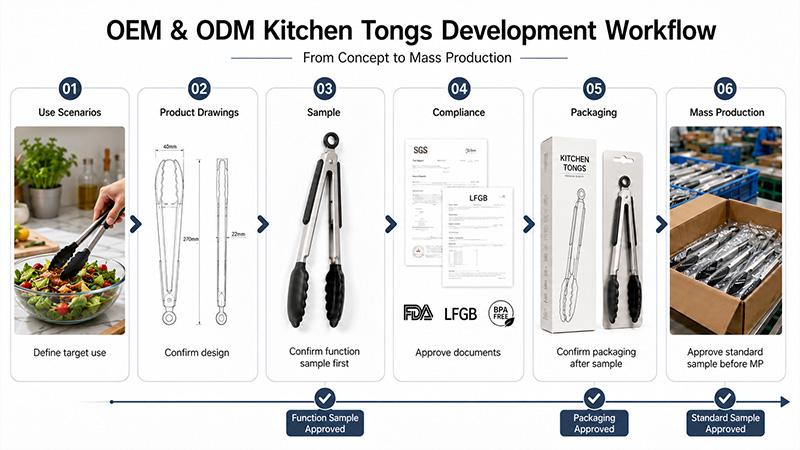
Development should begin with a written product brief covering cookware, food, length, head shape, grip, lock, target price, and sales channel. Existing structures may support faster logo, color, or packaging customization. A new head or locking mechanism requires additional engineering, tooling, and verification time.
Function should be approved before decoration and packaging are finalized. The buyer and supplier should retain an approved golden sample together with dimensions, functional limits, colors, and finish standards. This creates one mass-production reference instead of relying on comments scattered across emails.
First-Hand Advice for First-Time Buyers
In our regular development process, we first confirm the cooking scenario because it defines the material. We then select an appropriate size, commonly 9, 12, or 14 inches, and choose the locking system according to target price and market positioning. These decisions establish the product’s main structure.
Only after those points are clear do we finalize temperature conditions, food-contact testing, labeling, and supporting documents. This order prevents buyers from paying for tests or packaging before the product specification is stable. It also makes sample comparison and approval more efficient.
MOQ, Pricing, and Private-Label Packaging
MOQ and price should reflect the customization level. Logo application on an existing model is different from a new color, material, tong head, or molded component. Quotations should separate product, tooling, testing, and packaging costs and show volume-based price tiers clearly.
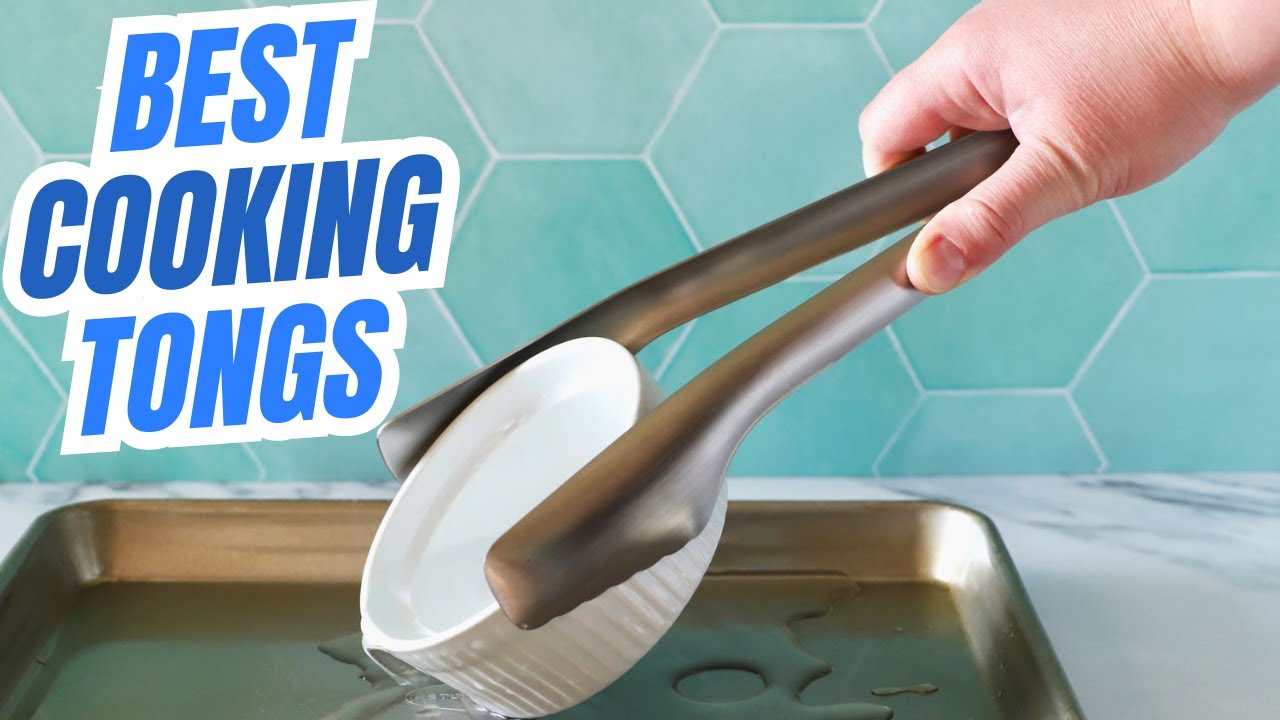
Private-label packaging may use a hanging card, sleeve, color box, or e-commerce pack. Final artwork should match the approved product and destination-market requirements. Before mass production, confirm barcode, material statement, warnings, care instructions, importer details, and packaging dimensions in one signed checklist.
Plan Supply and Retail Assortments
Manage Capacity, Suppliers, and Safety Stock
Delivery planning should include stamping, overmolding, finishing, assembly, testing, and packaging. Customized colors, molded heads, and new locks can extend lead times. A pilot run helps verify process stability and realistic output before full-volume scheduling.
Long-term suppliers should provide stable steel thickness, material formulations, color control, compliance records, and batch traceability. Hold safety stock for common steel and standard components, while controlling customer-specific colors and packaging more closely. This reduces shortages and excessive customized inventory.
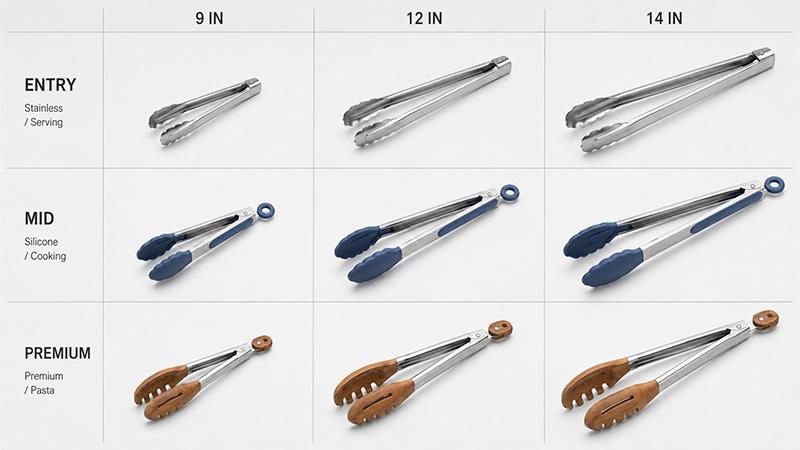
Build a Good-Better-Best Product Range
An entry range can use a proven structure and simple pull-ring lock. Mid-range products may add silicone or nylon heads and improved grip. Premium models can justify refined finishes or distinctive mechanisms when they deliver a clear user benefit.
On shelves and product pages, organize tongs by use. Show material, length, cookware compatibility, and intended food clearly. Coordinated 9-inch, 12-inch, and 14-inch options help buyers create a logical product series instead of collecting unrelated models. This also simplifies shelf communication and replenishment planning.
Set Quality Assurance and After-Sales Terms
Final Inspection and Complaint Tracking
Pre-shipment inspection should cover dimensions, alignment, spring recovery, lock operation, rivets, burrs, finish, packaging, and labeling. Agree on sampling rules and acceptance limits before production. A retained sample and batch records provide evidence for quality investigations.
After-sales procedures should separate manufacturing defects from wear, misuse, or unsupported applications. Record complaints by batch, model, and defect type, then compare them with inspection and material records. This turns returns into corrective-action data instead of isolated cases.
Common Buyer Questions
Which size is most versatile? A 9-inch model offers control for many kitchen and serving tasks, while 12-inch or 14-inch tongs provide more grilling distance. The choice still depends on food weight, heat exposure, and required reach.
Are kitchen tongs dishwasher safe? Use this claim only after the complete product passes suitable washing tests. Steel, overmolded heads, locks, rivets, coatings, and decorations may respond differently to repeated dishwasher cycles.
When should tongs be replaced? Replace them when the heads no longer align, the spring stops recovering, the lock releases unexpectedly, sharp edges appear, or components loosen. These changes may compromise safe and predictable gripping.
Conclusion
The right kitchen tongs begin with the cookware, food, heat exposure, and working distance. These conditions guide material, head shape, size, handle, and lock selection. Reliable products also require alignment control, functional testing, compliance documentation, and clear production standards. For a broader sourcing framework, continue with our kitchenware quality-control and sampling guide.
Discuss Your Kitchen Tongs Project With l-tools
l-tools supports OEM/ODM kitchen tong development for brands and retailers, including material selection, structural customization, sampling, testing coordination, and private-label packaging. To evaluate a product or range, send us your target market, use scenario, preferred size, and price position and request a sample or quotation.