

“Dishwasher safe” looks like a simple product claim. Consumers may reasonably understand it to mean that a kitchen tool can be washed in a dishwasher without losing its function, stability or expected appearance.
For brands and retailers, however, the label alone does not explain how the product was tested or what counted as an acceptable result.
In our development work, we have seen products remain visually intact during early checks but reveal moisture, joint or finish problems after further evaluation. These outcomes often depend on the complete structure, not only the headline material.
This guide explains what a dishwasher-safe claim can support, what it may leave unanswered and what buyers should verify before approving the claim for packaging or product pages.

What a Dishwasher-Safe Claim Does – and Does Not – Tell You
At its most useful, a dishwasher-safe claim tells the customer that the manufacturer expects the product to withstand the stated or intended dishwasher conditions. It should be connected to relevant testing and clearly defined acceptance criteria.
The claim does not automatically promise that a product will look new indefinitely. It also does not, by itself, identify the wash program, rack position, detergent, drying conditions or number of cycles used during evaluation.
Industry test methods do exist. For example, DIN EN 12875-1 is listed as a current reference test method for the mechanical dishwashing resistance of domestic articles.
However, the existence of a reference method does not mean that every product carrying the words “dishwasher safe” was tested under the same protocol. Buyers still need to ask which method was used and how the results were judged.
A dishwasher test also needs an agreed definition of failure. Depending on the product and claim, this may include:
- Functional change: Does the utensil still turn, cut, grip or serve correctly?
- Structural change: Have joints, rivets, handles or bonded areas loosened?
- Material change: Has any component warped, cracked or lost elasticity?
- Surface change: Has the finish faded, roughened, discoloured or corroded?
- Moisture retention: Does water remain inside a cavity or connection?
- Care limitation: Does performance depend on rack position or drying method?
Without these criteria, two teams may observe the same sample and reach different conclusions. One may accept minor colour change because the tool still works, while another may reject it because appearance retention is part of the intended product promise.

A Performance Claim Needs Evidence That Matches Its Scope
For products marketed in the United States, the Federal Trade Commission’s advertising guidance states that advertising should be truthful and supported by evidence. It also considers both explicit claims and reasonable implied meanings.
Applied to kitchenware, this means the supporting evidence should match the breadth of the statement. A limited test should not be presented as proof of unrestricted use under every dishwasher condition.
Buyers should therefore separate three questions:
| Question | What needs to be defined |
|---|---|
| How was it tested? | Complete product, wash conditions, placement and inspection method |
| What result was accepted? | Functional, structural, visual and hygiene-related criteria |
| What will the customer be told? | Unrestricted claim or qualified care instructions |
This distinction is especially important for multi-material products. A metal head, plastic handle and silicone grip may each tolerate dishwasher exposure individually, while the interfaces between them create a different risk in the finished product.
When reviewing a kitchen utensil collection, buyers should not rely only on material declarations. The dishwasher claim should reflect the tested product configuration, including removable parts, fasteners, coatings and internal cavities.
A structured kitchenware sampling review can identify visible and functional concerns early. Repeated washing evaluation then examines whether the same product remains acceptable after exposure, rather than only when it is new.
Why Product Structure Matters as Much as Material
A kitchen tool may use materials that individually tolerate dishwasher exposure and still perform poorly as a finished product. Water does not interact with a material specification; it interacts with the complete structure.
Sleeves, caps, hollow handles, seams and push-fit components can create narrow paths through which moisture enters. If the same structure provides no effective drainage or drying route, water may remain hidden after the product appears dry from the outside.
When a Removable Grip Created a Hidden Water Trap
We encountered this issue while evaluating a stainless steel spatula with a removable silicone grip. Both materials remained stable during initial dishwasher checks, and the assembled utensil showed no obvious deformation or looseness.
The limitation became visible only after repeated washing. When the silicone grip was removed, moisture marks appeared around the retaining groove, and a small amount of water remained within the handle area.
Further inspection showed that the narrow interface between the grip and metal structure allowed water to migrate inward. The enclosed section then provided no reliable path for the retained moisture to escape.
The problem was not that the silicone or stainless steel could not tolerate the dishwasher environment. Instead, the connection between the two materials created a moisture trap.
The metal section was revised to remove the internal cavity, while small drainage paths were added around the removable grip. Revised samples were then evaluated using the same post-wash inspection criteria before the project moved forward.
This experience changed our review process for products with sleeves, caps and inserted components. These products now require post-wash drainage checks and, where practical, disassembly inspection, rather than an external appearance check alone.

A Practical Drainage Review
For products with removable or assembled handles, buyers can add several observations to the dishwasher evaluation:
- Shake test: Does water leave the product after washing and drying?
- Orientation check: Can water drain when the utensil is stored normally?
- Disassembly check: Is moisture visible beneath removable components?
- Residue check: Are water marks or deposits forming around grooves?
- Odor check: Does an enclosed area develop an unusual smell?
- Drying check: Are hidden surfaces still wet after exposed areas have dried?
These checks do not replace a defined dishwasher test method. They help identify structural conditions that an external inspection may miss.
The lesson is straightforward: material resistance and structural drainage are separate questions. Buyers need evidence for both when a product contains enclosed or overlapping components.
Why the Complete Product Needs Validation
Material reports are an important starting point, but they do not represent every component in an assembled utensil. Rivets, springs, welds, adhesives, coatings and seals may introduce different performance limits from the main body material.
A dishwasher-safe decision should therefore be based on the complete product configuration. This is particularly important for moving tools, where minor corrosion or dimensional change can affect alignment, joint resistance and functional stability.
The Smallest Component Became the Weakest Point
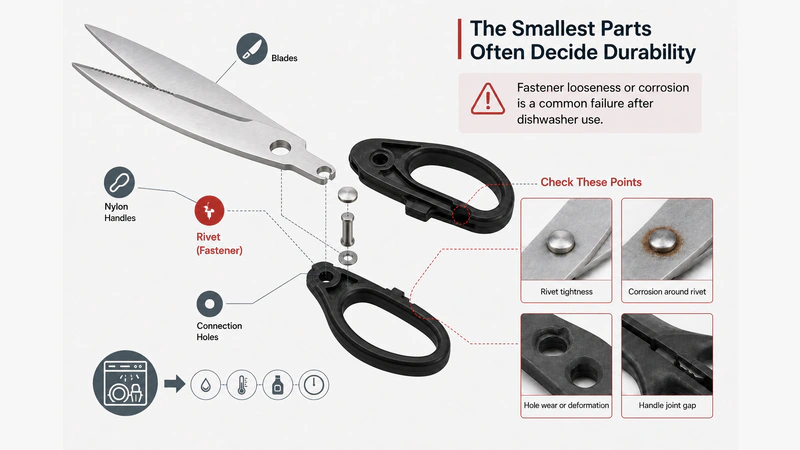
In another project, a pair of kitchen shears combined stainless steel blades with reinforced nylon handles. Because both primary materials were considered suitable for repeated washing, the product was initially expected to support a dishwasher-safe claim.
Complete-product testing produced a different result. Residue began appearing around the pivot area, followed by early movement between the handle and blade.
After the joint was examined, the weakness was traced to a coated carbon-steel fastener with lower corrosion resistance than the main components. Repeated exposure affected the fastener and gradually reduced the stability of the connection.
Neither the blade material nor the nylon handle had caused the problem. A comparatively small connecting part had become the limiting component in the finished assembly.
The fastener specification was changed to a more corrosion-resistant stainless steel option, and the joint interface was revised to reduce moisture exposure. The updated assembly was then re-evaluated as a complete product.
The experience established a useful rule for later projects: a dishwasher-safe claim should follow whole-product testing, including the parts that may not appear prominently on a material list.
Our related analysis of small manufacturing details that create larger product problems explains why rivets, joints, edges and assembly tolerances deserve attention before mass production.
What Buyers Should Inspect After Repeated Washing
The correct inspection points depend on the product, its intended claim and the selected test method. However, a complete review should look beyond cracks or obvious breakage.
Buyers may need to inspect:
- Joints and fasteners: Has movement, corrosion or residue appeared?
- Hollow areas: Is moisture retained inside handles or caps?
- Material interfaces: Are gaps, separation or distortion developing?
- Functional movement: Do scissors, tongs or hinged tools still operate correctly?
- Surface condition: Has the texture, gloss or color changed beyond the agreed limit?
- Removable parts: Can they still be removed, cleaned and reassembled correctly?
The acceptance criteria should be recorded before testing begins. Otherwise, the team may discover a change but have no agreed basis for deciding whether it supports or contradicts the intended claim.
Test records should also identify the exact product configuration. If a fastener, coating, grip structure or component supplier changes, buyers should consider whether the existing dishwasher evidence still represents the production version.
When “Can Be Machine Washed” Needs a Qualified Care Message
A product may remain functional after dishwasher exposure while still showing changes that matter to the customer. Functional survival and appearance retention are not always the same promise.
This distinction matters most for natural materials, coated surfaces and decorative finishes. If repeated washing changes the look or feel that originally made the product attractive, the care wording should set realistic expectations before purchase.
When Bamboo Remained Functional but Aged Too Quickly
In one project, a salad-serving set used treated bamboo handles. The handles remained attached and usable during dishwasher evaluation, which initially appeared to support a dishwasher-safe claim.
Longer-term observation showed a different limitation. Repeated washing and drying gradually changed the protective finish, making the bamboo surface look lighter, duller and less smooth.
The structure had not failed, but the natural appearance and hand feel declined faster than expected. For a product whose warmth and finish formed part of its value, that change could not be treated as irrelevant.
The solution was not to replace the bamboo with metal or plastic. Instead, the packaging and care information were qualified to explain the validated washing conditions while recommending gentler cleaning and prompt drying to help preserve the material’s color and surface feel.
This created a more accurate message for the user. The product could tolerate defined dishwasher conditions, but repeated machine washing was not necessarily the best care method for preserving its appearance.

Make the Care Message Match the Evidence
A product claim should not communicate more certainty than the available evidence supports. The final wording needs to reflect the tested product, tested conditions and agreed acceptance criteria.
For example, an unrestricted dishwasher-safe claim may be suitable only when the full product remains acceptable under the intended washing and drying conditions. If the product requires a specific rack position, gentler program or additional drying step, that limitation should be stated clearly rather than assumed.
Buyers can use three practical claim categories:
- Unqualified dishwasher-safe claim: Use only when the complete product supports the intended washing conditions and acceptance criteria.
- Qualified dishwasher-use guidance: Use when performance depends on conditions such as rack position, component removal or drying procedure.
- Hand-washing recommendation: Use when machine washing does not cause immediate functional failure but may accelerate foreseeable changes in color, finish or texture.
The aim is not to add warnings unnecessarily. It is to ensure that the product label, instructions and online description communicate the same level of performance that testing actually supports.
This is also why care wording should be reviewed alongside the physical sample. A supplier may have evidence that supports a material property, while the final product configuration requires a narrower consumer-facing instruction.
A Buyer Checklist Before Approving a Dishwasher-Safe Claim
Before confirming packaging artwork or product-page copy, buyers should document the following:
- Final product configuration: Are the tested materials, fasteners, coatings and removable parts identical to the production version?
- Test conditions: Do the washing, drying and placement conditions reflect the intended use and claim?
- Acceptance criteria: What level of functional, structural and appearance change is acceptable?
- Hidden-risk review: Have cavities, joints, seams and material interfaces been inspected?
- Care wording: Does the label explain any validated limitations clearly?
- Change control: Will the product be re-evaluated if a component, supplier or process changes?
A kitchenware manufacturing and testing review should connect these questions before mass production. Testing, product design and consumer communication need to support one another.

A Better Standard for Dishwasher-Safe Kitchenware
“Dishwasher safe” should not be treated as a shortcut for product quality. A credible claim depends on the complete structure, the defined test conditions, the agreed acceptance criteria and the care message given to the customer.
For kitchenware buyers, the most useful question is not only whether a utensil survives a dishwasher cycle. It is whether it remains functionally stable, easy to clean and consistent with the expectation created by its label.
Reviewing a Dishwasher-Safe Claim for Your Next Project?
If you are reviewing a dishwasher-safe claim for a new kitchen tool or updating an existing range, L-Tools can help assess materials, structural details, testing needs and care-message feasibility before production. Send us your product brief or inquiry to discuss a practical development and validation approach for your market.