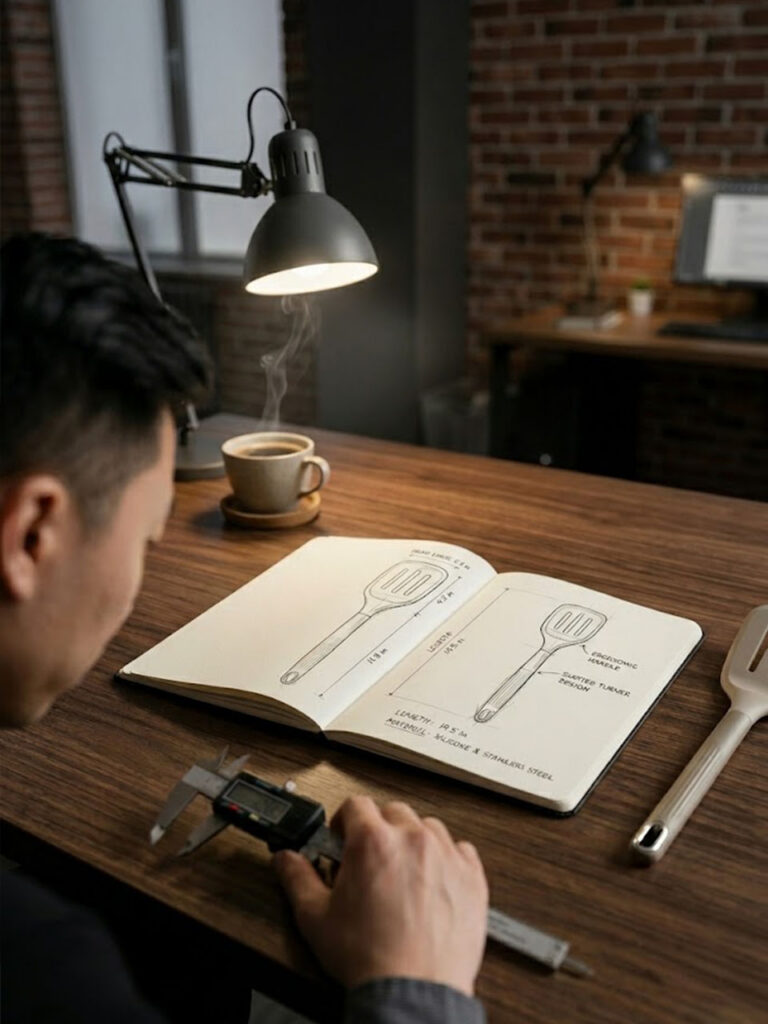
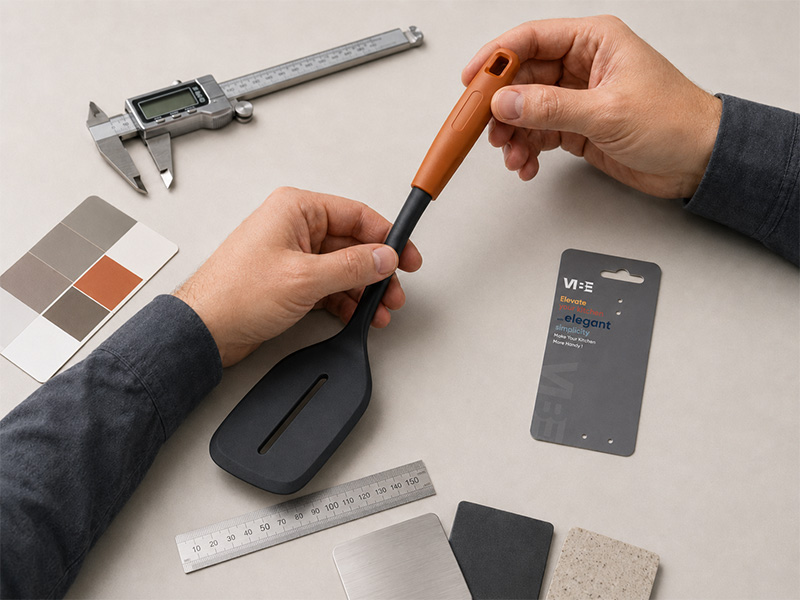
A kitchenware sample is often the first point at which a product moves from a drawing, quotation, or screen into something physical. The buyer can finally hold it, operate it, compare it, and question whether the original concept has been translated correctly.
For B2B buyers, the purpose of sampling is not simply to decide whether a product looks acceptable. It is to identify which characteristics should be changed, which should be approved, and which must remain repeatable during production.
A useful sample review therefore produces more than comments such as “too light” or “not premium enough.” It should turn those reactions into clear product requirements that development, production, and quality teams can understand.
A Sample Is More Than a Physical Product
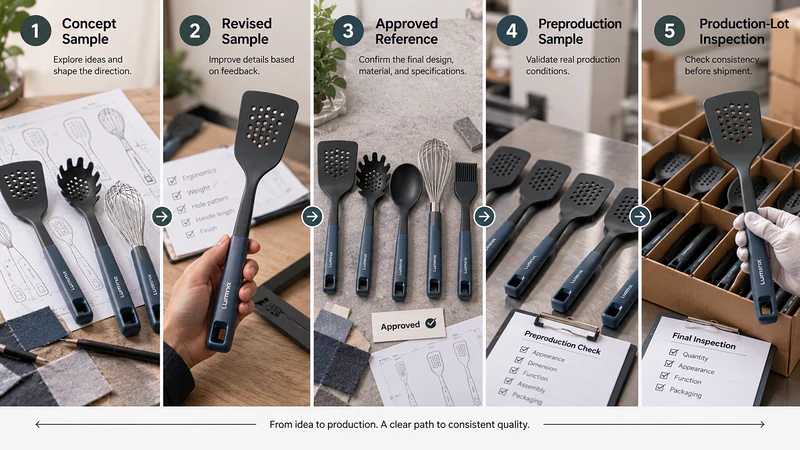
Different samples may serve different purposes during development. The terminology varies between companies, but a concept sample, revised sample, approved reference, and preproduction sample should not be treated as interchangeable.
An early development sample helps buyers review structure, dimensions, materials, and basic function. An approved reference records the agreed result, while a preproduction sample should demonstrate that the intended materials and production process can reproduce it.
A single well-made sample cannot prove that an entire production batch will remain consistent. Its value comes from becoming a clear physical reference supported by measurable specifications and repeatable test methods.
Subjective Feedback Must Become a Product Requirement
Buyers often describe sample concerns through perception because that is how users initially experience the product. Comments such as “it feels hollow,” “the balance seems wrong,” or “it does not match the price position” can be useful starting signals, but they are not yet production instructions.
Discussions about perceived quality in kitchen tools may involve weight, rigidity, sound, surface texture, or structural stability. During sample approval, the supplier must identify which physical characteristic is creating that impression.
A practical review asks more specific questions. Is the total weight inappropriate, or is the weight distributed poorly? Is the handle actually too thin, or does its cross-section fail to support the palm during the intended cooking motion?
At l-tools, we use comparative handling and realistic operating movements to narrow these questions. The objective is not to eliminate professional judgment, but to connect that judgment with a feature that can be adjusted and recorded.
When “Too Light” Is Really a Balance Problem
We encountered this challenge while reviewing a stainless steel spatula. The buyer described the sample as light, uncomfortable, and less substantial than expected, but could not identify one visible defect or incorrect material.
We placed the sample beside several reference products positioned for a similar market level. Reviewers handled the unheated tools without seeing their appearance, then performed single-handed pickup, grip, and simulated turning movements.
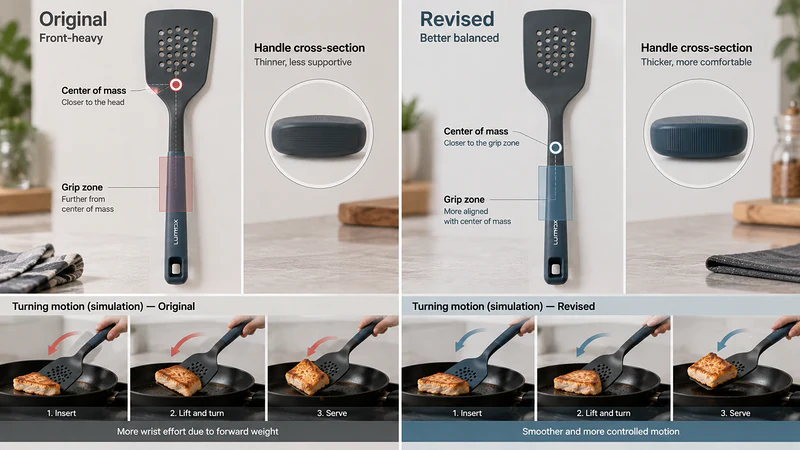
The comparison revealed that total weight was not the main problem. Much of the mass sat toward the spatula head, while the handle was relatively light, creating a front-heavy feeling during the turning motion.
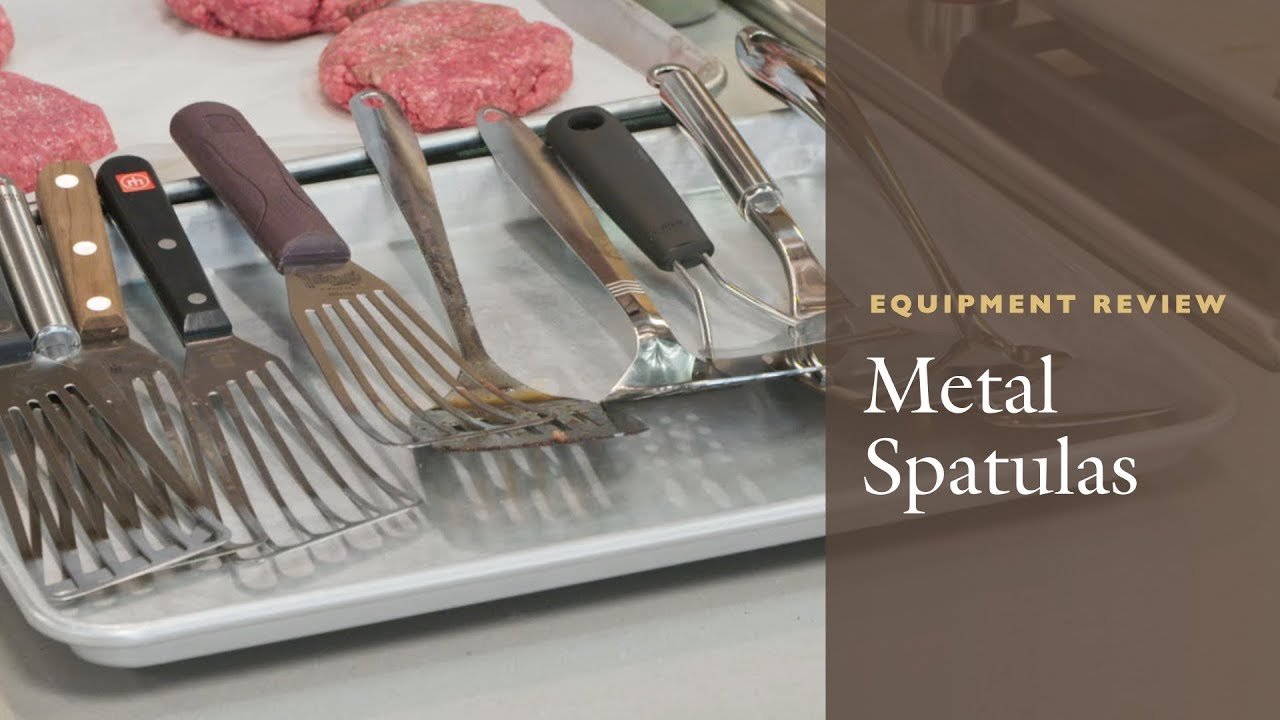
The handle cross-section also contributed to the impression. It was thin and offered limited palm support, so reviewers applied additional finger pressure to keep the spatula controlled during the simulated movement.
Because similar observations appeared across different reviewers, including during the appearance-blinded comparison, we treated the feedback as a repeatable balance and grip issue rather than a purely visual preference.
Turning Hand Feel Into a Specification
The solution was not to make the complete spatula heavier. Instead, the internal weight distribution was adjusted so that the center of mass moved closer to the intended grip zone.
The handle cross-section was slightly increased and changed to an oval profile with a gentle curve. This created more palm contact and a clearer resting position for the fingers without substantially changing the product’s external appearance.
The revised sample was then compared through the same handling sequence. Reviewers no longer needed to compensate for the head in the same way, and the product felt more controlled during pickup and simulated turning.
This result was not converted into a universal rule that every spatula must balance at one identical point. The acceptable center-of-mass zone must reflect the product’s length, head geometry, handle design, and intended cooking movement.
The approved specification recorded the defined balance zone, handle cross-section, grip dimensions, and comparison method. This allowed a subjective description such as “too light” to become a repeatable product requirement.
A buyer does not need to describe every concern in engineering language. However, before the sample is approved, the supplier should translate the buyer’s reaction into a feature that can be modified, verified, and repeated.
A Color Can Pass Alone and Fail as Part of a Range
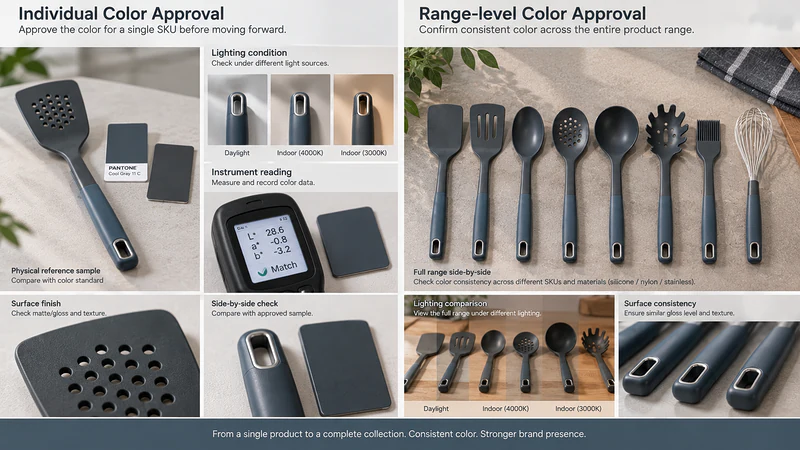
A color sample may appear acceptable when it is reviewed by itself. However, series-level approval requires different products, materials, and finishes to remain visually connected when they are displayed together.
This becomes difficult when a product range combines silicone, nylon, plastic, painted metal, or coated components. Even when similar pigments are used, each substrate may absorb, scatter, and reflect light differently.
Gloss and surface texture can increase the difference. A warm matte gray and a cool semi-gloss gray may have similar color names, but their combined appearance can make one assortment look like two unrelated ranges.
Instrument readings can help describe this difference. ISO/CIE 11664-6:2022 specifies the CIEDE2000 method for calculating color differences from CIELAB values, providing a recognized framework for comparing two color stimuli.
A numerical result should not replace visual review. Product shape, texture, gloss, surrounding colors, and lighting conditions still influence how buyers perceive a coordinated kitchenware range.
When Matching Formulas Produce Different Results
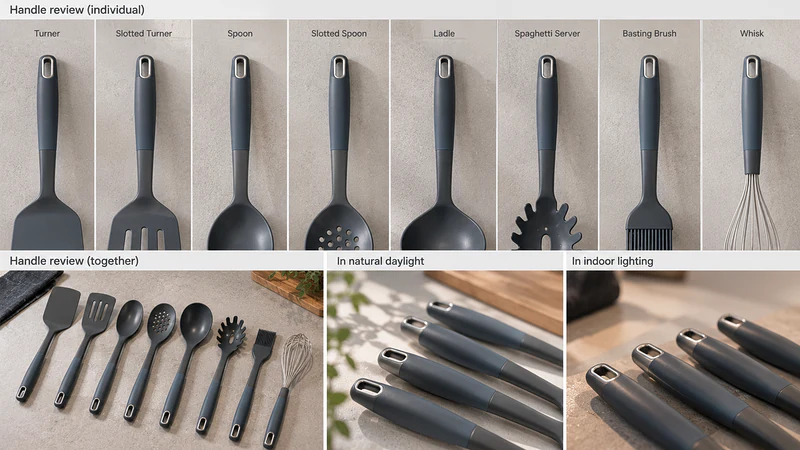
At l-tools, we encountered this issue while reviewing a kitchen tool range that combined silicone and nylon handles. Each sample appeared to belong to the intended gray color family when it was evaluated individually.
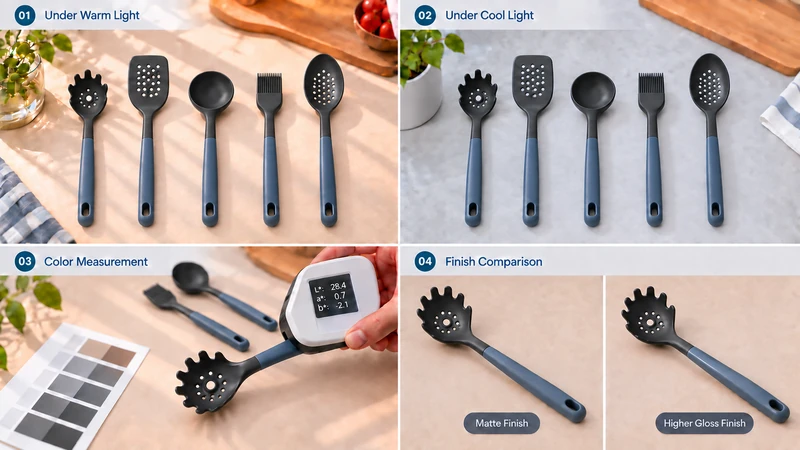
The inconsistency became visible when the complete range was placed on a white surface. The silicone components appeared warmer, while the nylon components showed a cooler gray direction.
We repeated the comparison under natural daylight and indoor lighting. Although the apparent strength of the difference changed, the warm and cool relationship remained visible under both conditions.
Color measurements were then used to support the visual observation. The CIELAB readings confirmed that the two material groups were not occupying the same intended hue direction, rather than the difference being caused only by personal preference.
The root cause was the way the two materials responded to pigment and light. Using a similar color formula across silicone and nylon did not guarantee the same final visual result on both substrates.
From a Color Sample to a Range Standard
The silicone handle was selected as the visual reference for the range. Instead of forcing both materials to use an identical formula, the nylon pigment formulation was adjusted to move its appearance closer to the approved silicone reference.
Surface finish was reviewed at the same time. The nylon handle was changed from a more reflective finish to a controlled matte appearance that reduced the visible gloss difference between the two materials.
The revised samples were again placed together under the agreed viewing conditions. Approval was based on the appearance of the complete series, supported by instrument readings rather than determined by either method alone.
This did not create one universal color-difference limit for every kitchenware material. Acceptable variation should reflect the substrates, surface geometry, finish, lighting conditions, and brand requirements of the specific range.
The final reference included physical samples of every relevant material, the agreed viewing conditions, instrument records, and finish descriptions. This created a parallel range reference instead of separate, unrelated color approvals.
Packaging Must Be Reviewed in Its Sales and Shipping Context
Product sampling should also consider how the approved item fits inside its intended packaging. A tool may look correct by itself but still appear compressed, unstable, poorly supported, or visually inconsistent when placed inside the insert.
A packaging mock-up can confirm dimensions, presentation, labeling position, and removal experience. However, visual approval alone does not prove that the packed product can withstand the intended distribution environment.
A detailed kitchenware packaging evaluation should therefore consider the sales channel, internal support, package volume, and transport method. These checks prevent a presentation sample from being mistaken for a transport-validated package.
For parcel-distribution projects, ISTA 3A provides a general simulation procedure for packaged products moving through parcel delivery systems. The appropriate protocol still depends on the package type, distribution route, product risk, and buyer requirements.
During sample approval, buyers should record what has actually been verified. A printed mock-up, fitted packaging sample, and transport-tested package represent different levels of evidence, even when they look nearly identical on the review table.
An Approved Sample Does Not Guarantee Production Consistency
An approved sample shows that the intended product can be made successfully at least once. It does not prove that the same dimensions, movement, appearance, and hand feel will automatically be repeated across production.
This distinction is especially important for products containing hinges, locks, pivots, springs, rivets, or fitted components. Their performance depends on the combined variation of several parts and assembly conditions, not one dimension alone.
An approved unit may contain components that happen to fit together near the ideal point. When parts from different positions within the allowed tolerance range are assembled, the finished products may feel tighter or looser than the reference sample.
For B2B buyers, sample approval should therefore include two questions. Does the reference product meet the intended requirement, and can the planned production process reproduce that result consistently?
When the Reference Sample Hides a Tolerance Problem
At l-tools, we encountered this issue while developing a pair of kitchen tongs with a locking mechanism. The approved sample had a smooth opening action, controlled resistance, and a clear locking response.
During trial production, variation appeared between finished units. Some tongs required more effort to open, while others released more easily, meaning that the approved hand feel was not being repeated consistently.
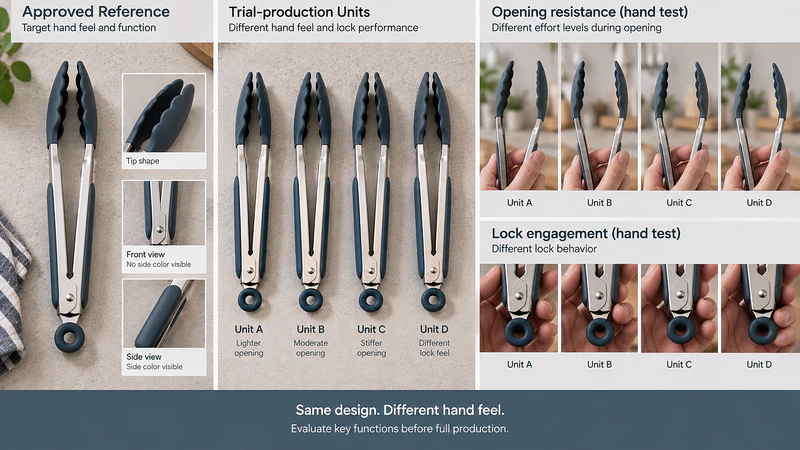
The sound of the lock also varied. Some units produced a clearer response while others sounded more muted, but sound was treated as an investigation signal rather than the primary acceptance criterion.
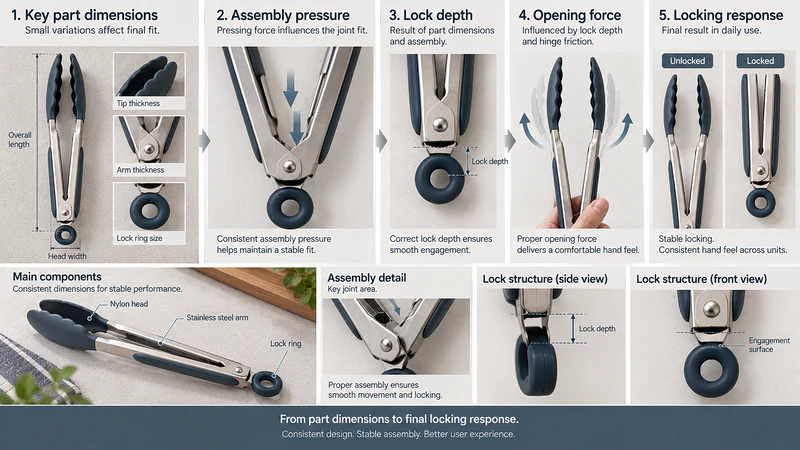
Component comparison showed small differences around the locking contact surfaces. The lock depth depended on the combined dimensions of two molded parts, so variation accumulated when the components were assembled.
Assembly pressure introduced another variable. When the parts were pressed together without a controlled force setting, the final lock engagement could change even when the individual components appeared acceptable.
The approved sample happened to contain a favorable combination of component dimensions and assembly conditions. The product concept worked, but its repeatable production window had not yet been converted into controlled parameters.
Controlling the Process Before Changing the Product
The product structure was not changed immediately. First, the team introduced dimensional checks for the locking components and defined which fitted dimensions directly influenced lock depth and opening resistance.
The assembly process was then moved to equipment with a visible pressure setting. This replaced operator judgment with a defined and recordable assembly condition.
Finished products were checked for opening force as well as correct locking and release. The lock sound remained useful as a secondary screening signal, but it did not replace dimensional and force-based checks.
If those controls had failed to create a workable production range, the component geometry would have required further redesign. In this project, however, tighter process definition and inspection methods were sufficient without changing the overall product structure.
This illustrates why small manufacturing details should be reviewed before mass production. A minor dimensional or assembly difference can affect the movement that buyers approved in the reference sample.
Products with moving joints also require appropriate repeated-use evaluation. Issues involving long-term tong joint stability are related to, but different from, the initial production consistency checked during trial manufacturing.
Turning the Golden Sample Into a Control Standard
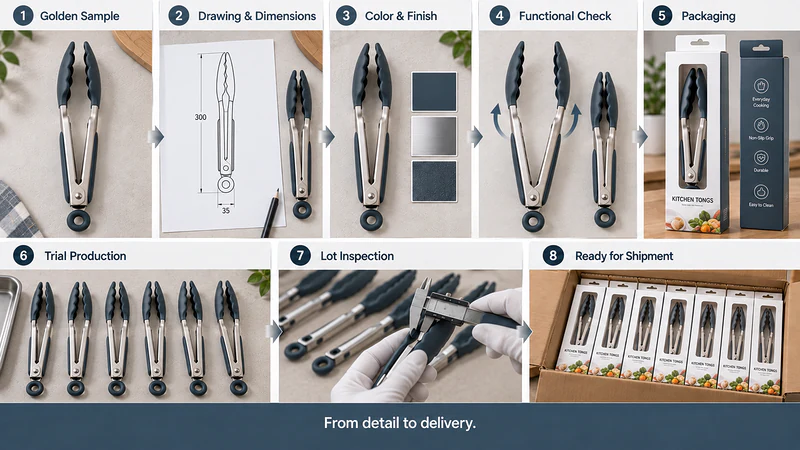
A Golden Sample is most useful when it is supported by records explaining why it was approved. The physical item should be connected to drawings, materials, critical dimensions, functional ranges, finish references, packaging status, and agreed test methods.
For the locking tongs, the reference was translated into a defined opening-force range, lock engagement requirements, component dimensions, assembly settings, and repeated-operation checks. Trial production was then used to verify whether these controls produced a consistent result.
This process does not replace batch inspection. ISO 28590 provides an introduction to acceptance sampling systems by attributes, illustrating that production-lot acceptance is a separate activity from approving one development reference.
The buyer should therefore understand what each item proves. A Golden Sample defines the agreed target, while trial production tests repeatability and production inspection evaluates whether a shipment conforms to its specified requirements.
What B2B Buyers Should Confirm Before Approval
Before approving a kitchenware sample, buyers should confirm both the product result and the method used to reproduce it:
- Sample purpose: Is this a development sample, an approved reference, a preproduction sample, or a transport-test sample?
- Critical characteristics: Which dimensions, materials, finishes, and functional ranges affect buyer approval?
- Evaluation method: How will hand feel, balance, color, movement, packaging fit, or alignment be checked again?
- Reference records: Are the physical sample, drawings, material details, color references, and test notes connected?
- Production controls: Which process parameters or component tolerances must remain within an agreed range?
- Trial verification: Has a small production run demonstrated that the approved result can be repeated?
- Lot inspection: How will the production shipment be sampled and evaluated separately from the development sample?
A sample should not be approved only because it looks and feels correct on one review table. Approval becomes useful when another team can reproduce the decision using the same references, measurements, and test actions.
A Good Sample Becomes a Usable Standard
B2B kitchenware sampling is not a search for a perfect first prototype. It is a process of turning buyer perception into physical causes, agreed improvements, measurable requirements, and repeatable production controls. The strongest sample is not simply the best-looking unit; it is the one that gives development, production, and inspection teams the same definition of an acceptable product.
Build Kitchenware That Production Can Repeat
l-tools supports brands and private-label buyers with sample evaluation, product refinement, specification development, and preproduction verification. Explore our kitchen utensils for private-label development or discuss your sample development project with our team.