A few years ago, it felt like every kitchen problem needed its own gadget.
One tool for avocados.
Another for strawberries.
Something only for corn.
Something only for bagels.
A lot of those products sold well too.
They looked clever online.
Easy to demonstrate.
Easy to package into gift sets or seasonal displays.
But kitchens feel different now.
Not dramatically. Just enough that people are starting to look at products differently.
Most Drawers Are Already Too Full
One thing that comes up more often during product discussions at L-Tools is storage.
Not design trends.
Not colors.
Just simple kitchen space.
A lot of modern apartments have smaller kitchens now:
- narrower drawers
- less cabinet depth
- cleaner countertops
- limited shelf space
And once storage becomes tight, every product has to justify staying there.
That changes buying behavior quietly.
Consumers become more selective without even realizing it.
People Don’t Want More Stuff Anymore
This doesn’t mean people stopped buying kitchen tools.
They still care about cooking.
Still care about usability.
Still enjoy finding products that make life easier.
But many consumers are becoming tired of products that only solve one tiny problem.
Especially single-use kitchen gadgets that end up forgotten after two or three uses.
An avocado slicer is a good example.
The idea sounds useful at first. The packaging looks smart. Maybe the online video looks satisfying too.
Then eventually people realize a knife already works fine.
The gadget slowly disappears into the back of a drawer.
Kitchens Became Part of the Living Space
Open kitchens changed a lot.
Years ago, crowded kitchens felt more acceptable because they were treated mostly as work areas.
Now kitchens are visible constantly.
They’re part of the apartment aesthetic.
Part of the dining space.
Sometimes even part of the background during video calls.
Too many gadgets create visual noise very quickly.
That’s one reason minimalist kitchenware feels more appealing now, even outside minimalist lifestyle audiences.
People don’t necessarily want fewer tools.
They want fewer unnecessary tools.
Some Products Look Better Online Than They Feel in Real Life
This happens more often than people admit.
Certain novelty kitchen accessories perform extremely well online.
Short videos make them look efficient, clever, almost addictive to watch.
But actual kitchens are repetitive places.
People cook while distracted.
They clean quickly.
They don’t want complicated storage situations afterward.
Some gadgets create more inconvenience than the original task itself.
Especially:
- bulky gadget sets
- oversized manual tools
- products with too many detachable parts
- difficult-to-clean plastic accessories
At L-Tools, we’ve noticed more brands quietly questioning whether certain categories still deserve long-term shelf space.
The Products That Actually Stay in Use
Interestingly, the products surviving long term are usually pretty simple.
Good tongs.
Reliable spatulas.
Compact graters.
Stackable storage pieces.
Tools people reach for automatically.
Especially products that can handle multiple tasks without feeling oversized.
That’s where multifunction kitchen tools started becoming more relevant.
Not because consumers suddenly want “more functions.”
Mostly because they don’t want five separate tools anymore.
Cleaning Frustration Is Real
A lot of products stop getting used simply because they’re annoying to clean.
Consumers rarely describe it that directly.
But behavior shows it clearly.
If a product has:
- hard-to-reach corners
- too many parts
- awkward drying areas
- oversized shapes
It slowly disappears from daily use.
Especially in smaller households where people prioritize convenience over novelty.
This is also why compact kitchen tools continue gaining attention. They fit modern kitchens more naturally.
Less effort. Less storage pressure. Less friction after cooking.
Fewer but Better Tools Feel More Valuable Now
There was a period when larger assortments automatically felt impressive.
More SKUs.
More gadgets.
More accessory variations.
Now many retailers and product teams are becoming more cautious about SKU overload.
Not loudly. Just gradually.
It’s becoming harder to justify oversized product assortments filled with items consumers may only use occasionally.
Especially when:
- inventory costs rise
- shelf efficiency matters more
- shipping density becomes important
- repeat purchase behavior becomes easier to track
These are the kinds of discussions more kitchenware brands are having recently.
Kitchen Clutter Feels Different Today
People are more sensitive to clutter now.
Not only in kitchens.
In general life too.
Notifications.
Subscriptions.
Packages arriving constantly.
Storage bins full of forgotten things.
So when consumers open a crowded drawer filled with random gadgets, the feeling isn’t excitement anymore.
Usually it’s mild frustration.
That’s partly why coordinated product systems feel more attractive now:
- matching utensils
- stackable storage
- consistent materials
- cleaner visual organization
A calmer kitchen feels easier to live with.
Some Brands Are Quietly Reducing SKUs
This shift is happening behind the scenes too.
Some brands working with L-Tools have gradually shifted toward:
- fewer overlapping products
- more versatile tools
- tighter collections
- products with stronger repeat use potential
Not necessarily because minimalism is trendy.
Mostly because real usage patterns became harder to ignore.
A product that gets used twice creates very different long-term value compared to one that stays on the countertop for years.
Storage Became Part of Product Design
One thing discussed more often during product development at L-Tools is where the product actually lives after use.
That question matters more than before.
Consumers actively notice:
- nesting structures
- slimmer profiles
- hanging convenience
- stackability
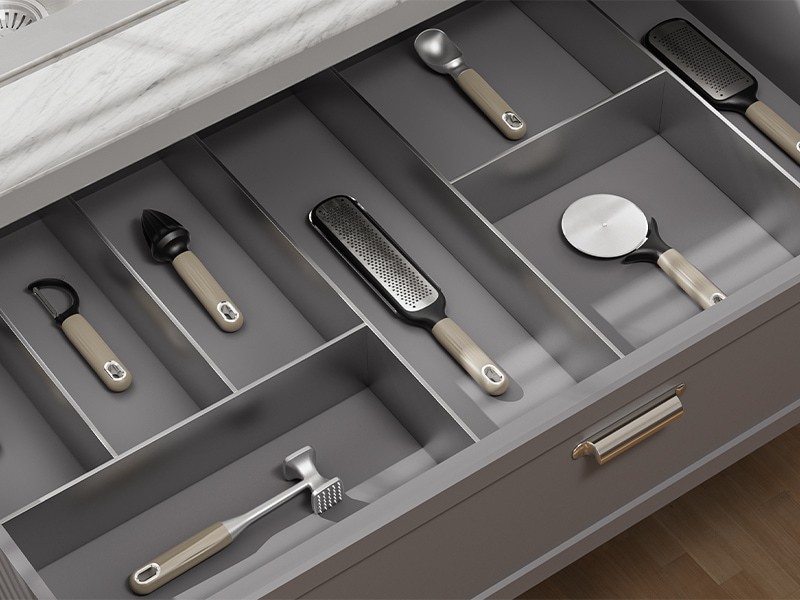
- drawer efficiency
Especially in homes where kitchen tool storage is already limited.
Sometimes storage convenience affects purchase decisions as much as functionality itself.
A Lot of Current Kitchen Gadget Trends Are Actually Moving Toward Simplicity
That’s probably the interesting part.
The industry still innovates constantly.
But many newer ideas are becoming quieter.
Less about adding more features.
More about removing friction.
Simpler cleaning.
Better storage.
Fewer duplicate tools.
More natural everyday use.
In many projects at L-Tools, the conversation has gradually shifted toward products people actually keep using after six months, not just products that perform well during launch season.
And honestly, consumers seem happier with that direction too.
People still enjoy buying kitchen tools.
They just want fewer regrets sitting in the drawer afterward.