For a long time, larger kitchen tool sets looked like the safer choice.
More pieces. More value. More functions. A bigger box that seemed easier to sell on a shelf or online listing.
A 15-piece set looked more impressive than a 5-piece set. A drawer full of tools looked like a complete kitchen solution. For gift seasons, promotions, and private label programs, large assortments often felt like the obvious direction.
But consumer behavior has been shifting.
Many people are no longer asking, “How many tools do I get?”
They are asking something quieter, but more important:
“Will I actually use all of these?”
That question is changing how brands, retailers, sourcing managers, and product developers think about kitchen tool assortments.
Most Kitchens Are Already Full
The modern kitchen is not always big.
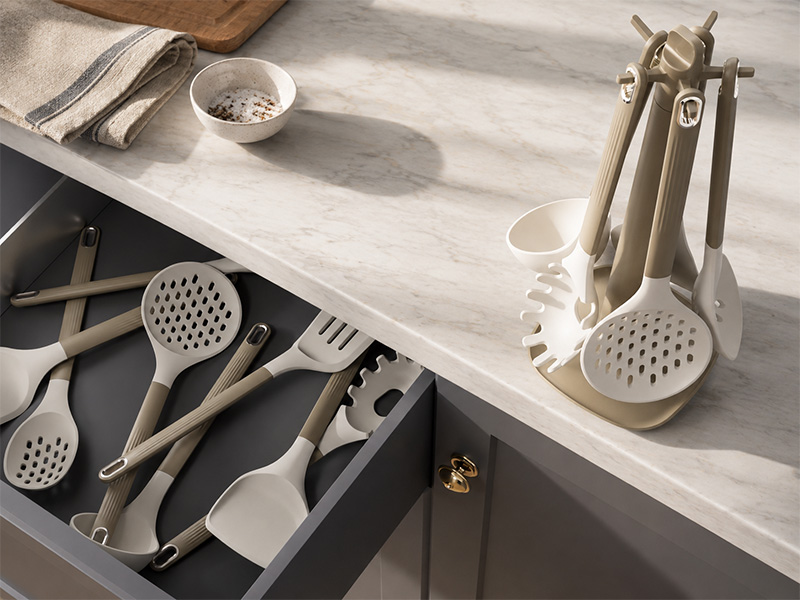
Apartments are smaller. Countertop space is limited. Drawers are already crowded with utensils, food storage lids, measuring spoons, clips, peelers, and tools people bought once and forgot about.
This is one reason compact kitchen tools are becoming more attractive.
Consumers are not only buying products. They are buying space back.
A large tool set may look good in packaging, but once it enters the home, the reality can be different.
The buyer may ask:
- Where do I store all of this?
- Which tools do I actually need every week?
- Why are three pieces almost doing the same job?
- Will this set make my drawer easier or harder to manage?
That last question matters more than many brands realize.
A kitchen tool set should make cooking feel easier. If it creates more kitchen clutter, the value starts to disappear.
Large Sets Can Feel Like Better Value, Until They Are Used
Large assortments often work well at first glance.
They create a strong value impression. They fill packaging nicely. They give retailers more to show in one product. For e-commerce, the product photo can look generous and complete.
But after purchase, the experience becomes more practical.
Some tools get used every day. Others stay untouched.
A consumer may use the spatula, tongs, peeler, and whisk regularly. But the melon baller, specialty scraper, small fork, or unusual serving tool may sit in the drawer for months.
This does not always lead to a complaint.
But it does affect how the consumer remembers the product.
If half the set feels unnecessary, the purchase can feel wasteful. And when that happens, repeat purchase becomes harder.
At L-Tools, we’ve observed that buyers are becoming more careful about this point. A larger set is not automatically stronger. A smaller set with clearer usage logic can sometimes feel more valuable because every piece has a reason to be there.
Smaller Sets Are Easier to Understand
A curated kitchen tool set usually has a clearer story.
It does not try to cover every possible cooking task. Instead, it focuses on a specific use case.
For example:
- A 4-piece everyday cooking set with spatula, spoon, turner, and tongs.
- A compact baking prep set with scraper, whisk, measuring cups, and pastry brush.
- A small cutting and prep set with peeler, grater, slicer, and garlic press.
- A nested measuring set that stores neatly inside itself.
These products are easier for consumers to understand in a few seconds.
They also make shelf presentation cleaner.
Retailers do not have much time to explain a product. A customer walking past a shelf, or scrolling through an online product page, needs to understand the product quickly.
A smaller set often does that better.
It tells a tighter story.
“This is for daily cooking.”
“This is for small kitchens.”
“This is for baking prep.”
“This is for easy drawer storage.”
That kind of clarity helps buyers too. It makes the product easier to position, easier to price, and easier to compare against existing items in the category.
Multifunction Matters, But Only When It Feels Natural
The rise of multifunction kitchen tools does not mean every product needs to do five things.
In fact, consumers can be skeptical of tools that claim too much.
A product that tries to slice, peel, grate, chop, open, scrape, and serve may sound efficient, but it can also feel confusing. If the function is not obvious, people may not trust it.
The better direction is usually more subtle.
Some examples are simple:
- A nested measuring cup set that stacks tightly and saves drawer space.
- A grater with multiple surfaces but a compact body.
- A peeler that works comfortably across different ingredients.
- Tongs that lock closed for easier kitchen tool storage.
- A scraper that can also help transfer chopped ingredients.
These are not dramatic innovations.
They are practical improvements.
And practical improvements often matter more than big claims.
For product developers, the question is not just “Can we add another function?”
It is also:
“Does this added function make the tool more useful, or just more complicated?”
That distinction is important. Especially for private label buyers who need products that consumers can understand quickly and use repeatedly.
Minimalist Does Not Mean Empty
The word minimalist kitchenware can sometimes sound too design-focused.
Neutral colors. Clean packaging. Fewer visual details. A calm lifestyle image.
Those things matter. But in kitchen tools, minimalism is not only about appearance.
It is also about removing what does not need to be there.
A smaller tool set can still feel complete if the selection is thoughtful.
For example, a five-piece set may perform better than a twelve-piece set if the five pieces match real cooking habits. The consumer may feel that the brand understands their kitchen better.
That creates a different kind of value.
Not more pieces.
Better choices.
This is also where sourcing and product development become more strategic. It is not enough to select tools from a catalog and combine them into a set. The assortment needs to reflect how people actually cook, clean, store, and repeat their routines.
At L-Tools, this is often part of the discussion with brands and buyers. The goal is not always to create the biggest assortment. Sometimes it is to refine the assortment until it feels more useful, more organized, and more realistic for everyday kitchens.
What This Means for Buyers and Retailers
For retailers, smaller sets can bring several practical advantages.
They are easier to merchandise. They take up less shelf space. They can be positioned around specific consumer needs instead of broad product counts.
A compact set may also reduce hesitation.
A consumer may think twice before buying a large box of tools if they are unsure where to store it. But a smaller, well-edited set feels easier to bring home.
For sourcing managers and private label buyers, this trend also affects how products are evaluated.
The discussion moves from:
“How many pieces can we include at this price?”
To something more useful:
“Which pieces will the consumer actually use?”
That shift can influence:
- Product selection
- Packaging size
- Retail pricing
- Shelf layout
- Online product images
- Repeat purchase potential
It also affects returns and reviews.
When a set feels practical, consumers are more likely to use it often. When they use it often, they are more likely to remember the brand positively. That memory can matter when they buy again.
Fewer Tools, Clearer Purpose
Large kitchen tool sets will not disappear.
They still have a place in gift programs, starter kitchens, promotional bundles, and certain retail channels.
But the idea that “more pieces always means more value” is becoming less reliable.
Many consumers now want fewer tools that work better for real life.
They want drawers that are easier to organize. They want tools that earn their place. They want sets that feel useful after the packaging is gone.
For brands and buyers, this is a quiet but important change.
A good kitchen tool assortment is no longer only about filling a box.
It is about understanding the kitchen it will eventually live in.
And sometimes, the strongest set is not the largest one.
It is the one where every piece makes sense.