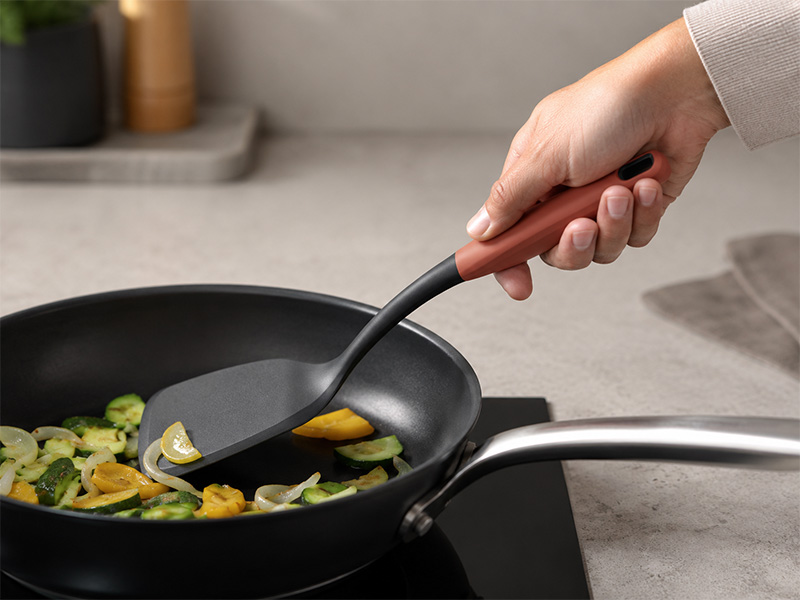
A kitchen tool can feel perfectly comfortable when a buyer first picks it up. The handle looks smooth, the weight seems reasonable, and nothing feels obviously wrong during a short sample review.
Real cooking places different demands on the product. Repeated stirring, flipping, lifting, and scraping can reveal pressure points, poor balance, and unnecessary gripping effort that remain invisible during a brief inspection.
For B2B buyers, this creates an important distinction: first-touch comfort is not the same as long-term usability. A sample should not only feel good in the hand; it should remain controlled and comfortable throughout the task it was designed to perform.
Why First-Touch Comfort Can Be Misleading
Most sample reviews happen quickly. A buyer may check the finish, hold the product, move it a few times, and confirm that the handle feels acceptable.
That process can identify sharp edges or an obviously unsuitable grip. However, it may not reveal how the hand responds after the same cooking motion is repeated.
A slightly rounded handle can begin rotating during forceful stirring. A front-heavy turner can make the user grip harder to control the head. An edge that feels harmless at first can create concentrated pressure against the palm during a longer task.
These issues do not necessarily mean the product is unusable. They indicate that the original review did not reproduce the duration, force, and movement of real cooking.
General hand-tool guidance from the National Institute for Occupational Safety and Health recommends evaluating a tool in relation to its actual task, including the force required, repeated movement, and working posture. Although this guidance is not a kitchenware standard, the same evaluation logic is useful during utensil development.
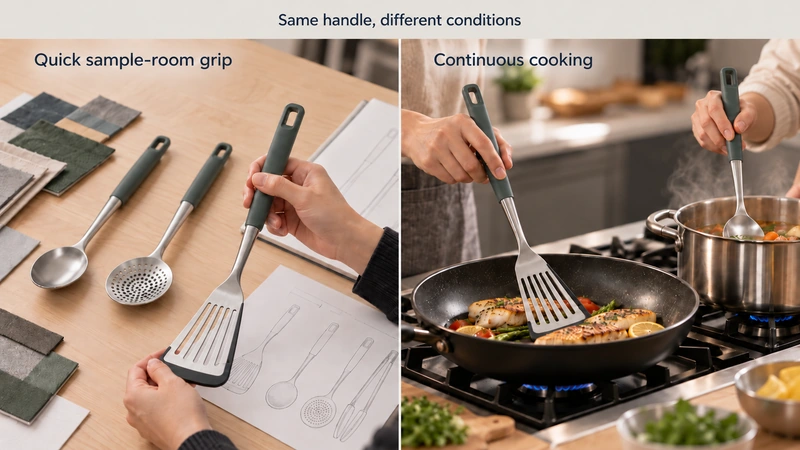
Repetition Reveals What a Sample-Room Check Misses
Long-term comfort problems often appear through small changes in user behavior before anyone describes the handle as uncomfortable.
During a realistic test, the evaluator may change hands, tighten the grip, move the thumb repeatedly, or hold the tool farther forward. These actions can be more useful than asking whether the product simply “feels comfortable.”
For buyers reviewing kitchen utensils, the test should match the product’s intended function. A turner should be evaluated through repeated lifting and flipping, while a whisk or masher needs a different sequence of force and movement.
The purpose is not to create one universal comfort test. It is to identify where the product causes the user to compensate during its normal task.
Useful observation points include:
- Grip adjustment: Does the user repeatedly move the fingers or change the holding position?
- Compensatory force: Does the user begin gripping more tightly to keep the tool stable?
- Contact pressure: Do the handle end, seam, or edge leave visible pressure marks?
- Wrist position: Does the product encourage unnecessary bending or rotation during use?
- Balance control: Does the head pull the hand forward or make the tool feel difficult to guide?
These observations help turn a vague comment such as “the handle feels tiring” into a more actionable product-development question.
From “It Feels Tiring” to Measurable Design Changes
In one utensil project reviewed by l-tools, a stainless steel turner appeared comfortable during initial handling. Its brushed handle looked refined, and short static checks did not reveal a clear problem.
The issue became visible during a continuous cooking simulation. Multiple testers began adjusting their grip during the same part of the workflow, while pressure appeared near the base of the palm.
Because people with different hand shapes and holding styles showed similar behavior, the team treated the result as a structural signal rather than an individual preference.
Further comparison indicated that the nearly circular handle offered limited resistance to rotation. The tool was also weighted toward the head, so the hand had to apply additional force to control it during repeated turning movements.
The solution did not require a complete material change. The handle cross-section was changed from round to oval to provide better palm support and rotational control.
The weight distribution was also adjusted so that the balance point moved closer to the grip area. The internal structure remained sealed and stable, while a smoother end transition reduced localized pressure against the palm.
The external appearance changed very little, but the revised product required fewer grip corrections during the same cooking sequence. More importantly, the problem had been converted into specific design variables that could be reviewed again.
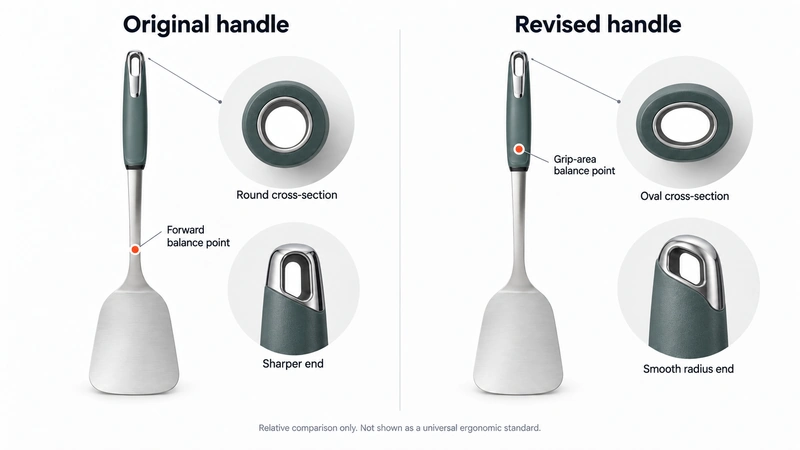
Following this evaluation, l-tools added a continuous-cooking grip review for relevant hand-held products. The test records balance position, handle cross-section, edge transitions, palm support, and observable grip adjustments.
This does not produce a universal definition of comfort. It gives buyers and product developers a repeatable way to identify avoidable strain before approving the design.
A Dry Hand Is Not the Real Kitchen Test
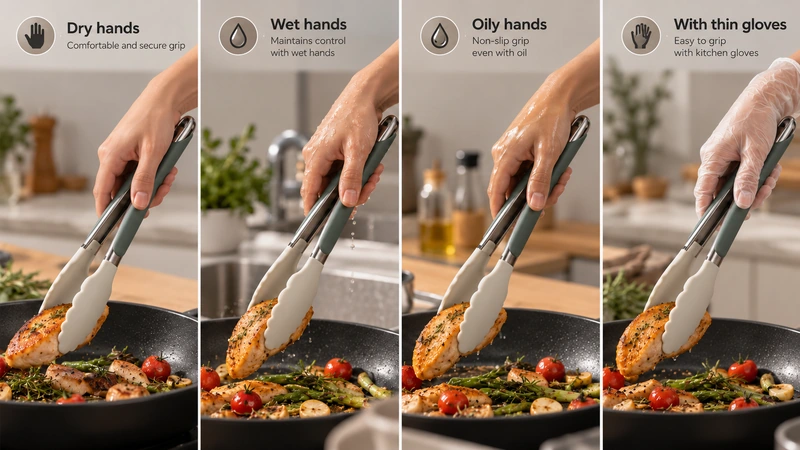
A utensil that feels secure in a clean, dry hand may behave differently around water, oil, flour, and steam. These conditions can reduce control and cause the user to apply more gripping force than the original sample test revealed.
This matters because most kitchen tools are not used under ideal conditions. A pair of tongs may be handled beside a steaming pan, while a turner may be picked up immediately after the user has touched oil or rinsed an ingredient.
The question is therefore not simply whether the handle has a textured surface. Buyers need to determine whether the complete grip system remains stable during the intended cooking action.
That system includes the handle cross-section, surface texture, material hardness, thumb position, and the amount of force needed to operate the tool. Changing one feature without reviewing the others can create a new usability or cleaning problem.
For example, deeper texture may improve resistance to movement, but excessively deep grooves can become harder to clean. A softer grip may initially feel comfortable, but it can still rotate if the underlying handle shape provides little directional control.
The goal is not to add as much texture as possible. It is to achieve adequate wet-condition control without compromising cleanability or normal hand movement.
Grip Texture Must Work With Shape and Material
General guidance from the Occupational Safety and Health Administration identifies prolonged gripping, pressure against the palm, and incorrectly sized hand tools as factors that can increase hand effort. This occupational guidance is not a household-kitchenware standard, but it supports evaluating grip design through force, posture, and repeated movement rather than appearance alone.
A textured surface can support control, but texture should not be treated as an isolated decoration. Material behavior and handle geometry determine whether that texture remains useful once the product becomes wet or oily.
An almost circular handle may still rotate inside the hand even when the surface has shallow ribs. A slightly oval or directional cross-section can provide mechanical resistance to rotation, reducing the need to stabilize the product through grip force alone.
Material hardness also affects the result. If a grip area is too firm, the texture may provide limited contact with the hand; if it is too soft, it may deform excessively during operation.
There is no single hardness or handle shape that works for every kitchen tool. The appropriate combination depends on the task, operating force, user group, cleaning method, and surrounding product structure.
This is why buyers should avoid approving a “non-slip handle” based only on visual inspection. The claim should be supported by observable control under relevant kitchen conditions.
Practical warning signs include:
- Handle rotation: The grip turns inside the palm during opening, lifting, or transferring.
- Extra gripping effort: The tester tightens the hand noticeably when moisture or oil is introduced.
- Repeated repositioning: The fingers or thumb repeatedly move back to the intended control area.
- Slower operation: The user pauses or reduces movement speed to avoid losing control.
- Cleaning conflict: The grip texture improves control but traps residue or becomes difficult to rinse.
These observations do not produce a laboratory coefficient of friction. They provide repeatable behavioral evidence that the handle needs further review.

How Wet-Condition Testing Changed a Tong Handle
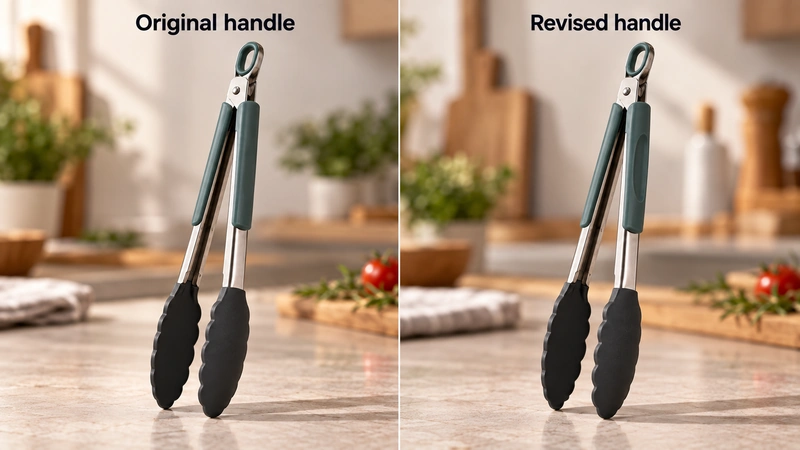
In one tong project assessed by l-tools, the silicone handle felt secure during normal dry-hand checks. The molded texture was visible, and the opening and closing action appeared stable during initial sampling.
The result changed when the team repeated the same food-handling sequence with wet and lightly oiled hands. Several testers tightened their grip, adjusted their thumb position, and experienced rotation of the handle inside the palm.
Because the same reactions occurred under the same operating conditions, the issue was treated as a product-control problem rather than an individual preference. The review focused on the texture depth, silicone hardness, handle cross-section, and thumb contact area.
The handle was not simply made thicker. Instead, the grip zone received a more defined but cleanable texture, while the cross-section was changed to a subtly angular oval that provided greater resistance to rotation.
A small positioning feature was also added near the thumb contact area. The material specification was adjusted within an agreed range so the surface could maintain stable contact without feeling unnecessarily soft during dry use.
After revision, the team repeated the same dry-, wet-, oily-hand, steam-area, and thin-glove operations. The assessment focused on whether testers still needed to grip harder, rotate the wrist, or repeatedly reposition the tool.
The experience led l-tools to make wet-condition grip testing a regular review point for applicable hand-held products. “Non-slip” is no longer treated as a visual description alone.
For B2B buyers, the practical lesson is straightforward: evaluate grip performance under the conditions in which the utensil will actually be used. A dry sample-room check cannot confirm wet-kitchen control.
Comfort Can Change After Repeated Cleaning
A newly manufactured handle represents only the beginning of the product experience. Repeated exposure to water, detergent, heat, drying, and handling can gradually change surface feel, texture definition, joints, and grip stability.
A product may remain structurally functional while becoming less pleasant to hold. For that reason, long-term comfort testing should not stop after confirming that the handle has not cracked, melted, or detached.
This distinction is particularly important when evaluating products described as dishwasher safe. As explained in what “dishwasher safe” really means in kitchenware, material survival alone does not confirm that the complete product will retain its original user experience.
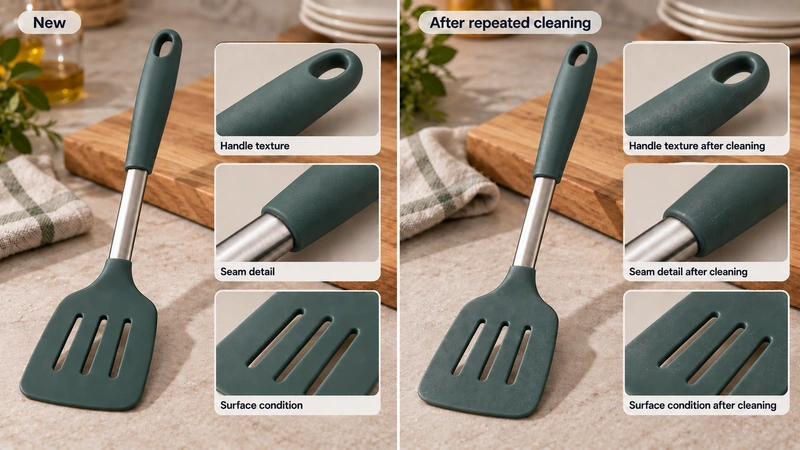
For grip areas, buyers should compare samples before and after repeated cleaning. The review should consider whether the surface has become sticky, rough, polished, loose, or less clearly textured.
The cause should not be assumed from touch alone. A change in surface feel may be connected to detergent residue, material formulation, curing conditions, surface contamination, texture loss, or an interaction between several factors.
The purpose of testing is therefore not simply to report that the handle “feels worse.” It is to separate the observed change from the possible manufacturing cause before deciding how the product should be corrected.
The Approved Sample Must Become a Production Standard
In one silicone-handled turner project reviewed by l-tools, the confirmed sample had a soft, clean surface and a clearly defined grip texture. After repeated cleaning, however, some samples developed a less clean surface feel and weaker texture definition.
Variation also appeared during trial production. Some handles felt firmer than the approved sample, while others felt softer, making the product experience inconsistent across the same batch review.
The team first separated the issues instead of assigning them to one cause. Mold-surface buildup was associated with reduced texture reproduction, while material hardness variation required a review of mixing, curing, temperature, and process consistency.
The sticky feeling observed after cleaning was investigated separately. Cleaning comparisons and process checks were used to review possible detergent residue, surface contamination, curing conditions, and formulation-related factors.
This distinction mattered because mold contamination can explain weaker texture replication but does not automatically explain post-cleaning tackiness. Combining both symptoms under one assumed cause could have led to the wrong corrective action.
The production response included scheduled mold cleaning, an agreed silicone-hardness range, and clearer surface-reference requirements. Retained production samples were also compared with the approved reference sample before release.
Where practical, hardness, surface condition, and texture definition were recorded as controlled specification or inspection items. A batch showing an unexplained difference could then be held for review and corrective action instead of being accepted through subjective judgment.

A Practical Comfort Checklist for B2B Buyers
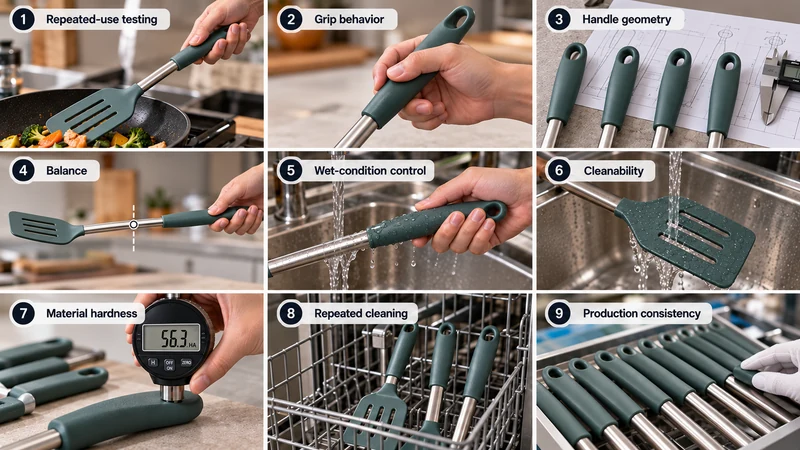
Comfort should be reviewed as a combination of product geometry, material behavior, real-use conditions, and production consistency. No single measurement can represent the entire user experience.
Before approving a sample or trial-production batch, buyers can review the following points:
- Task and duration: Has the product been tested through the complete intended cooking action rather than a short static grip?
- User behavior: Do testers change hands, tighten their grip, reposition their fingers, or alter wrist posture during use?
- Handle geometry: Does the cross-section support the palm and resist unwanted rotation?
- Weight distribution: Does the head pull the product forward or require additional effort to control?
- Contact areas: Do seams, edges, or handle ends create concentrated pressure against the hand?
- Wet-condition control: Does the tool remain manageable with wet or oily hands and around steam?
- Texture and cleanability: Does the grip provide useful control without creating difficult-to-clean recesses?
- Material consistency: Are hardness, flexibility, and surface feel reasonably consistent with the approved sample?
- Cleaning durability: Does the handle retain an acceptable surface, texture, joint condition, and grip after repeated cleaning?
- Production repeatability: Have measurable or reference-based comfort characteristics been added to the product specification?
The checklist does not require every tool to have the same handle dimensions or material hardness. It helps buyers ask whether the chosen design suits the product’s actual task and can be reproduced consistently.
Long-Term Comfort Comes From Controlled Details
Kitchen-tool comfort is not determined by one soft material or an ergonomic-looking handle. It develops from balance, cross-section, edge treatment, surface control, operating force, cleaning durability, and repeatable production.
A short sample-room check may confirm that a tool has no immediate problem. Real cooking simulations and post-cleaning comparisons reveal whether the same comfort remains during repeated use and across production batches.
For B2B buyers, the goal is not to eliminate every difference in personal preference. It is to identify avoidable sources of extra effort and convert vague feedback into design details and inspection points that a supplier can control.
Develop Kitchen Tools for Real Repeated Use
l-tools supports brands and private-label buyers with handle evaluation, real-use testing, material review, sample development, and production-consistency planning. Our wider development process is outlined in the kitchenware resources and support center.
Explore our kitchen utensils for private-label programs or contact l-tools to discuss better grip, balance, cleaning durability, or long-term usability for your next kitchen-tool project.