From a Simple Tool to a Product System
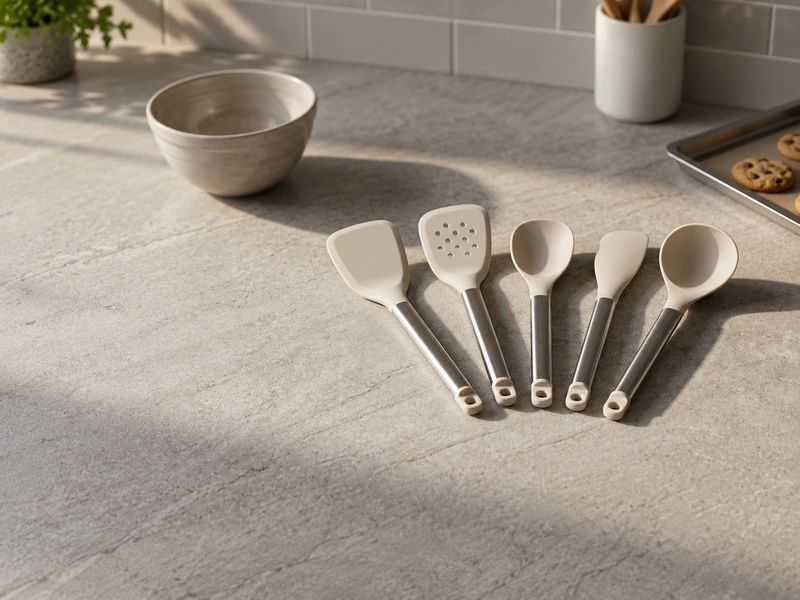
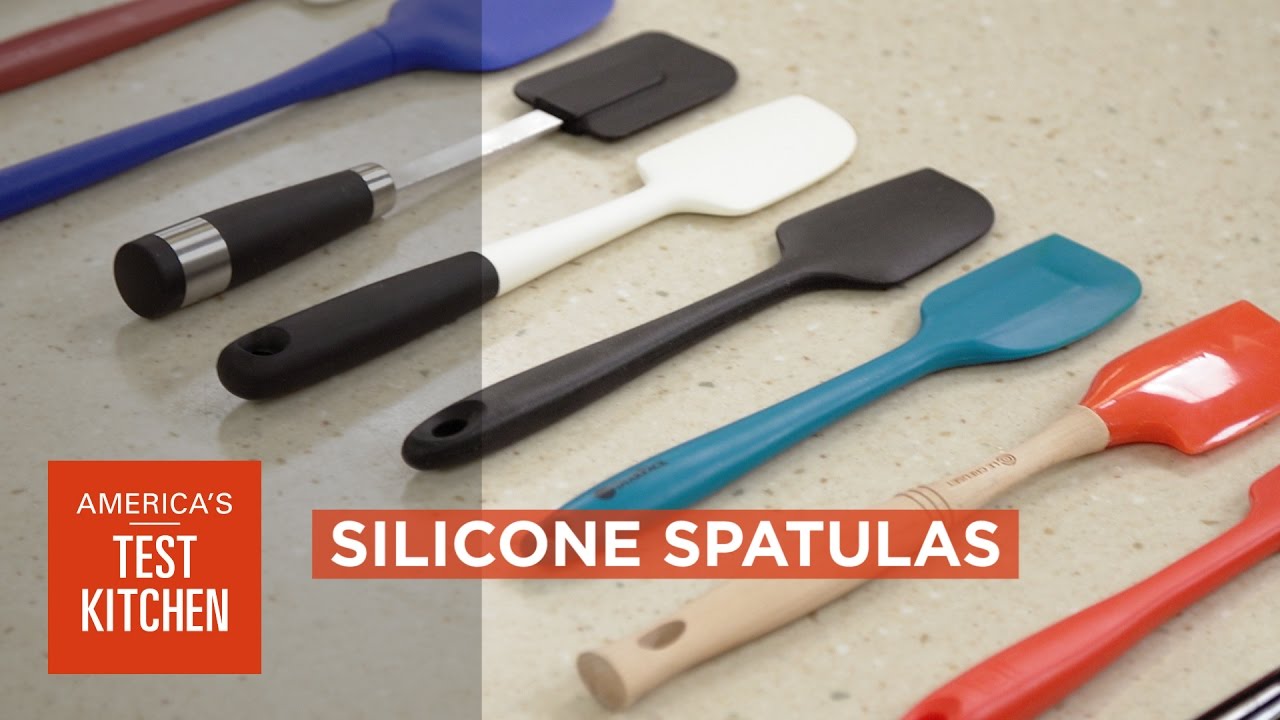
Silicone spatulas may look simple, but similar shapes can perform differently. A tool that folds cake batter well may be too soft for stirring thick sauce or turning food in a hot pan.
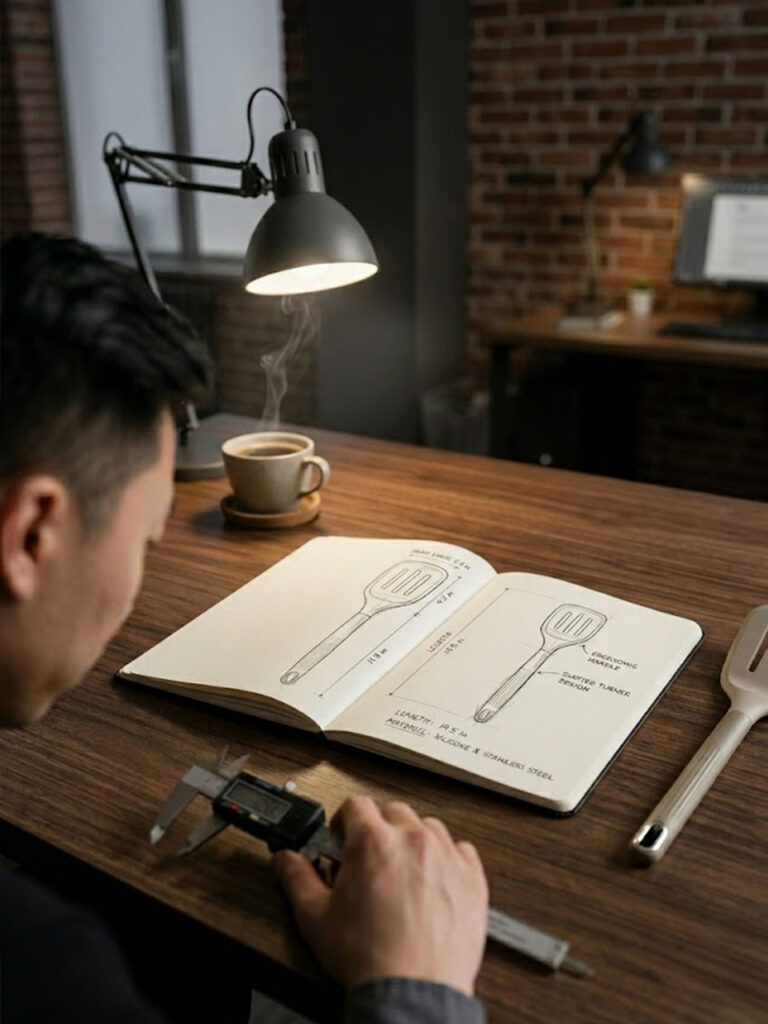
For a B2B buyer, the task is to connect function, structure, materials, and retail positioning before requesting a quotation. Blade geometry, internal support, handle balance, heat exposure, cleaning, and packaging determine whether the product suits its market.
This guide shows how to turn an idea into a specification that can be sampled, tested, and repeated at scale. It helps brands, retailers, importers, and distributors reduce late changes and approve products with clear performance expectations.
Start With Use: Baking, Cooking, or Multipurpose?
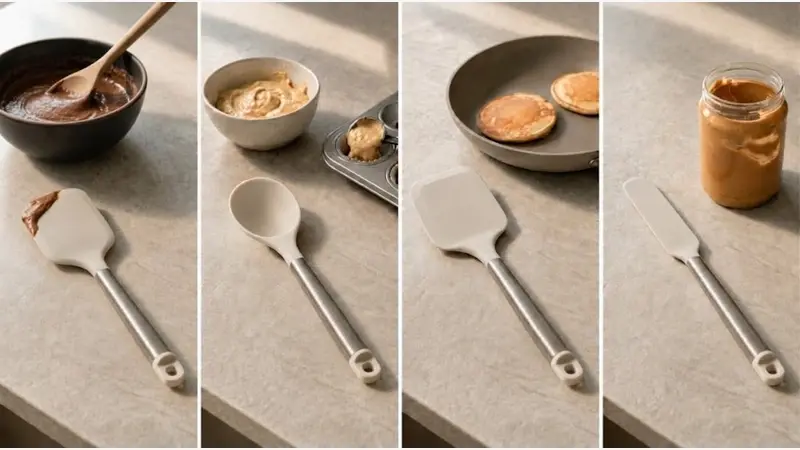
A baking spatula needs controlled flexibility to follow a bowl, scrape the sides, and fold ingredients without excessive force. A thin edge improves scraping, while adequate neck support gives it the ability to handle thick mixtures like brownie batter or cookie dough and clean out every last bit from the bowl without the blade collapsing.
A cooking spatula faces different demands. It also needs to mix ingredients cleanly when combining components before or during cooking. Stirring sauces, scraping cookware, or lifting food requires greater structural support and a construction suited to repeated heat exposure. Treating a baking scraper and cooking turner as the same product can produce an unclear brief and a disappointing sample.
A multipurpose model can work when its intended tasks are compatible, and its versatility only matters when those tasks genuinely overlap rather than conflict. Buyers should identify the food, cookware, motion, load, and temperature before comparing samples. This also helps determine whether the item should be sold alone or within a wider kitchen utensil range.
Head Shape, Edge Flexibility, Handle Length, and Color
A classic scraper combines a broad face with straight and curved edges. A spoonula adds a shallow, spoon-like head that works for mixing and also helps scoop ingredients, while a narrow jar spatula reaches into smaller containers. Turner-style heads need a flatter surface and more structural support. Another thing to check is head size.
Edge flexibility depends on silicone hardness, blade thickness, and core coverage. The edge should follow a mixing bowl or pan, while the central blade transfers pressure without folding excessively.
Handle length should match the cookware and required level of control. Short handles suit small bowls, and smaller or narrower spatulas can better reach the nooks and crannies around the sides; longer handles reach into deeper cookware. Grip diameter, balance, storage, and smooth, easy-clean transitions also affect daily use.
Color comes after function. Neutral palettes may suit premium collections, while brighter colors can support baking or seasonal programs. Buyers should approve physical silicone color samples, because one Pantone reference can appear different across silicone, plastic, metal, and packaging.
Choose Silicone and Verify Food-Contact Compliance
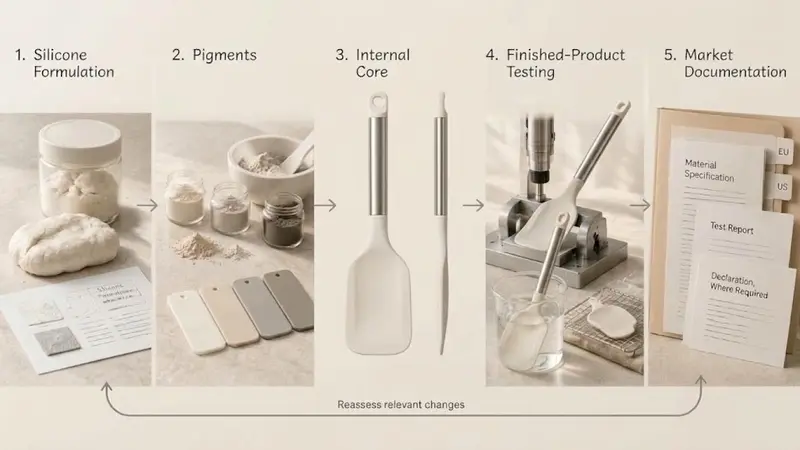
“Food-grade silicone” is a starting point, not a complete specification. Buyers should define the silicone formulation, curing system, hardness, pigment, fillers, processing aids, and any primer used around the internal core.
Hardness must support the intended action without making the edge difficult to control. Documentation should match the approved color and construction, because a report for one base material may not cover every pigment, additive, production batch, or finished product.
Before sampling, create a bill of materials for every food-contact component. This supports document review, laboratory planning, and traceability when the color, core, material grade, or production source changes.
Match Testing to the Destination Market
Testing must follow the destination market and foreseeable use. For the United States, buyers should confirm the regulatory status of food-contact substances under relevant FDA and 21 CFR requirements rather than asking only for an “FDA certificate.”
Products for the European Union must meet the EU food-contact framework and good manufacturing practice requirements. Silicone may also face national or market-specific expectations. For South Korea, buyers should check the current MFDS standards for utensils, containers, and packages.
A useful report review covers the tested material, color, sample, food simulants, contact time, and temperature. The sample should represent the production product. Our silicone utensil safety guide explains why formulation, construction, and intended use should be evaluated together.
Define Heat Resistance by Real Use, Not One Number
A silicone data sheet may state 230°C or 250°C, but that figure does not automatically establish the label for a finished spatula. The core, pigment, handle, bonding method, logo, and exposure time may become the limiting factors. By contrast, judging heat performance based only on experience with an old-style rubber scraper can be misleading, since that material faces higher risk if left in a hot pan.
The test plan should define temperature, time, heating medium, product position, load, cooling, and acceptance criteria. After testing, inspect for deformation, cracking, blistering, tackiness, odor, color change, core movement, and separation.
Field Insight: Dry Heat and High-Temperature Cooking
In our development work, buyers sometimes begin with a broad request such as “heat resistant to 230°C.” We first clarify how the spatula will be used. Some retail models, such as U-Taste, claim baby-bottle-grade material and heat resistance up to 600°F (about 316°C) without deformation. Brands such as HOTEC also mark 800°F (about 427°C), but buyers should still verify performance against the realities of the intended use. Normal stirring differs from leaving it in an empty heated pan or against an overheated pan edge, where local temperature may exceed the intended condition.
High-heat frying, prolonged stir-frying, and caramel preparation deserve separate consideration. A spatula that performs well in ordinary cooking may not suit every extreme-temperature task.
The practical lesson is to connect the temperature claim to a defined scenario and clear care instructions. Finished-product heat-resistance validation provides a stronger basis for specifications, warnings, and packaging than a raw-material number alone.
What “Dishwasher Safe” Should Prove
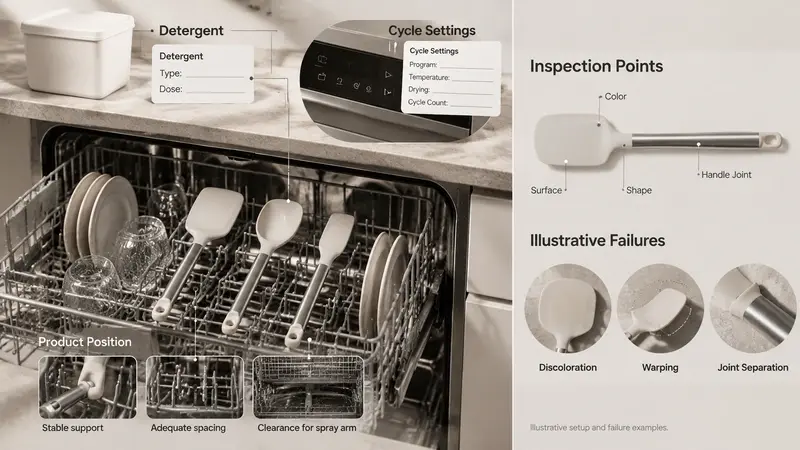
A dishwasher-safe claim should describe the finished product, not only the silicone: all tested silicone spatulas should remain functional after dishwasher cleaning, and the blade, core, handle, joint, logo, and finish must remain acceptably stable after repeated washing.
Define the dishwasher program, water and drying temperatures, detergent, loading position, cycle count, and inspection intervals. Pass criteria may cover warping, cracking, tackiness, discoloration, odor, logo damage, core movement, and separation.
An early visual check is not enough when moisture can collect inside a joint or repeated heat can weaken bonding. The test method and acceptable limits should be recorded in the product specification.
For easier cleanup, they should also be easy to hand wash quickly when no dishwasher is available.
Field Insight: Structure, Detergent, Staining, and Odor
In our development work, a fully overmolded spatula with a properly enclosed stainless-steel or reinforced-plastic core is generally a better dishwasher candidate, but it still needs finished-product validation. A detachable silicone head with a wooden handle has a different risk profile because repeated heat and moisture can damage the wood and joint. This also changes cleaning ease in daily use.
Strong alkaline detergent may dull the surface or change its feel over time. Colored or aromatic food residues can also reveal staining and odor-retention problems that affect consumer acceptance even when the tool remains usable.
Buyers should connect a dishwasher-safe claim to a defined construction, test method, and acceptance standard. Care instructions should distinguish fully overmolded products from detachable or wood-handled designs.
Metal or Plastic Core? Make the Trade-Off Early
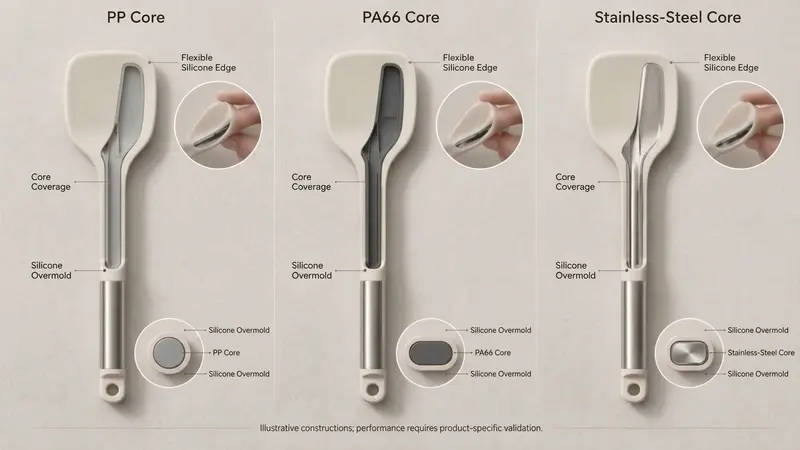
Most standard cooking and scraping spatulas need internal support, but the best core depends on use, price, weight, heat exposure, and desired flexibility. The choice should be made before tooling because it affects geometry and overmolding.
As a market reference, Tovolo Flex-Core spatulas are often described with a sturdy nylon core for added support, and this design is commonly paired with heat-resistance claims up to 600°F. OXO can also be used as a market reference, but different brands may vary in weight, support feel, and how heat ratings are stated, so sourcing decisions should not rely on brand name alone.
PP or PA66 cores can reduce cost and weight while supporting many everyday products. Glass-fiber reinforcement may increase rigidity, but the grade, fiber content, molding behavior, heat performance, and applicable material requirements must be validated.
A stainless-steel core can provide stronger load support and a firmer hand feel. Choosing between options such as 304 and 430 stainless steel should consider corrosion resistance, magnetic properties, processing, and cost. Core edges must be finished and completely enclosed.
Required resilience in a flex core design comes from material grade, thickness, profile, and cold working, with the structure relying on a firmer center and softer edges working together—not simply from calling the insert “spring steel” or claiming it has been quenched. The core should recover after bending without creating a sharp stress point.
Field Insight: Core Selection Also Changes Manufacturing
Plastic and metal cores behave differently during silicone overmolding. Metal transfers heat more quickly and may need different surface preparation, positioning, curing control, or bonding measures. Plastic has its own heat-deformation and adhesion limits.
We evaluate the core as both a performance component and a manufacturing input. A lighter plastic core may suit an entry-level home product, while a well-designed stainless-steel core may support heavier tasks or premium positioning, with each option matched to a different price point and usage load so it can do the intended job consistently.
Buyers should compare samples under the intended load rather than judging stiffness by hand alone. Record the bending direction, applied force, recovery, core position, and any separation so the same requirement can be used during production inspection.
Move From an Approved Sample to Repeatable Production
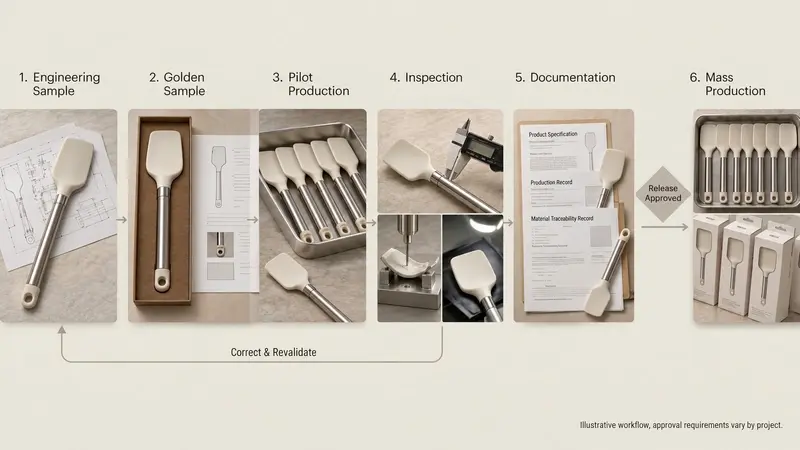
A good sample proves that one product can work. It does not yet prove that a supplier can deliver the same structure, color, flexibility, and finish across a production batch.
Use engineering samples to refine dimensions, blade shape, core position, hardness, grip, weight, and balance. Once these details are confirmed, the approved golden sample should be supported by a written specification rather than used as the only quality reference.
The specification should record materials, dimensions and tolerances, product weight, hardness, color standard, logo, surface finish, packaging, and functional tests. A pilot run can then reveal consistency gaps across different production models or structural variants that individual samples may hide, including core movement, inconsistent bonding, warping, or color differences.
Testing, Quality Control, and Supplier Evaluation
Production inspection should cover incoming materials, first articles, in-process checks, and final packed goods. Key checkpoints include core dimensions and position, silicone hardness, edge flexibility, recovery, bonding, appearance, odor, logo quality, and packaging accuracy.
Supplier evaluation should go beyond a general factory presentation. Buyers should review silicone overmolding experience, tooling control, material traceability and process control, equipment calibration, nonconforming-product procedures, corrective actions, and available testing reports and compliance documents.
When cores, packaging, or specialist processes come from different suppliers, responsibilities must remain clear. Parallel sourcing may reduce capacity risk, but it can also create color, material, tolerance, and accountability gaps unless every component follows one approved specification.
A complete launch file should retain the approved sample, bill of materials, test reports, inspection limits, packaging artwork, care instructions, and batch records. Traceability supports complaint investigation and recall decisions if a problem appears after shipment.
Balance Sets, Packaging, MOQ, and Landed Cost
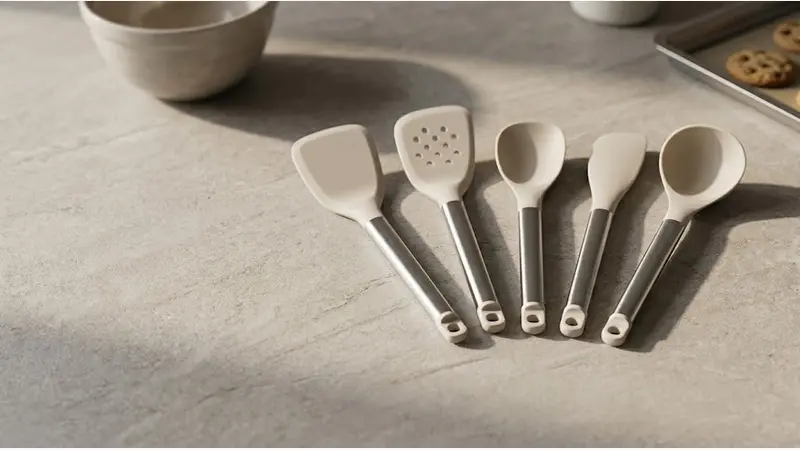
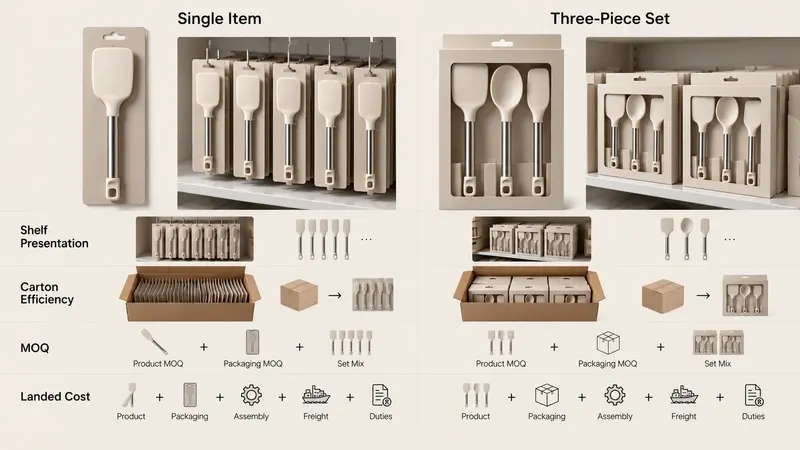
A single spatula works when the function is distinctive or the buyer wants to test demand. In set planning, head size directly affects use: a wider head such as Our Table at about 2.73 inches is better for higher-volume scraping. A narrower head such as GIR at under 2 inches is more useful for reaching nooks. A set is more useful when each piece solves a different task, such as a large scraper, spoonula, and narrow jar spatula. Avoid adding similar sizes only to increase the piece count; our kitchen utensil set development guide explains how function should shape assortment planning.
Packaging must protect the product while supporting its channel. A paper sleeve or hanging card may suit a single item, while a box may provide better protection and communication space for a set. Small packaging changes can alter carton quantity, freight cost, shelf use, and e-commerce damage risk. This is especially important for marketplace channels such as Amazon, where display quality and transit damage can both affect sell-through.
MOQ depends on more than the final assembly quantity. Custom silicone colors, cores, printed packaging, logo processes, and exclusive molds may each have separate component-level minimums. Buyers should confirm these requirements before approving a complex assortment.
Cost planning should work backward from the target retail price and landed-cost ceiling. In e-commerce channels, packaging and the user experience can also influence customer reviews and return rates. Include tooling, product cost, testing, packaging, inspection, freight, duties, warehousing, retailer margin, promotions, returns, and quality reserves.
Existing tooling may suit an initial market test, while a new mold is easier to justify when it creates a meaningful functional or brand difference. Mold ownership, maintenance, storage, and amortization should be agreed before development begins.
Build a Product That Performs Beyond the Sample
A silicone spatula should not be approved by appearance, softness, or a single temperature figure alone. Its performance depends on how head geometry, edge flexibility, silicone formulation, internal support, cleaning conditions, and intended use work together.
The commercial decisions matter as much as the technical ones. SKU structure, packaging, tooling, MOQ, testing, and landed cost determine whether the product can move from an attractive sample to a repeatable retail program.
A stronger approval process begins with the use scenario, confirms the structure and material, tests the finished product, and converts the results into measurable production limits. This helps buyers reduce late redesigns, unsupported claims, inconsistent batches, and avoidable launch delays.
Develop Your Silicone Spatula Range With l-tools
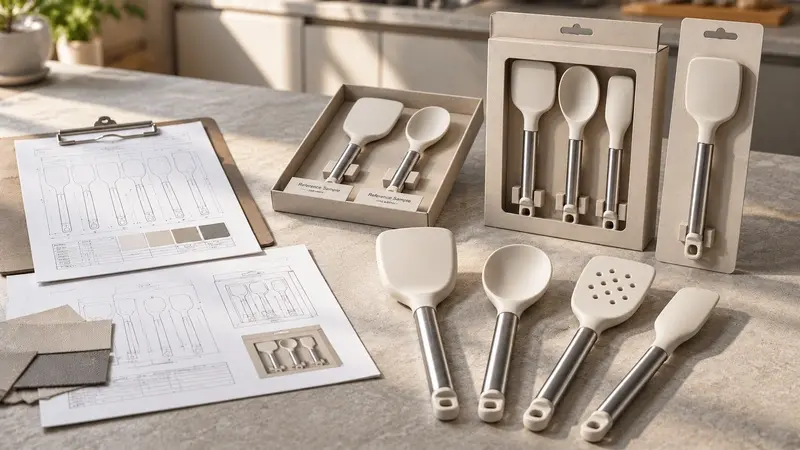
If you are planning a baking, cooking, or multipurpose spatula program, explore our kitchenware OEM/ODM capabilities and share your target market and intended use, reference dimensions, estimated quantity, compliance needs, and packaging direction.
l-tools can support product definition, material and core review, sampling, testing coordination, packaging development, and production control. Whether you begin with an existing structure or a new concept, the next step is to create a practical brief that connects product performance with your channel and price position.
Send us your project requirements to discuss a suitable sampling and quotation route for your silicone spatula range.