
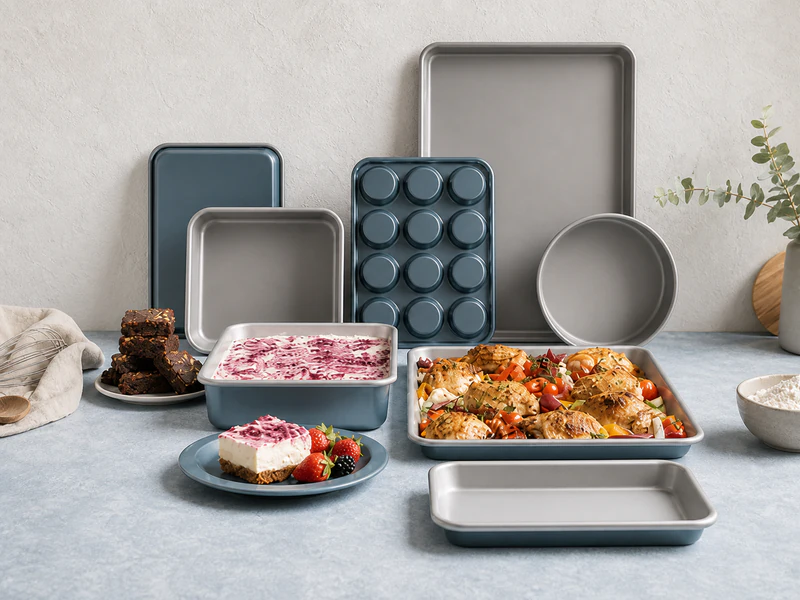
Choosing the best baking pans for a retail range involves more than comparing materials or copying a popular product. The pan must suit its intended consumer, baking tasks, sales channel, price point, and expected service life.
For B2B buyers, these factors eventually become decisions about dimensions, construction, surface treatment, testing, packaging, and cost. A product can perform well in an oven and still fail commercially if it does not fit the target market.
This guide explains how to turn a product concept into a measurable sourcing brief. It will also show you how to compare samples, evaluate suppliers, and reduce avoidable production risks.
Who Is This Baking Pan Guide For?
This guide is intended for retail brands, importers, distributors, private-label developers, product managers, and sourcing teams. It focuses mainly on household retail bakeware rather than pans developed exclusively for industrial bakeries.
Different departments will use the information in different ways. A category manager may define the assortment, while a sourcing manager compares suppliers and a quality team develops inspection criteria.
Before requesting samples, the project team should agree on:
- Target consumer and destination market
- Retail or e-commerce channel
- Main baking applications
- Target retail price and landed cost
- Expected order quantity
- Material and surface preferences
- Packaging format
- Food-contact requirements
- Target launch date
North America, the UK, and the EU should be treated as separate product briefs when necessary. Oven dimensions, familiar product names, retail prices, labeling, and compliance documentation may differ between markets.
The recommended project deliverables include a SKU matrix, sample specification, technical drawing, benchmark report, test plan, inspection checklist, packaging specification, and supplier scorecard. These documents help different teams evaluate the same product against the same requirements.
Buyers can review the current l-tools bakeware and baking tools range when identifying possible product formats. The final range, however, should be based on market needs rather than available catalog items alone.

Baking Pan Market Opportunities and Project KPIs
Bakeware remains commercially relevant because many products support both baking and everyday oven cooking. A rimmed sheet pan, for example, may be used for cookies, pastries, roasted vegetables, and sheet-pan meals.
One market estimate valued the global bakeware category at approximately USD 4.1 billion in 2024 and forecasts it to reach about USD 5.9 billion by 2030. The report identifies home baking, easy-clean products, product quality, and design-led bakeware among the demand signals. Review the bakeware market forecast and methodology.
Market growth does not mean every new pan will succeed. The more useful question is whether the proposed product offers a clear reason to buy within an established and competitive category.
Possible opportunities include a lightweight everyday baking sheet, a more rigid pan for frequent users, a colorful coated collection, or a compact starter set. Each direction requires a different balance of performance, appearance, price, and packaging.
The project should also define measurable KPIs. These may include target landed cost, gross margin, sample approval time, inspection pass rate, packaging damage rate, return rate, on-time delivery, and reorder performance.

Baking Sheet, Sheet Pan, and Baking Pan Terminology
Product terminology should be defined before quotations, drawings, and sample development begin. Baking pan is a broad category that may include baking sheets, cake pans, loaf pans, muffin pans, and other ovenware.
A sheet pan is generally a rectangular metal pan with raised rims on all four sides, which makes rimmed bakeware better suited to a wider range of cooking tasks. The term is often associated with standardized commercial sizes, although many retail products use similar names without following identical dimensions.
A baking sheet is a broader retail term. Depending on the market or seller, it may describe either a rimmed sheet pans or a flatter oven tray.
A cookie sheets often has one or more open or low-profile edges so baked goods can slide off more easily onto a cooling rack. Because terminology varies, a product name should never replace a dimensioned drawing.
How Should Sheet Pan Sizes and Samples Be Defined?
Common nominal formats provide useful category references:
| Nominal size | Approximate external dimensions | Typical positioning |
|---|---|---|
| Full sheet | 26 × 18 in | Commercial ovens and foodservice |
| Half sheet | 18 × 13 in | Large household ovens and commercial use |
| Quarter sheet | 13 × 9 in | Household baking and smaller batches |
| Eighth sheet | 9.5 × 6.5 in | Compact portions and food preparation |
These dimensions are reference sizes rather than automatic production specifications. For example, half sheet pans usually refer to the 18 × 13 in category, but rim shape, corner radius, forming method, and existing tooling can still change the external and usable internal dimensions.
Every SKU specification should record the external dimensions, usable base area, rim height, corner radius, material thickness, finished weight, and tolerance. Buyers should also confirm oven fit, rack fit, packaging size, and nesting clearance.
Sample names should identify the product family, size, material, surface treatment, and revision. A code such as SP-HALF-AL-U-R02 can distinguish a revised uncoated aluminum half-sheet pan from an earlier sample.
The team should separately identify the concept sample, tooling sample, pre-production sample, and approved golden sample. This prevents the factory from using an outdated sample as the production reference.

Which Baking Sheet Material Should Buyers Prioritize?
There is no single best baking sheet material for every retail program. Material selection should consider heating behavior, rigidity, weight, corrosion resistance, surface compatibility, consumer expectations, and cost.
| Material | Main advantages | Points to evaluate |
|---|---|---|
| Aluminum | Lightweight, fast heat conduction, and responsive baking performance | Denting, scratching, rigidity, and surface finish |
| Aluminized steel | Steel rigidity with an aluminum-silicon surface, and it is made of aluminized steel for added durability | Weight, edge exposure, corrosion, and slightly less even heating than pure aluminum |
| Stainless steel | Durable appearance and corrosion resistance | Heat response, weight, and cost |
| Carbon steel | Formable and suitable for many coated products | Corrosion, coating dependence, and deformation |
| Silicone | Flexible, colorful, and convenient to store | Support, browning, odor, and dimensional stability |
In our product-planning experience, consumer positioning often narrows the material choice before technical comparison begins. Silicone may suit a colorful, easy-clean range, while buyers developing products for more traditional baking users often begin with metal constructions.
Aluminum is frequently considered because it combines low weight, effective heat transfer, and accessible cost positioning. Its alloy structure transfers heat quickly, and many products positioned among the best baking sheets use 10-12 gauge aluminum with either a pure aluminum body or reinforced rims to improve rigidity. Adding a suitable nonstick treatment can improve release and cleaning, but it also introduces coating durability, care, testing, and compliance requirements.
The practical lesson is to define the target user and expected product life first. A fashionable easy-clean range and a performance-focused range can both be valid, but they should not automatically use the same material or construction.

Thickness, Weight, and Rim Construction
After selecting the material, buyers should define thickness and finished weight together. These specifications influence rigidity, heating response, forming, freight weight, perceived quality, and unit cost.
Gauge alone is not precise enough because gauge conventions can vary between materials and suppliers. Record thickness in millimeters or inches, together with the permitted production tolerance.
Rim construction also affects pan performance. A rolled or wire-reinforced rim can improve rigidity, but the design should be checked for secure closure, smooth handling, residue traps, water retention, and dimensional stability.
Flatness should be measured before and after heating. A pan that sits flat at room temperature may behave differently in the oven, so the next development stage must turn these construction decisions into test methods and acceptance limits.
Surface Treatment and Coating Strategies for Baking Sheets
Surface treatment affects more than appearance. It can change food release, make the pan easy to clean, corrosion resistance, care instructions, product claims, and expected service life.
Buyers should select a surface system only after confirming the substrate, intended foods, operating temperature, cleaning method, and retail positioning. A nonstick surface is also easy to maintain because it helps residue release during washing, but the coating name alone does not describe how the finished baking sheet will perform.
Should You Offer Both Coated and Uncoated Baking Sheets?
Offering coated and uncoated ranges can make sense when they serve clearly different users. It should not simply create two visually similar products that compete at almost the same price.
An uncoated aluminum baking sheet may appeal to experienced users who value responsive heating and accept natural discoloration or surface marks. Its specification should define acceptable appearance changes, cleaning instructions, and whether acidic or salty foods require additional precautions, while noting that smoother surface finishes are generally easier to clean.
Uncoated carbon steel or aluminized steel requires a different review. Buyers should examine exposed edges, corrosion-prone areas, water retention, and drying requirements, especially around rolled rims and folded structures.
A coated baking sheet can provide easier release, stronger color differentiation, and a simpler cleaning story. However, its performance depends on the substrate preparation, coating formulation, application process, curing conditions, and edge coverage. To prolong service life, most baking sheets should still be hand wash only after use rather than routinely put in the dishwasher.
The product brief should therefore explain why each line exists. For example, an uncoated range may prioritize traditional baking performance, while a colored coated range may focus on convenience, presentation, and coordinated retail collections.

How Should Coating Requirements Be Specified?
Terms such as nonstick, ceramic-coated, PTFE-coated, and enameled are starting points rather than complete specifications. Buyers need to define the performance expected from the finished product.
A coating specification should cover:
- Coating supplier and system reference
- Intended substrate
- Surface preparation
- Target color and gloss
- Coating thickness and tolerance
- Edge, corner, and underside coverage
- Curing conditions
- Maximum intended-use temperature
- Adhesion and abrasion requirements
- Food-release and stain-resistance tests
- Cleaning method and care restrictions
- Applicable food-contact documentation
Different coating systems involve different trade-offs. A PTFE-based system may offer effective release when correctly formulated and applied, while a ceramic system may support different color or positioning requirements. Enamel can provide a durable glass-like surface, but it creates its own requirements for weight, impact resistance, edge coverage, and firing control.
The project team should avoid turning broad material descriptions into unsupported claims. “Ceramic” does not automatically mean more durable, just as “nonstick” does not explain abrasion resistance, temperature limits, or dishwasher performance.
Food-contact compliance and finished-product performance should also be reviewed separately. l-tools applied this principle in a heat-resistance validation project, where material documentation alone could not confirm how the complete product structure would behave under a defined use condition.
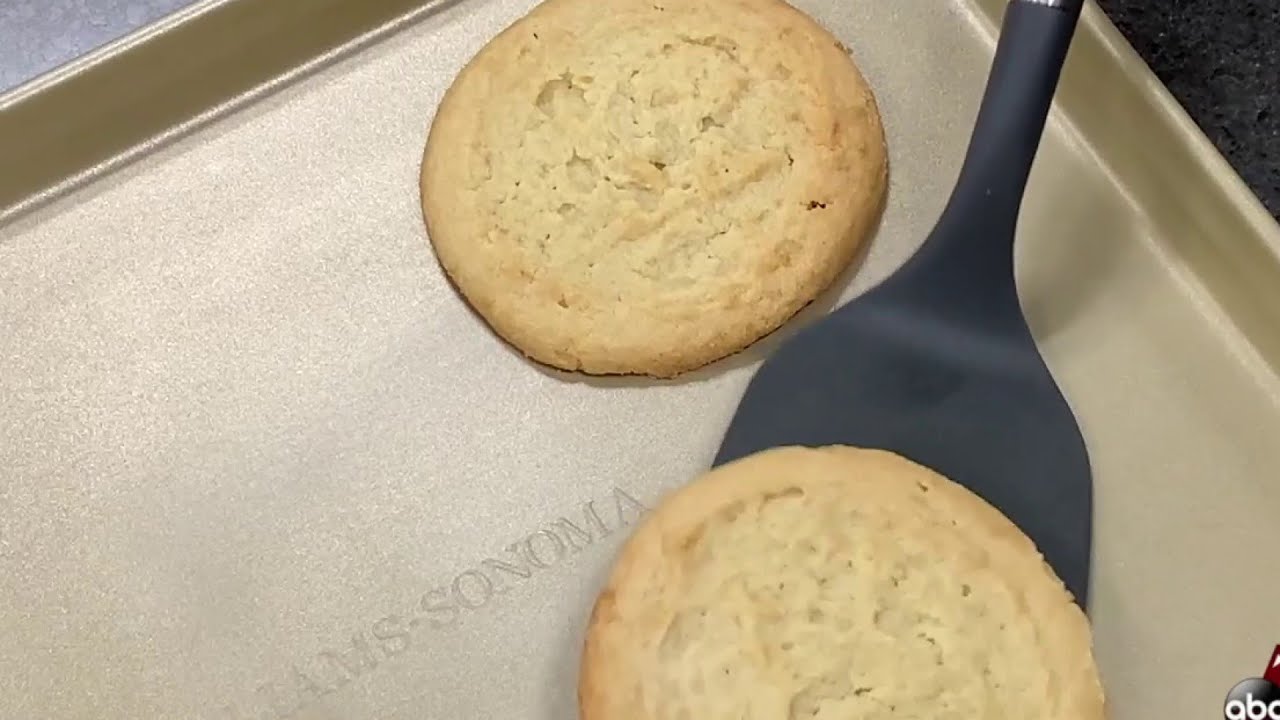
Field Insight: Acid Resistance Is Often Overlooked
In our product development experience, buyers usually remember temperature resistance, scratch resistance, and coating adhesion. Resistance to acidic food contact receives less attention, even when the baking sheet may be used with sourdough, fruit fillings, tomato-based dishes, or marinades.
Acidic ingredients, heat, contact time, scratches, and repeated cleaning can act together. A surface that performs well in a short release test may show different results after repeated exposure under realistic conditions.
For projects involving acidic foods, enamel or an appropriately validated ceramic coating may be considered. However, the final decision should be based on tests conducted on the actual substrate, coating, color, and production process, not on the coating category alone.
Care instructions form part of the solution. Where appropriate, recommend cleaning with hot soapy water and a sponge, while warning against metal utensils, abrasive pads, and hard cleaning tools that may damage the surface. For stubborn stains, baking soda and hydrogen peroxide can help loosen baked on residue.
The buyer takeaway is simple: add acidic-food exposure to the validation plan when it reflects intended use. Do not evaluate coating durability through dry abrasion and high-temperature tests alone.

Design Benchmarking: Nordic Ware Naturals and Holy Sheet
Benchmarking helps buyers understand how established products connect material, performance, appearance, care, and price positioning. It should identify design logic rather than provide a template for copying.
Two useful references represent different product directions:
| Benchmark | Published construction | Published size | Published use and care direction | Product-positioning lesson |
|---|---|---|---|---|
| Nordic Ware Naturals Baker’s Half Sheet | Uncoated formed aluminum with reinforced rim | 17.9 × 12.9 × 1 in exterior | Oven-safe to 500°F; hand washing recommended | Performance-led, traditional, utilitarian |
| Great Jones Holy Sheet | Aluminized steel with colored nonstick coating | 18.5 × 13.5 × 1 in | Oven-safe to 450°F; dishwasher-friendly, but hand washing recommended | Design-led, colorful, easy-clean |
These are manufacturer-published specifications, not independent comparison-test results. Buyers can review the exact product configurations on the official pages for the Nordic Ware Naturals Baker’s Half Sheet and Great Jones Holy Sheet.
The comparison shows two valid routes. One emphasizes uncoated aluminum, recognizable professional-style construction, and a higher published oven temperature; for buyers using Nordic Ware Naturals Baker’s as a benchmark, this pan is typically referenced for even heating and durable everyday use. The other uses coated aluminized steel, color, and easier-clean positioning to create a more lifestyle-oriented retail identity. In the same benchmarking context, naturals baker’s half sheet references are often used to represent a classic formed-aluminum standard, while ware naturals baker’s half can serve as a shorthand buying reference for the same traditional direction; if a nonstick benchmark is also needed, Oxo Nonstick Pro Half-Sheet Pan is the best nonstick option and can be used as a comparison sample.
Neither route should be called universally better. The relevant question is which combination of performance, care expectations, appearance, cost, and consumer identity fits the proposed range.
Build a Differentiation Matrix Before Designing
Record benchmark samples under controlled headings rather than relying on general impressions. The comparison matrix should include:
- External and usable dimensions
- Material and finished weight
- Thickness
- Rim and corner construction
- Room-temperature flatness
- Surface color and gloss
- Coating coverage
- Published temperature limit
- Food-release behavior
- Cleaning method
- Packaging format
- Retail price
- Warranty and claims
Buyers should score each feature for consumer relevance, production feasibility, cost impact, and differentiation value. This separates meaningful product decisions from details that merely increase complexity.
For example, a brighter color may improve shelf recognition but create tighter color-control requirements. A heavier construction may feel more substantial but increase material and freight costs.
Sample review should include these interactions. The l-tools guide to what buyers notice during kitchenware sampling explains how finish consistency, packaging fit, balance, and small production details can influence confidence beyond the basic specification sheet.

Convert Benchmark Findings into an Original Product Brief
The final product should use original, brand-neutral design guidelines rather than reproducing another company’s proportions, colors, surface details, or visual identity.
Define the product’s own corner radius, rim profile, usable base, surface texture, color family, logo position, and packaging presentation. Every visual decision should remain compatible with repeatable forming, coating, inspection, and packing processes.
For coated products, approve a physical color and finish standard alongside the golden sample. The specification should define acceptable color variation, gloss range, visible marks, coating edges, contact points, and underside appearance.
The development team can then compare each revised sample against a stable product brief. This creates a stronger basis for the next stage: controlling stamping, edging, flatness, coating application, and thermal performance during production.
Production and Quality Control for Baking Sheets
An approved sample does not automatically guarantee stable mass production. Buyers must translate it into controlled materials, process parameters, inspection points, and acceptance limits.
Small changes in material thickness, forming stress, rim construction, or coating cure can affect flatness, appearance, and oven performance. Quality control should therefore begin during production planning rather than at final inspection.
Control the Critical Manufacturing Processes
A typical production flow may include material cutting, stamping, corner forming, rim rolling, reinforcing-wire insertion, surface preparation, coating, curing, inspection, and packing. The exact sequence depends on the material and pan construction.
During stamping, the supplier should monitor dimensions, corner consistency, cracking, tool marks, and distortion. Gradual tool wear may change the rim profile or finished dimensions before the difference becomes visually obvious.
Rolled and folded edges require checks for smoothness, secure closure, residue traps, and reinforcing-wire position. Any annealing or stress-relief process should be confirmed according to the alloy, forming method, and product design.
For coated baking sheets, record surface preparation, coating batch, application thickness, curing temperature, and curing time. These variables can influence adhesion, color, coverage, and durability.

Approve a First Article Before Mass Production
A first article should be made with the intended tooling, material, process, and production operators. A handmade development sample cannot provide the same evidence.
The first-article inspection should cover:
- Product identity: SKU, drawing number, and revision
- Material: grade, supplier, thickness, and certificate
- Dimensions: external size, usable base, rim height, and tolerances
- Construction: weight, corner radius, rim profile, and wire position
- Surface: color, gloss, coating coverage, and visible defects
- Performance: flatness, rocking, coating adhesion, and thermal behavior
- Packaging: product fit, protection, labels, and pack quantity
Photographs and measurements should be attached to the report. Every deviation must be corrected, rejected, or formally approved before the production batch proceeds.
Compare the first article with the sealed golden sample, technical drawing, bill of materials, coating reference, artwork, and packaging specification. Together, these documents form the controlled approval package.
The l-tools article on what buyers notice during kitchenware sampling provides additional guidance on assessing finish consistency, packaging fit, and small construction details during sample review.
Sample Baking Sheet Specification
Avoid unclear descriptions such as “heavy duty,” “premium coating,” or “warp resistant.” A usable specification needs measurable requirements and test conditions.
| Specification item | Information to record |
|---|---|
| Product reference | SKU, drawing number, revision, and golden sample |
| Material | Grade, supplier, thickness, and certificate |
| Dimensions | External size, usable base, rim height, and tolerance |
| Construction | Weight, corner radius, rim type, and reinforcement |
| Surface | Coating system, color, gloss, coverage, and thickness |
| Flatness | Measurement positions and acceptance limit |
| Thermal test | Temperature, duration, loading, cycles, and deformation limit |
| Cleaning test | Method, detergent, cycles, and acceptance criteria |
| Packaging | Protection, pack quantity, carton size, and gross weight |
The sheet should distinguish buyer requirements from supplier-reported values. Specifications related to performance, compliance, or marketing claims require supporting documents or test evidence.

Build a Risk-Based Batch Inspection Checklist
Inspection should cover incoming materials, forming, coating, finished products, and packed goods. Sampling frequency should reflect order size, process stability, defect risk, and the quality agreement.
| Inspection stage | Main checks |
| Incoming material | Grade, thickness, surface, and traceability |
| Forming | Dimensions, corners, rims, sharp edges, and flatness |
| Coating | Color, coverage, scratches, particles, adhesion, and cure |
| Finished product | Weight, rocking, appearance, cleanliness, and function |
| Packaging | Separators, corner protection, labels, quantity, and carton condition |
Classify defects as critical, major, or minor before inspection. An incorrect food-contact material, exposed sharp edge, or structural failure cannot be evaluated in the same way as a small cosmetic variation.
Where lot-by-lot attribute sampling is suitable, the buyer and supplier may establish a plan based on ISO 2859-1:2026. The inspection level and AQL should be selected for the product risk, not copied automatically from another order.

How to Test Baking Sheet Warpage
Warpage testing should record both movement during heating and permanent deformation after cooling. As part of an internal comparison protocol to find the best options and find the best baking performance for home-use pan formats, a pan that appears flat at room temperature may behave differently in an oven.
A development protocol may use the following sequence:
- Condition the pan and place it on a verified level surface.
- Record initial rocking, edge lift, and measurement points.
- Heat it at 450°F or the approved maximum-use temperature.
- Use 500°F only when the material, surface, and product claim support it.
- Keep the oven, rack position, loading, exposure time, and cooling method consistent.
- Cool the pan naturally on a level, heat-resistant surface.
- Repeat the agreed number of thermal cycles.
- Measure permanent deformation and inspect the rims, corners, and surface.
Acceptance criteria should define maximum edge lift, diagonal distortion, and permanent deformation. The threshold must reflect the pan size, construction, intended use, and retail claim.
Validate Baking, Coating, and Cleaning Performance
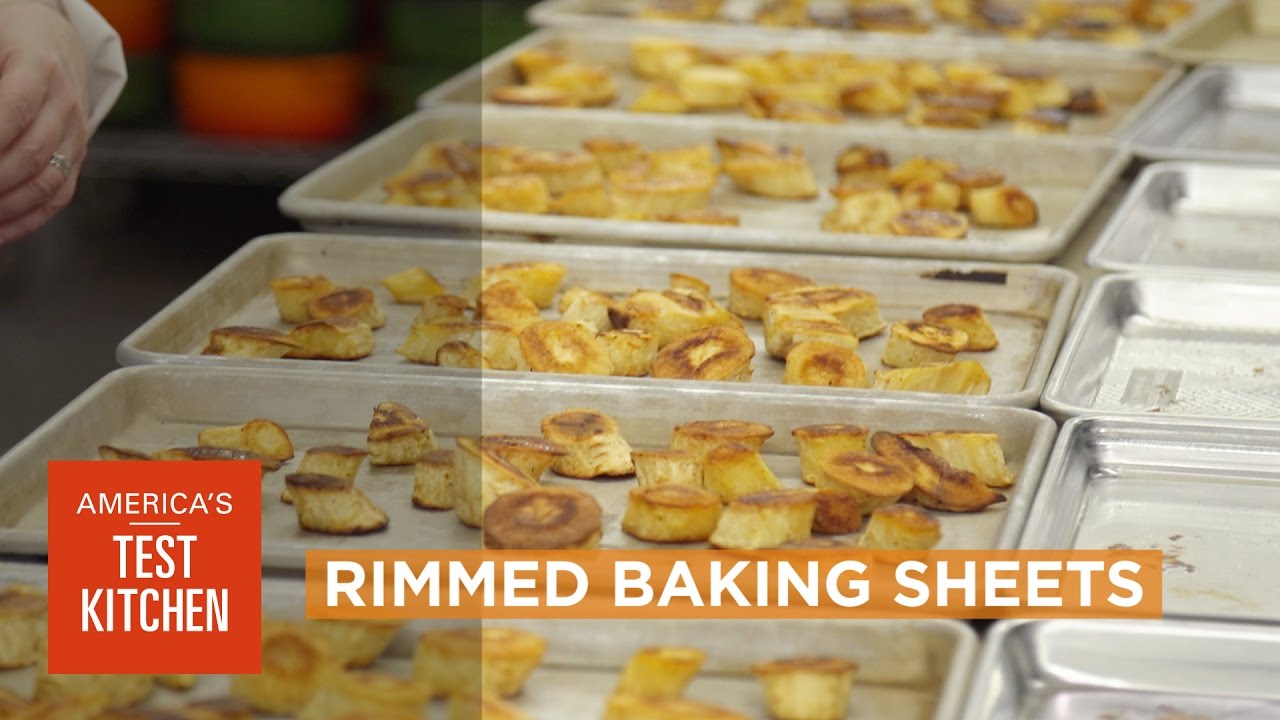
For baking-consistency testing, place equal portions of a controlled test food across the pan, and run both parchment-lined and unlined conditions to see how release changes. Compare edge-to-center browning, release, and repeatability under fixed oven conditions. For example, note how chocolate chip cookies brown, how cookies baked on each surface release, and whether potato wedges crisp evenly. Because light-colored pans help avoid over-browning, record pan color during the evaluation so you can compare results fairly.
Keep the recipe, portion weight, preheating, rack position, baking time, and photography method consistent. Otherwise, the test may measure oven or recipe variation rather than pan performance.
Coating validation may combine adhesion, abrasion, utensil simulation, staining, and food-release tests. ASTM D4060 describes a laboratory abrasion method for coatings on rigid surfaces, but its suitability must be confirmed for the specific coating and specimen.
Flat test panels cannot fully represent formed corners, rims, or areas affected by production handling. Tests on the finished pan should therefore supplement laboratory coating comparisons.
Cleaning reviews may be conducted after agreed intervals such as 10, 25, and 50 cycles. Record the detergent, water temperature, sponge or dishwasher program, drying method, and inspection criteria.
After testing, inspect discoloration, corrosion, loss of gloss, blistering, peeling, retained residue, food release, and deformation. A dishwasher-safe claim needs a defined validation protocol, not an assumption based on the substrate alone.
Control Rework and Nonconforming Products
The quality agreement should state which defects may be reworked and which require rejection. Cracked rims, incorrect materials, severe deformation, or failed coating adhesion will generally require stricter disposition than removable surface contamination.
Every reworked product should be reinspected against the original requirements. Repeated defects require root-cause analysis and corrective action, not continuous sorting at the end of the line.
Compliance, Cost, Packaging, and Supplier Evaluation
A baking sheet is not ready for purchase simply because the sample performs well. Buyers must also confirm market-specific compliance, commercial cost, transport protection, and production capacity.
These workstreams should progress together. A late change to the coating, packaging, or destination market may invalidate previous reports or alter the landed cost and launch schedule.
Build a Market-Specific Compliance Checklist
Food-contact requirements depend on the destination market, material, coating, color, and intended conditions of use. Avoid requesting a generic “international certificate” or assuming one report covers every product configuration.
For the United States, review the regulatory status of each relevant food-contact component. The FDA explains that food-contact substances may include materials used in cookware and nonstick surfaces, and that authorization depends on their intended use. Read the FDA overview of food-contact substances.
For the EU, food-contact articles must comply with the applicable framework, including Regulation (EC) No 1935/2004 and good manufacturing practice requirements. Material-specific and national requirements may also apply. Review the European Commission’s food-contact materials guidance.
The compliance file may include:
- Material and coating declarations
- Alloy or steel-grade certificates
- Coating technical data sheets
- Migration or composition test reports
- Restricted-substance documentation
- Product traceability records
- Labeling and care instructions
- Packaging material declarations
Check that every report identifies the tested material, supplier, color, coating, production site, food type, temperature, and contact condition where relevant. A report for another coating or substrate may not support the final product.
l-tools provides an overview of its available kitchenware compliance reports and testing support. The final test plan should still be confirmed against the exact product and destination market.

Calculate the Full Cost, Not Only the Factory Price
A useful cost model should include material, forming, coating, tooling allocation, branding, packaging, testing, inspection, freight, duties, and expected defect allowance.
Changing material thickness may increase rigidity but also raise product weight and freight cost. A premium coating may support a higher retail position but require additional testing, tighter process control, and a higher MOQ.
Use several cost scenarios rather than one quotation:
| Cost variable | Lower-cost direction | Possible trade-off |
|---|---|---|
| Material thickness | Thinner sheet | Greater denting or deformation risk |
| Surface treatment | Uncoated finish | Different cleaning and appearance expectations |
| Custom color | Standard coating color | Less visual differentiation |
| Packaging | Simple separator | Lower protection or weaker presentation |
| Order quantity | Higher MOQ | Greater inventory exposure |
| Tooling | Existing tooling | Less control over dimensions or differentiation |
The objective is not always to select the lowest unit price. It is to identify which costs protect performance, retail readiness, or supply reliability, and which features do not add enough customer value.
Develop the Product and Packaging Together
Packaging must protect the coating, rims, corners, and flat base through factory handling, export shipping, warehousing, retail stocking, and e-commerce delivery. It should be validated before the product specification and landed cost are finalized.
In our experience, thin carbon-steel baking sheets are especially vulnerable to dents and deformation during drops or stacking. The four corners often become impact points, while pans placed near carton edges or at the bottom of a stack may receive concentrated pressure.
Possible controls include paper corner guards, surface separators, controlled nesting, stronger master cartons, and limits on carton quantity. Increasing steel thickness may also help, but it changes the material cost, product weight, freight, and retail-price calculation.
This means packaging and construction should be tested together. A cheaper pan that needs excessive protective material may not produce the lowest packed cost, while a stronger pan may allow a more efficient carton.
The l-tools article on how packaging affects kitchenware product sales explains how protection, presentation, and retail format influence the complete product decision.
Evaluate OEM and ODM Suppliers Beyond the Sample
A supplier audit should examine relevant bakeware experience, equipment, material control, coating capability, testing, traceability, capacity, and corrective-action processes.
Require prototypes and a small pilot batch before full production when tooling, coating, or construction is new. The pilot should confirm that the supplier can reproduce the approved dimensions, flatness, finish, packaging, and inspection results.
Tooling agreements should define ownership, maintenance, service life, storage, transfer rights, confidentiality, and unauthorized production restrictions. Any exclusive geometry or appearance should also be reviewed for intellectual-property risk.
Finally, assess raw-material lead times, coating availability, peak-season capacity, reorder lead time, and backup arrangements. A supplier that produces an excellent sample but cannot maintain stable delivery may still create a high-risk retail program.

Retail Planning, Acceptance, and Risk Management
A successful baking-sheet range needs a clear role for every SKU. Adding more sizes, colors, or set combinations does not automatically create more value.
Build the assortment around consumer use rather than product count. A practical opening range might combine one everyday half sheet, one compact quarter sheet, and one coated or premium alternative.
Price tiers should represent meaningful differences in material, construction, surface performance, packaging, or warranty. Avoid creating several products whose only distinction is a minor cosmetic change that customers may not understand.
For retail and e-commerce listings, translate technical features into supportable benefits. Instead of saying “premium quality” or “warp-free,” explain the verified construction, intended oven temperature, cleaning method, and suitable baking applications.
The l-tools article on why focused kitchenware sets can offer clearer value provides additional guidance on building assortments around actual use rather than maximum product count.

Define Acceptance, Warranty, and After-Sales Procedures
Before shipment, establish the inspection level, sample size, defect classifications, and release authority. The final inspection should verify product quality, packaging, labels, quantities, and approved changes.
Retain samples from the production batch when traceability or repeat orders are important. A retained sample can help distinguish an isolated complaint from a systemic material or production problem.
Warranty terms should separate manufacturing defects from normal wear, cosmetic changes, misuse, thermal shock, and damage caused by unsuitable utensils or cleaning tools. The care guide and product claims must support the same performance boundaries.
Prepare an after-sales package containing product specifications, care instructions, FAQs, defect photographs, batch records, and complaint forms. These materials help retailers respond consistently and provide useful evidence for corrective action.
The main risks should also be assigned before launch:
| Risk | Preventive action |
|---|---|
| Warpage | Confirm thickness, rim design, forming control, and thermal-cycle limits |
| Coating failure | Control preparation and cure; validate adhesion, abrasion, and cleaning |
| Corrosion | Review substrate, exposed edges, drying instructions, and intended foods |
| Transit damage | Test nesting, corner protection, carton strength, drops, and stacking |
| Compliance mismatch | Match reports to the final material, color, coating, and destination |
| Excessive SKU complexity | Start with a focused range and expand using sales evidence |
| Supply interruption | Approve backup materials or suppliers before urgent substitution |

Five Next Steps for Baking Pan Procurement
The first priority is to define the target consumer, market, channel, applications, and price tier. These decisions provide the basis for every later specification.
Second, confirm the initial SKU matrix, material, thickness, rim, coating, and packaging direction. Third, convert those choices into drawings, specifications, test methods, and measurable acceptance limits.
Fourth, evaluate benchmark and supplier samples under controlled conditions using of our test criteria and the same methods we tested across all samples. Use a pilot batch to confirm that the factory can reproduce the approved construction, finish, performance, and packed-product protection.
Fifth, hold a cross-functional sample review involving product, sourcing, quality, compliance, packaging, and sales teams. Each issue should receive an owner, deadline, and decision of approve, revise, retest, or reject.
Building the Right Baking Pan Range for Your Market
The best baking pans are not defined by one material, coating, thickness, or benchmark brand; what matters is the way the best choice is the one whose consumer positioning, construction, performance, compliance, packaging, and cost work together.
A structured development process helps buyers identify problems before they become production defects or customer returns. Clear specifications, realistic testing, pilot production, documented inspection, and supplier evaluation create a stronger foundation for a focused and scalable retail range.
Start Your Baking Pan Project with L-Tools
If you are developing a new baking-sheet range or reviewing an existing supplier, explore the l-tools bakeware collection and our OEM/ODM development capabilities.
To discuss a project, send us your target market, preferred sizes, material or coating direction, target price range, estimated quantity, packaging requirements, and reference products, including review samples such as Nordic Ware, usa pan, or the caraway baking sheet. serious eats can also be used as one public benchmark source. If helpful, share notes on the caraway baking sheet, caraway baking sheet performance in home kitchens, and any comparison points from sheets we tested. See how to start a kitchenware project with l-tools and request an initial product and sourcing review.