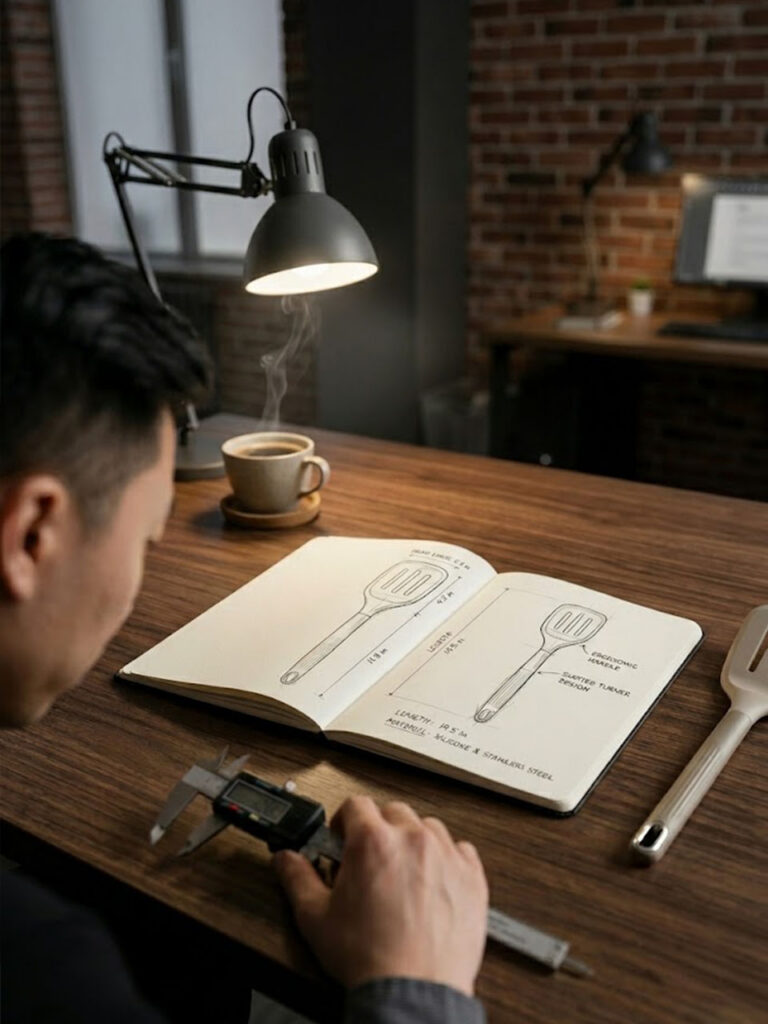

A fish spatula looks simple: a thin blade, an angled head, and drainage slots. For brands and retailers, however, development is not simply a search for the thinnest model.
A thin blade may enter beneath food easily yet flex under load or feel unbalanced. A stronger blade may solve those problems but lose the surface contact and controlled flexibility that make the tool useful.
This guide shows how to turn the intended cooking task into a practical product and sourcing brief.
Why Fish Spatula Development Involves More Than a Thin Blade
Blade thickness is often the first specification buyers compare because it is visible, measurable, and connected to how easily the blade enters beneath a fillet. It does not show whether the blade will recover after bending or remain stable while lifting food.
A successful product needs a balance between entry, support, and control. Blade geometry, handle position, connection structure, finished weight, and cookware compatibility should be evaluated together during sampling.

What Is a Fish Spatula?
A fish spatula, also called a fish turner, has a thin leading edge and an angled, usually slotted blade. The edge helps it enter the space between delicate food and the pan, while the wider blade supports the food during lifting.
Drainage slots allow oil and cooking liquid to escape and can reduce resistance beneath the food. Despite the name, fish spatulas are not limited to seafood and are also well suited for flipping pancakes and burgers, as well as lifting eggs and other foods that require a precise lifting action.
How It Differs From Other Kitchen Turners
A standard slotted turner is often broader and more rigid. A burger turner usually prioritizes surface area and strength, while a silicone turner prioritizes contact with coated cookware.
A fish spatula is defined by the way its features work together, not by the slots alone. This matters in OEM sourcing because two products with the same name may provide very different flexibility, support, and cookware compatibility.

From Home Kitchens to Professional Use
For a home retail model, buyers may prioritize comfortable handling, easy cleaning, cookware protection, and clear packaging communication. A model for coated cookware may use nylon, silicone, or a protected edge, even if that creates a thicker entry profile.
Professional kitchens may place more weight on frequent-use durability, direct control, and simple cleaning. All-metal construction can suit cast iron, carbon steel, or compatible stainless steel cookware, but the final choice still depends on the kitchen’s pans and working habits.
Private-label supply may begin with a mature existing design and add branding or retail packaging.
OEM modification can adjust the handle, finish, dimensions, or material, while ODM development is more appropriate when the required function or structure differs substantially. The right route depends on the performance target, investment level, volume, and launch schedule.
Who This Guide Is For
This guide is written for product managers, retail buyers, importers, distributors, foodservice purchasers, and QA teams. Their shared task is to turn a market opportunity into a product that can be specified, tested, manufactured, and reordered consistently.
The primary markets considered are the United States, Europe, Japan, and Southeast Asia. Instead of assuming that one specification suits every region, buyers should define the market, channel, user, cookware, price position, and compliance needs before comparing samples.
When developing a wider product assortment, buyers should also decide how the fish spatula fits their kitchen utensil range. Our guide to kitchen tools in cookery explains how individual tools can form part of a retail-ready program.
Design Parameters That Shape Fish Spatula Performance
A buyer cannot judge a fish spatula by appearance alone. The most important dimensions interact, so a change that improves entry beneath food may reduce support, recovery, or control elsewhere.
Blade Thickness and Leading-Edge Geometry
The leading edge needs to be thin enough to enter beneath delicate food without pushing or tearing it. In most fish spatula designs, the blade is typically made from stainless steel, and many buyers group these among versatile spatulas used not only for fish but also for eggs, pancakes, burgers, and precise plating. However, the specification should describe more than one thickness measurement because the front taper, main blade body, steel grade, and forming process all influence stiffness.
Buyers should define where thickness is measured and establish limits for flatness, smoothness, and burrs. An edge that is thin but wavy may contact the pan unevenly, while an unfinished edge can affect cookware and user safety.
A practical sample review should compare entry performance with support under load. If reducing thickness causes excessive twisting or permanent deformation, the design may need a different taper, material condition, reinforcing geometry, or blade length rather than another simple reduction.
Blade Angle and Surface Contact
The angle between the blade and handle affects wrist position, approach, and surface contact. Too little offset may force the user to lower the hand toward the pan, while too much can make entry and lifting feel less direct.
There is no single ideal angle for every fish spatula, but a common industry reference for the blade edge is a blade angle in the 70–74° range; buyers should still begin with a reference sample, then compare prototypes on representative flat pans while keeping the blade length, handle height, and intended food in view, since not all products perform exactly the same.
The approval criterion should describe the required action. For example, the front edge should reach beneath a fillet without an awkward wrist position, and the supporting area should remain close enough to the pan to lift the food evenly. As a brand reference, Wüsthof uses a 72° angle that is often treated as an easy-entry benchmark.

Flexibility, Load Capacity, and Product Balance
Flexibility allows the blade to follow the pan, but the blade on the spatula also needs good flexibility with enough support to stay stable under load, because flexibility without support is not useful. The blade also needs to carry the expected food, resist unwanted twisting, and return to its original shape after pressure is removed.
In our sample work, we have seen thin heads become difficult to control when the weight relationship between the handle and blade was not considered. Once food was added, the head dropped and the tool lost balance even though the unloaded sample looked acceptable.
We therefore assess thinness together with representative loads and the user’s hand position. A suitable sample should enter beneath the food, support it during lifting, and recover without a permanent bend.
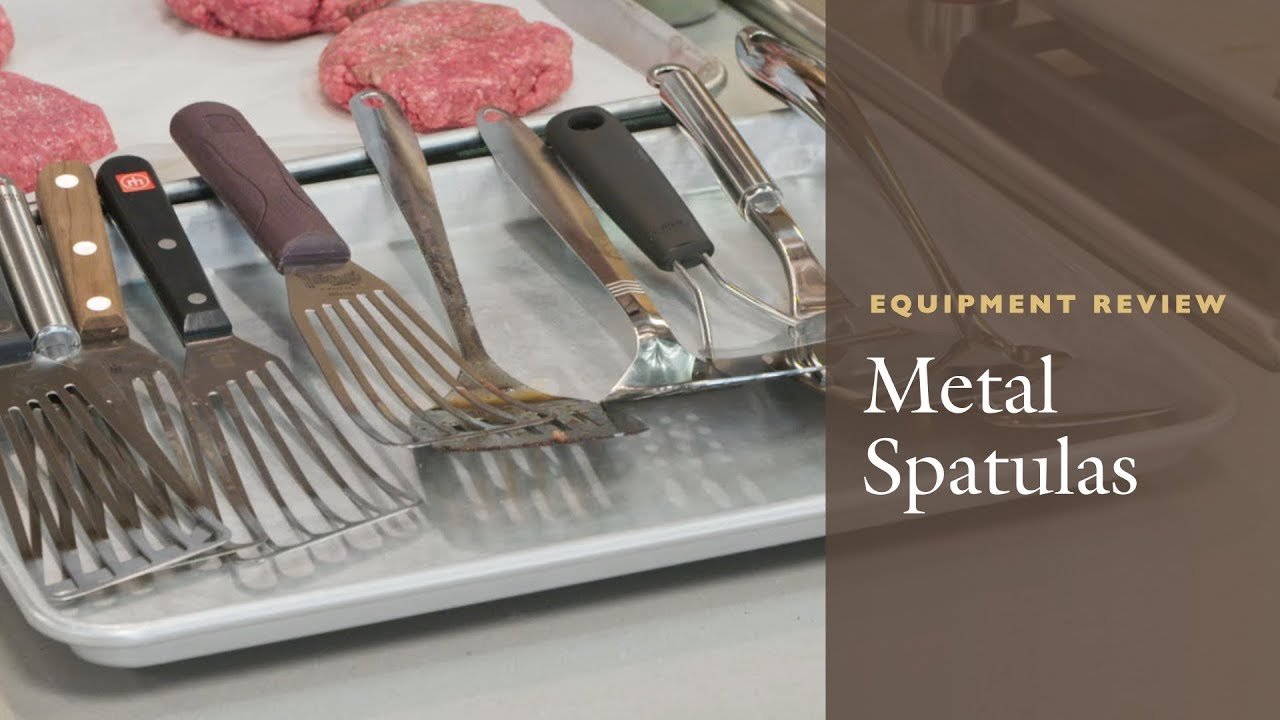
Handle, Slot, and Size Decisions
The blade receives most of the attention, but the handle, drainage slots, and overall dimensions determine whether the product remains comfortable and controllable in its intended setting.
Handle, Slot, and SKU Planning
A handle specification should cover usable grip length, cross-sectional shape, surface texture, connection strength, and behavior with wet or oily hands. For surface texture, this spatula should have a handle that feels smooth yet remains slip resistant, especially for control with wet or oily hands. Home users may prioritize comfort, while professional users may give more weight to secure grip and repeated-use durability.
Slots should drain oil without removing too much supporting area. Instead of applying one universal maximum width, buyers can test the proposed slot size with the smallest intended food and check the edges for smoothness after punching, molding, or finishing.
A blade length of approximately 6–7 inches can serve as a development starting point, not a universal standard. A shorter SKU may suit small pans and lighter foods, while a longer professional version may provide reach but require new balance, torsion, and load tests. As a comparison point, OXO uses an 8-inch blade that better suits larger foods, but that added length also raises the bar for balance and load test validation.

Matching the Blade to the Cookware
An all-metal blade can work well on cast iron, carbon steel, and suitable stainless steel cookware because it can maintain a thin entry profile. Edge finish and normal use still matter, so metal compatibility should not be presented as permission to scrape every surface aggressively.
For coated cookware, buyers may consider nylon, silicone, or silicone-edged metal structures. Each option involves a trade-off among surface protection, entry thickness, heat performance, wear, bonding stability, and manufacturing complexity. If you are prioritizing service life over convenience, manual cleaning is the gentler option and may help the fish spatula last longer.
A silicone edge may protect the contact area, but the front profile can become thicker. Buyers exploring this route can review our guide to OEM silicone spatula development before defining materials and tests.
If the fish spatula will join a coordinated assortment, its handle, color, material language, and price role should fit the overall kitchen utensil set development. The next stage is to convert these design choices into material, compliance, sampling, and quotation requirements.
Materials, Compliance, and the Development Route
Once the function is clear, buyers must define materials, compliance, and the sourcing route. These choices affect performance, tooling, testing, MOQ, and production consistency.
Selecting Stainless Steel Blade and Handle Materials
For a metal blade, the specification should identify the stainless steel grade, thickness, surface finish, and any forming or heat-treatment conditions that affect flexibility. “High-quality stainless steel” is too broad for quotation or inspection.
High-carbon or another specialized stainless steel is not automatically superior. It still needs to deliver the required recovery, corrosion resistance, edge stability, and manufacturing consistency.
Handle materials create separate trade-offs. POM can provide dimensional stability and a consistent molded finish, while wood requires controls for moisture, coating, color variation, and care.
Silicone or overmolded grips can improve comfort and wet-hand control, but bonding, odor, heat exposure, and separation still need evaluation. An all-metal handle may simplify the structure, although heat transfer, grip, weight, and balance remain relevant.

Planning Food-Contact Compliance
Compliance should begin with the finished construction and intended use, not with a certificate name. Identify every food-contact component, expected temperature, food type, contact duration, and destination market before confirming the test plan.
In the United States, the FDA guidance on food-contact substances explains that this category can include cookware and food-preparation surfaces. Regulatory status depends on the substance and its conditions of use, so “FDA approved” may not adequately describe a finished product.
For Europe, the EU food-contact material legislation includes a general framework, good manufacturing practice requirements, and material-specific measures. Buyers may need different supporting evidence for plastic, metal, and wooden components, while national rules may also apply.
For South Korea, buyers can refer to the MFDS standards and specifications for utensils, containers and packages. A market-specific review is necessary because US, European, Korean, Japanese, and other requirements are not interchangeable certifications.
The tested sample should match the production material, color, structure, and process. A change to the resin, pigment, coating, adhesive, or supplier may require the supporting evidence to be reviewed again.
Choosing Between Private Label, OEM, and ODM
Private label is practical when a mature product already meets the required function and market conditions. Customization usually focuses on branding, color, labels, and retail packaging.
OEM modification keeps the main structure while changing a handle, finish, dimension, material, or package. Buyers should still review its effect on tooling, weight distribution, recovery, and existing test results.
ODM is more suitable when the required function or brand structure differs substantially from available products. It usually involves greater investment in design, prototyping, tooling, testing, and approval.

Development Stages and Sample Approval
A practical sequence moves from the product brief to feasibility review, drawings, functional prototypes, revised samples, packaging samples, and a pre-production sample. Timing should reflect tooling, materials, testing, and packaging complexity rather than one fixed lead-time promise.
Each approval should record the material, dimensions, weight, finish, color, branding, and functional results. A signed or golden sample can provide the reference for production inspection.
When the construction changes after testing, the supporting evidence should be reviewed again. An earlier report should not automatically support a materially different production version.
Cost Drivers, MOQ, and Quotation Logic
Steel usage, blade thickness, forming, heat treatment, grinding, handle construction, assembly, branding, packaging, and testing can all affect price. Buyers should compare the complete commercial cost, not only the unit quotation. For procurement reference, Winco can serve as a practical budget option, showing that a lower-cost fish spatula can still deliver acceptable performance when cost control is a priority.
MOQ depends on the customization level. Adding a logo to an existing model may require a different quantity from producing a custom color, changing a molded handle, or creating new tooling. Victorinox is also widely used in professional kitchens, making it a useful benchmark when balancing price and durability.
Tiered pricing should reflect realistic material and production batches. Tooling, testing, inspection, packaging development, spare units, and freight volume should remain visible in the comparison.
Turning the Product Brief Into a Useful RFQ
A useful RFQ should state the market, channel, cookware, food application, construction, dimensions, quantity, packaging, compliance needs, target cost, and launch date. Reference samples or drawings should clarify the function, not replace a written specification.
Buyers can review the l-tools OEM/ODM ordering process and our kitchenware product development capabilities before preparing the brief. The next step is to verify the design through repeatable tests and production controls.
Turning an Approved Design Into Repeatable Performance
A fish spatula sample should be approved for repeatable performance, not only dimensions and appearance. Testing should connect the intended cooking action with observations that both factory and buyer can reproduce.
Surface-Conformity and Recovery Checks
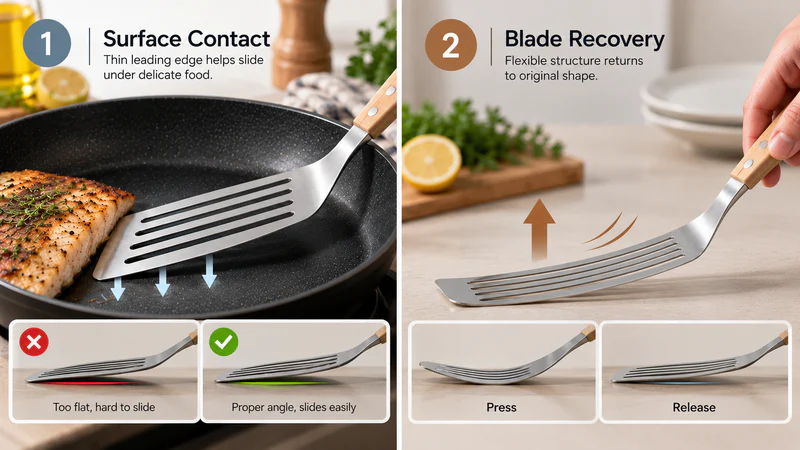
Place the fish spatula on a level surface or in a flat-bottomed pan. With the head touching the base, apply controlled forward and downward pressure to the handle and observe whether the blade settles evenly against the surface. This is also a practical point to verify whether the leading edge and blade angle stay within the intended 70–74 degree design range during the surface-conformity check.
In our sample evaluations, this action often reveals differences that drawings cannot show. Two heads with similar dimensions may provide noticeably different contact, resistance, and control through the handle.
We also place the product flat, secure the handle, and press vertically on the thinnest part of the leading edge. After release, the blade should return promptly without permanent deformation under the agreed condition.
The defined method should record the pressure point, force or displacement, holding time, and acceptance result. Otherwise, “good flexibility” remains subjective rather than repeatable.
Load, Torsion, and Durability Tests
A load test should represent the expected food and movement, including common cooking tasks such as sliding under pancakes, lifting burgers, and not only simulating fish. Observe head drop, sideways twisting, handle rotation, connection movement, and recovery while entering beneath, lifting, turning, and transferring the load.
One heavy lift does not represent repeated kitchen use. A cycle test can repeat the agreed load and motion, with inspections for deformation, looseness, cracks, or changes in handling.
The fixture, grip position, load, cycle count, and failure criteria should appear in the specification. The objective is a consistent comparison between samples and production batches, not an impressive number without context.
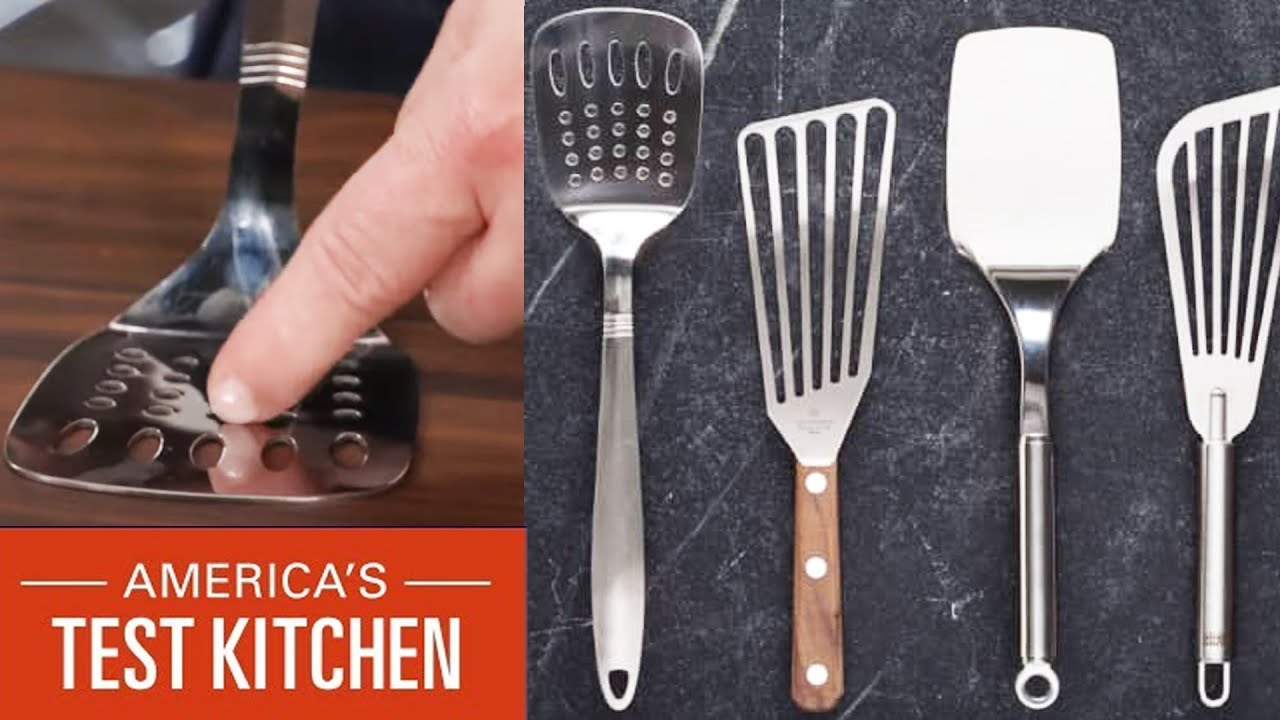
Heat, Corrosion, and Cleaning Validation
Heat testing should cover the complete product structure, including the blade, handle, joint, coating, adhesive, and overmolded areas. A material declaration alone does not show how these components behave together.
The temperature, medium, duration, contact area, and acceptance criteria must match the intended claim. Our heat-resistance validation for silicone kitchen tools shows why food-contact documentation and finished-product heat performance are connected but separate workstreams.
Corrosion testing should reflect the steel, finish, cleaning method, and expected environment. Define how staining, rust, discoloration, pitting, and finish changes will be assessed instead of choosing an arbitrary duration.
Dishwasher and manual-cleaning tests should check warping, corrosion, coating changes, loose joints, color change, odor, and logo durability. The spatula should be cleaned promptly after use so food residue does not harden around slots, joints, or the edge. Wooden handles need separate care instructions because repeated soaking or dishwasher exposure may not match their intended use. Manual care guidance should recommend mild soap and water while avoiding steel wool or other overly abrasive scrubbers.
Production Controls for Metal and Nylon Heads
The thinnest metal edge is vulnerable to waviness, uneven grinding, and burrs. In our production experience, it may require a rigid support fixture and controlled pressure through progressive grinding stages.
Final inspection cannot always correct an unstable process. Process control should cover the fixture, abrasive sequence, grinding pressure, edge profile, and operator method before unevenness spreads across the batch.
Nylon heads can show similar visible problems for different reasons. Mold temperature, venting, gate design, raw-material moisture, shrinkage, and any validated reinforcement can affect flatness and dimensional consistency.

Inspection, Golden Samples, and Release Standards
Incoming inspection should verify material identity, thickness, color, and supporting documents. In-process checks can focus on forming, molding, grinding, and assembly while defects remain practical to correct.
Final inspection should cover dimensions, weight, angle, edge flatness, burrs, slot finish, symmetry, surface condition, flexibility, load behavior, connection strength, logo, and packaging. Written criteria and the approved golden sample should work together as the release reference.
A golden sample is not enough when an important characteristic is hidden or functional. Test methods, tolerances, sample sizes, and results should remain traceable to the production lot.
Production records should connect material batches, process checks, inspection results, and final cartons. Traceability helps isolate a problem when one material or production lot differs from the rest.
Supply Chain and Delivery Control
Material lead times, custom colors, handles, and packaging can affect the schedule. For a first order, in-process confirmation before final assembly can reduce the risk of discovering a repeated defect after the batch is complete.
Long-lead-time materials and custom packaging may justify planned safety stock, but the quantity should follow a reliable forecast. Excess inventory can become unsuitable if the specification changes before a reorder.
Before shipment, confirm inspection status, spare-unit policy, carton markings, transport protection, shipping terms, and destination documents. Delivery planning should follow the actual market and order, not one standard logistics assumption.
Preparing the Fish Spatula for Market
Development is not complete when the functional sample passes. Packaging, claims, care instructions, inspection documents, and delivery details must reflect the approved construction.
Packaging, Pricing, and Product Listing
A fish spatula may use a hang card, paper sleeve, color box, display pack, or e-commerce package. The choice should balance protection, shelf presentation, packing efficiency, and freight volume.
Environmental claims need evidence from the actual package. Explain measurable material reductions or recyclability instead of relying on the broad term “eco-friendly.”
Pricing should consider the complete commercial cost. Tooling, testing, inspection, packaging, freight assumptions, and channel margin can determine whether a SKU fits its target position.
There is no universal retail price for every market. Buyers should study the intended channel and work backward from the target price before approving materials and customization.
Product images should show the leading edge, blade angle, slots, handle connection, and intended cookware. Listing copy should distinguish metal and non-stick-compatible versions without exceeding the supporting evidence. For amazon listings, recommendations should align images, key specs, price presentation, and verified claims with the channel’s reviews-driven shopping behavior, since reviews often shape trust more than brand messaging alone. A listing may also present different options and summarize relevant reviews, but unsupported variations or add-on choices should not create buyer confusion.
Care Guidance and Buyer FAQs
Care instructions should tell users to clean and dry the tool after use, especially around slots and joints; hand-washing is usually gentler than a dishwasher and may help extend service life, though care still varies by material. A thin blade should not be used for prying, cutting, or excessive loads, because this is a precision tool rather than a heavy-duty lever.
Which version suits non-stick cookware? Nylon, silicone, or silicone-edged options may work, but buyers should compare entry thickness, heat performance, wear, and coated-surface test results.
Is an all-metal model better for professional kitchens? It can offer a thin profile and direct control, but cookware, heat transfer, grip, cleaning, and workload still matter.
How should blade length be selected? Consider pan size, food, working distance, load, and balance; a 6–7-inch blade is a starting reference, not a universal answer.
Wooden handles normally need separate hand-washing and drying instructions. Dishwasher-safe, heat-resistant, corrosion-resistant, and non-scratch claims should remain within verified conditions.
Launch Preparation Checklist
Before release, the project team should confirm:
- Product approval: specification, drawing, tolerances, final sample, and golden sample.
- Compliance evidence: material declarations, applicable reports, and traceability records.
- Performance evidence: flexibility, recovery, load, heat, corrosion, cleaning, and connection checks.
- Retail materials: packaging artwork, barcode, images, claims, warnings, and care instructions.
- Production control: inspection plan, release criteria, spare-unit policy, and packing method.
- Delivery control: production dates, inspection status, shipping terms, markings, and destination documents.

Bringing the Product Decisions Together
A good fish spatula is not defined by thinness alone. Blade geometry, flexibility, load capacity, balance, edge finishing, handle design, cookware compatibility, and production control must work as one system.
The practical sequence is to define the application, select the construction, document measurable requirements, test representative samples, and protect the result during production. This creates a product that can be used confidently, inspected consistently, and reproduced for reorders.
Planning Your Fish Spatula Project
l-tools supports kitchenware brands and retailers with private-label, OEM, and ODM development, including specification review, sampling, packaging coordination, testing support, production follow-up, and quality control.
You can explore our kitchen utensil range or review the information needed to start a kitchenware quotation. Share your market, cookware, reference product, quantity, materials, packaging, testing requirements, and launch schedule so our team can assess a suitable development route.