
Introduction
A vegetable peeler looks simple, but a small change in the blade, handle, or assembly can alter the entire user experience. A model that looks acceptable in a sample room may remove too much food, slip in wet hands, or age poorly after repeated cleaning.
For brands and retailers, the challenge is not simply finding another peeler. It is defining a product that fits the target market, retail price, sales channel, and expected use.
This guide connects product selection with testing, compliance, customization, and mass-production decisions. It begins with the commercial context behind this everyday tool.
The Market Opportunity Behind a Small Kitchen Tool
Reliable figures for manual vegetable peelers alone are limited. Some reports combine handheld products with electric or industrial peeling equipment, so market scope must be checked before using any headline number.
As a broader reference, the Grand View Research U.S. kitchenware report values the U.S. kitchenware market at approximately USD 9.39 billion in 2025. It also cites consumer research indicating that peelers are found in more than 80% of U.S. kitchens.
The report says supermarkets and hypermarkets represented about 40.25% of U.S. kitchenware revenue in 2024. It forecasts online kitchenware sales to grow at a 6% CAGR from 2025 to 2033, showing the commercial importance of both physical retail and e-commerce.
These numbers describe the wider kitchenware category, not the peeler market itself. Their useful message is broad household adoption and access to several established retail channels—not a guaranteed sales forecast for one SKU.
Where Brands Can Look for Demand
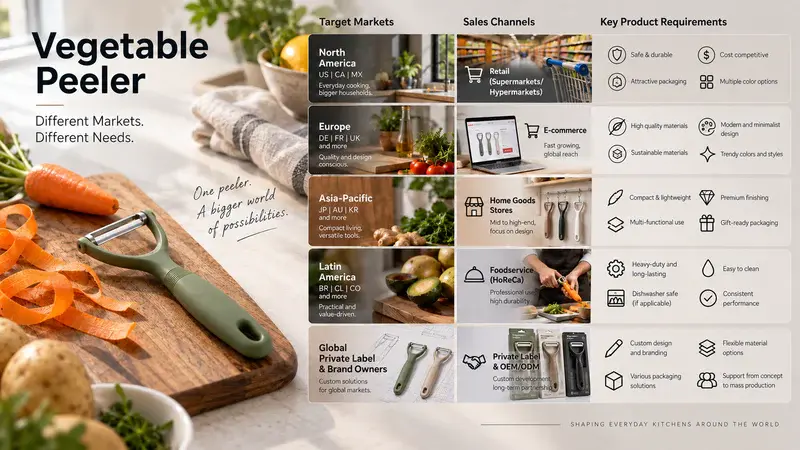
The United States offers the clearest starting point in the available evidence. For an export program, a practical screening list may also include Canada, the United Kingdom, Germany, France, Japan, South Korea, Australia, and selected Southeast Asian markets.
That list should not be treated as a fixed ranking. Buyers still need to compare each country’s retail price levels, cooking habits, packaging expectations, food-contact rules, and preferred sales channels before choosing a specification.
Supermarkets normally require clear value, compact packaging, and easy shelf comparison. Specialty stores can support stronger materials or distinctive ergonomics, while e-commerce creates greater pressure for visual differentiation, review performance, and convincing demonstration content.
What Is a Vegetable Peeler?
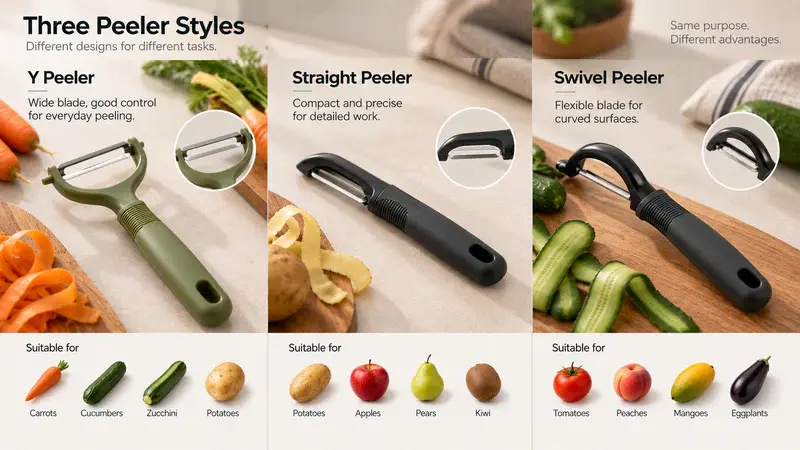
A vegetable peeler is a handheld preparation tool that removes the outer skin of fruits and vegetables while controlling how much edible material is lost. The Academy of Nutrition and Dietetics’ guide to peeler types distinguishes straight, Y-shaped, swivel, and julienne formats.
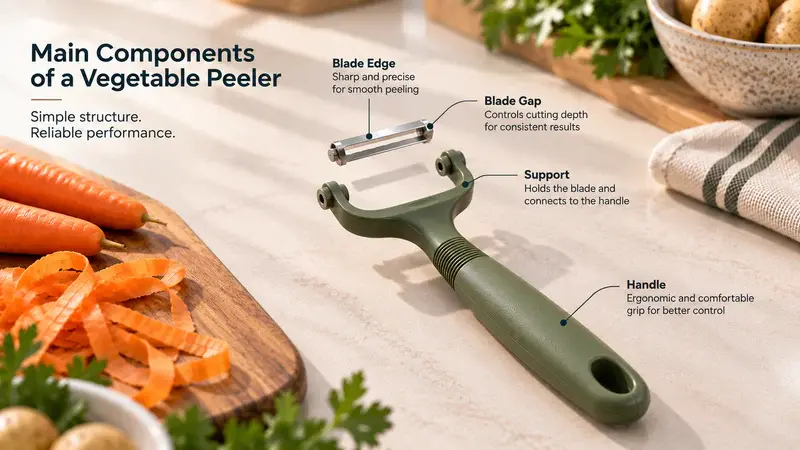
Most peelers combine a cutting edge, blade opening or guide surface, support structure, and handle. Some also include an eye remover for blemishes on potatoes and similar produce.
Blades may use stainless steel, carbon steel, or ceramic, while common handle materials include PP, ABS, TPR, silicone, stainless steel, and wood. Actual performance comes from the complete structure, not from a material name or a sharpness claim alone.
Who Buys Peelers in Volume?
The main B2B customers include kitchenware brands, retail chains, importers, distributors, e-commerce sellers, hospitality suppliers, and promotional-product companies. Their purchasing priorities differ according to price position, channel, usage frequency, packaging, and replenishment needs.
A handheld peeler can support repeated preparation in homes, restaurants, and smaller catering operations, but it is not industrial bulk-peeling equipment. This distinction prevents buyers from comparing products designed for entirely different workloads.
MOQ is a project variable rather than one fixed promise. An existing item with standard packaging normally starts lower than a custom color, new handle mold, or original ODM structure; buyers can review L-Tools’ cutting and chopping kitchen tools before defining the appropriate development level.
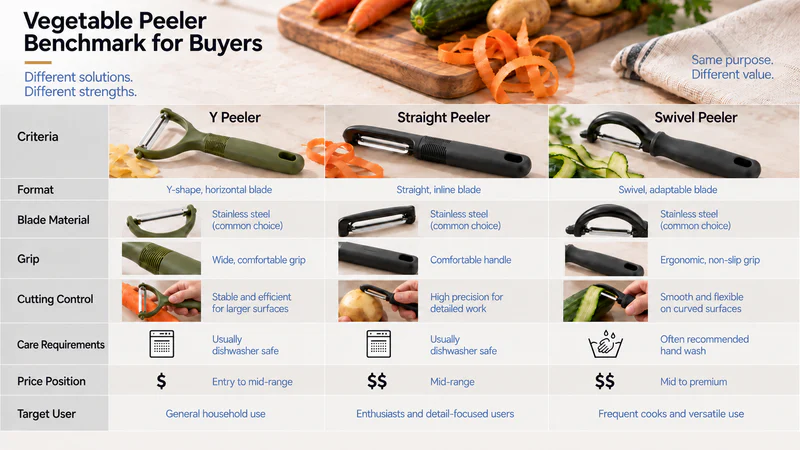
Choosing Between Y, Straight, and Swivel Peelers
Y Peelers: Control Across Broad Surfaces
A Y peeler positions the blade across the top of the handle and is commonly used with a pulling motion. Its wide working direction can provide efficient coverage and good visual control, which is also why Y-shaped peelers usually outperform straight styles in testing, on potatoes, apples, squash, and other rounded produce. The Y-shaped head is also usually easier to guide when removing lemon peel, helping lift fine lemon rind with less pith, so it tends to perform better on lemons as well.
The format also lets users rotate the ingredient while keeping the wrist relatively stable. However, a short handle or an aggressive blade may feel less comfortable for large hands, and the broad head can be less convenient around narrow or irregular areas. A common example is the Kuhn Rikon Original Swiss Peeler, often seen as a pro-chef favorite in this category and typically priced at about $5.
Straight and Swivel Peelers: Familiar, but Not Identical
A straight or sword-style peeler places the blade in line with the handle, creating a grip that can feel closer to using a small knife. It often suits carrots, asparagus, cucumbers, and other long ingredients where users prefer a lengthwise stroke, and this format is often better for finer tasks.
“Straight” describes the overall tool format, while “swivel” describes how the blade moves within its support. Many straight peelers are actually straight swivel designs, but the two terms should not be treated as exact opposites.
Left-handed suitability also depends on the cutting edges and handle geometry. A double-edged blade may work in both directions, but buyers should test the actual sample instead of assuming that every swivel peeler is ambidextrous.
For retail selection, the practical question is not which shape is universally better. Buyers should compare control, food shape, hand size, cutting direction, cleaning access, storage footprint, and the habits of their intended users.
Channel context can also change the decision. A lightweight Y peeler may work as an accessible impulse-buy or multipack item, while a heavier straight model with a larger grip may better support a premium single-product presentation.
Turn the Usage Demonstration into a Sample Test
For long produce, a straight, controlled stroke can make the result easier to assess. Rounded produce is usually better handled with short, progressive strokes while the ingredient is rotated, rather than forcing one continuous circular movement.
Users should keep their fingers outside the cutting path and hold the produce securely. Hands and handles should be reasonably clean and dry during normal use, followed by a separate wet-grip test under controlled conditions.
A buyer test should use comparable potatoes, carrots, and apples for every sample. Record peel thickness, the number of interruptions, clogging around the blade, starting force, surface finish, and the amount of edible material removed.
Repeat the test with more than one user where possible. This can reveal whether a product only works well with one grip style or whether its shape supports different hand sizes and left- or right-handed operation.
These observations should become part of the approved sample record. L-Tools’ article on kitchenware sampling explains why small signals such as hand feel, balance, finish, and functional movement can influence later sourcing decisions.
What a Market Benchmark Can Teach Buyers
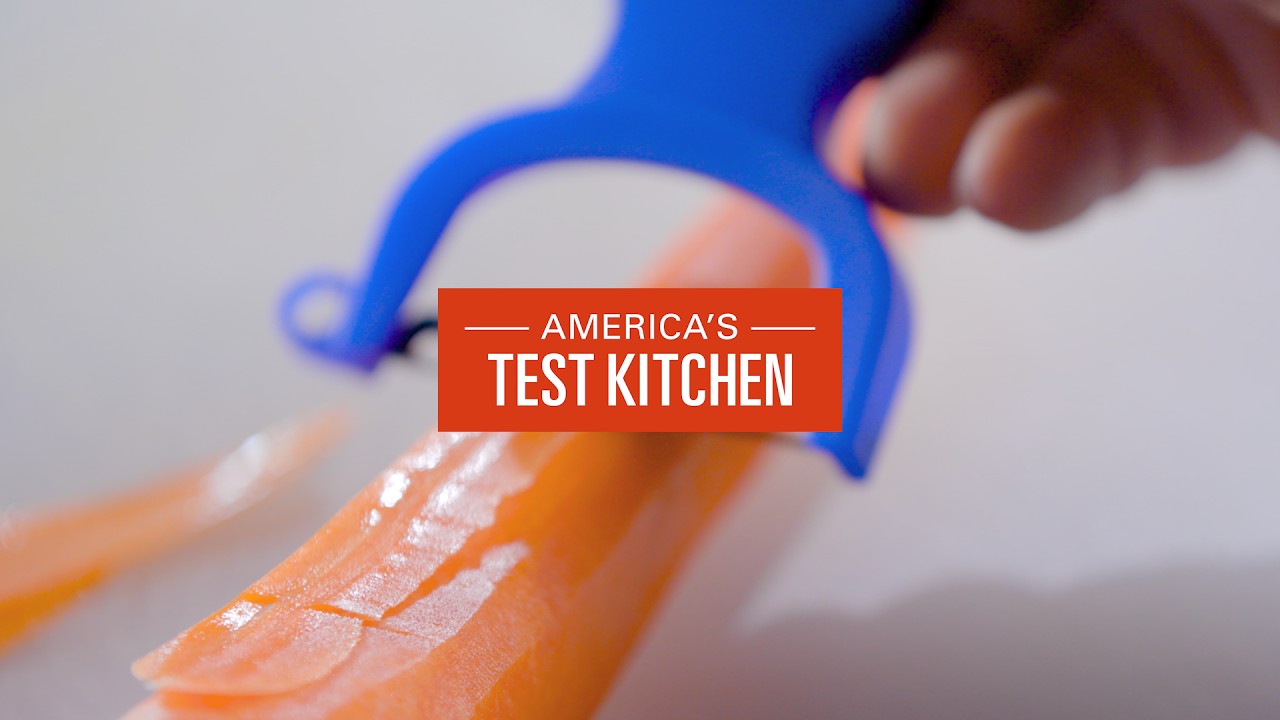
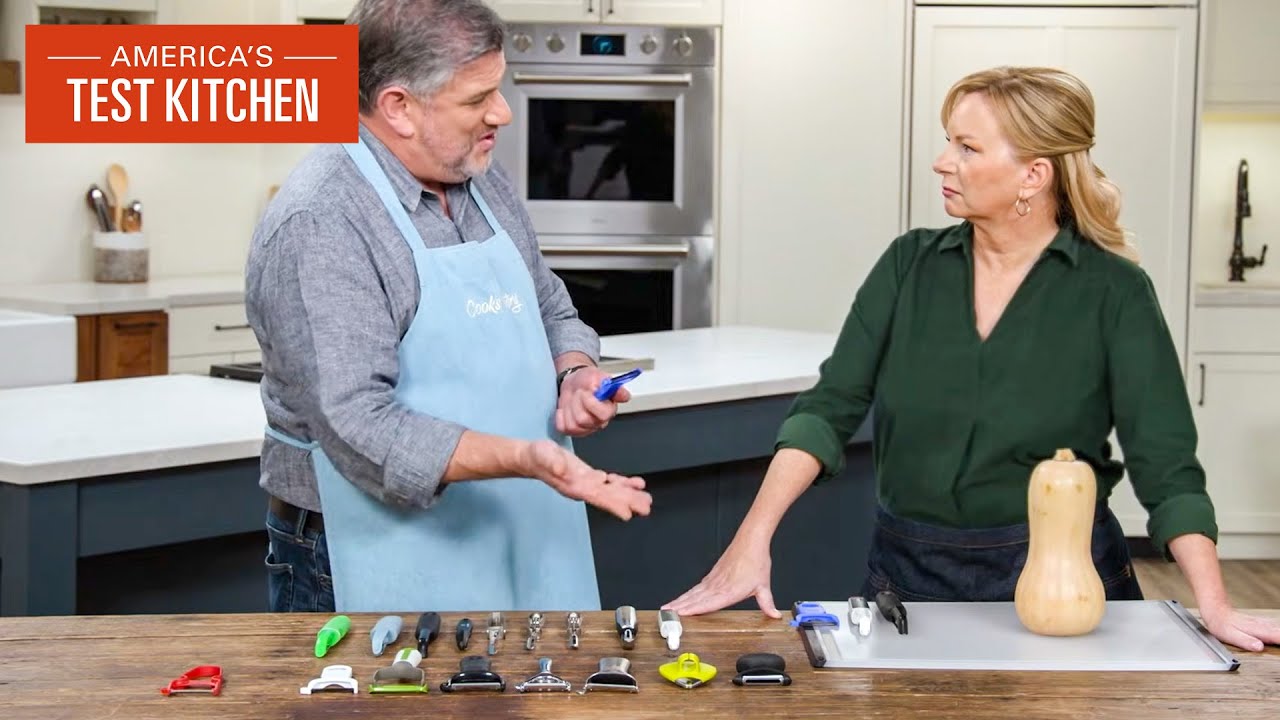
Independent reviews often use the Kuhn Rikon Original Swiss Peeler as a reference point for the Y-shaped category. Food Network’s 2026 peeler testing highlights its compact palm-friendly format, low weight, carbon-steel blade, bright colors, and accessible price. Food Wine also treats it as one of the common third-party benchmarks, while the oxo and oxo good grips are frequently used as comparison points for a different balance of grip feel and long-term durability.
These strengths also involve practical trade-offs. Carbon steel can provide strong cutting performance, and the carbon steel blade is a key selling point for this model, but it normally requires more careful washing and drying than a corrosion-resistant stainless-steel alternative.
Competing formats illustrate other product priorities. A longer straight or crosswise handle may suit users who want more leverage, while a soft or textured grip may improve perceived comfort; serrated and julienne blades serve different food applications rather than replacing a standard blade in every task.
Product teams should benchmark principles instead of copying a recognizable shape. Useful development directions may include controlled peel thickness, improved corrosion resistance, a handle sized for the target user, easier cleaning, clearer care instructions, and packaging that explains why the selected format belongs in the range.
Why Sharpness Alone Does Not Define Peeler Performance
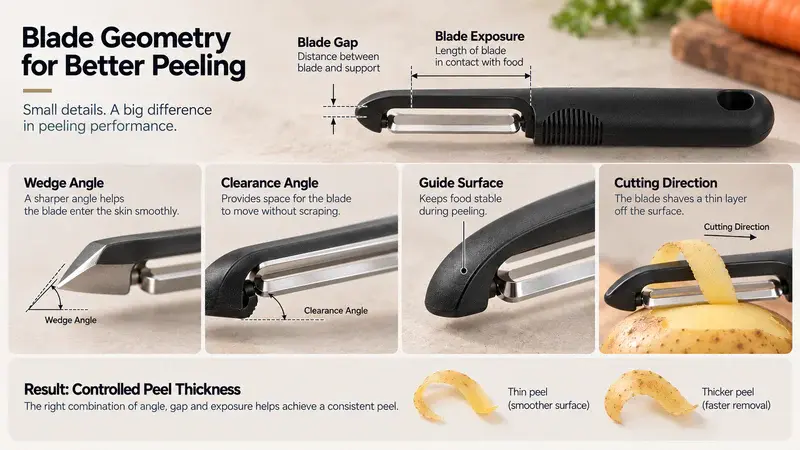
A sharp edge helps a peeler start the cut, but it does not determine how the tool behaves through the full stroke. If the complete geometry is too aggressive, the blade may remove edible flesh with the skin and create an inconsistent result.
For buyers, the useful target is controlled cutting rather than maximum sharpness. The peeler should enter the skin easily, follow the produce surface, release the peel, and leave a repeatable finish without requiring excessive pressure.
Blade Geometry and Food Waste
Several dimensions work together. The blade gap affects how much material can pass between the cutting edge and guide, while blade exposure influences how far the edge can reach beyond the surface controlling peel thickness.
The wedge and clearance angles affect how the edge enters and travels across the ingredient. Support rigidity and handle angle also matter because movement in the blade assembly can change cutting depth even when the blade itself remains sharp.
In our development work, buyers sometimes begin by requesting the sharpest possible blade. During practical tests, however, we have seen an overly aggressive setup “bite” too deeply into potatoes or apples, and the same issue can appear on butternut squash, removing more food than the user expects.
In one project context, we adjusted the blade gap and cutting angles and fine-tuned blade exposure within an approximate range of 0.3–0.5 mm. This is not a universal specification: the final value still depends on the blade material, support structure, intended produce, and approved performance standard. The right geometry also helps a peeler on curved produce maintain a steadier entry with less waste.
Test the Blade as Part of a Complete System
Sample testing should compare peel thickness across several strokes instead of judging the first cut alone. Buyers can also record starting force, smoothness, blade clogging, surface damage, and the amount of edible material left on the removed peel.
Use comparable produce and repeat the test after cleaning the product. If the blade moves within its support, check whether its range remains consistent and whether food residue collects around the pivot or guide surfaces.
Testing should reflect the intended price and channel rather than create unnecessary laboratory complexity. A mass-retail peeler and a premium catering model may use different specifications, but both need measurable approval criteria that production can repeat.
An approved golden sample should therefore capture the visible finish and functional limits. Written records for peel thickness, blade movement, attachment strength, and acceptable burrs make later inspection more objective.
Handle Comfort Can Change After the Sample Stage
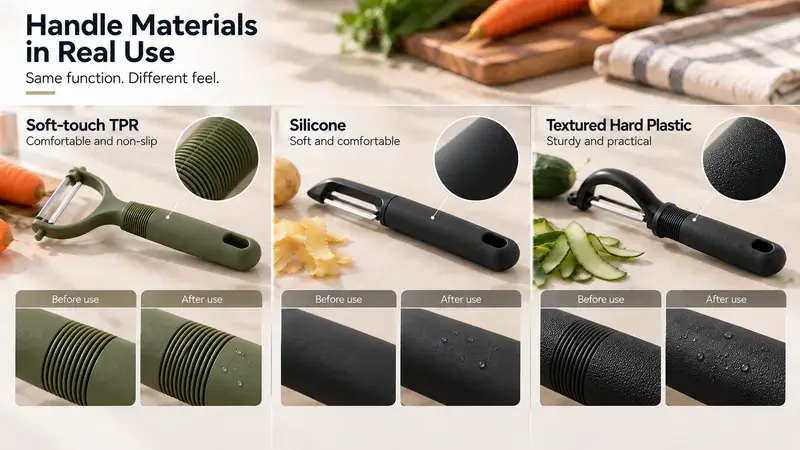
A soft handle may create a strong first impression, but initial touch does not prove long-term suitability. Cooking oil, detergent, moisture, repeated washing, storage conditions, and material formulation can gradually change the surface.
We have encountered lower-grade soft-touch TPR that felt comfortable and slip-resistant when new but later became tacky and collected dust after prolonged kitchen exposure. The lesson is not that every TPR handle will fail; grade, formulation, processing, and test conditions all influence the result.
Where the price position permits, a silicone handle may provide a more durable soft-touch option for the intended use, especially when long-term grip, slip resistance, and a more secure feel in wet use matter. For cost-sensitive programs, a well-shaped hard-plastic handle with fine etched or leather-like texture can improve control without adding a soft overmold.
Before final selection, teams should also check how easy it was to hold in wet conditions and whether the shape stays comfortable to use through repeated prep tasks. Buyers should compare wet grip, detergent exposure, oil contact, odor, discoloration, surface change, and edge comfort. The L-Tools guide to long-term kitchen tool comfort explains why a handle that feels acceptable for seconds may become tiring or unpleasant during repeated use.
Design for Grip, Cleaning, and Repairability
Grip performance comes from a peeler with a better-shaped handle and a peeler with a deeper texture balancing shape, thickness, edge transitions, texture, and overall weight distribution. Adding a soft material cannot correct an uncomfortable profile, while deep texture may improve control but also make cleaning more difficult.
Cleanability should be reviewed around blade supports, pivots, overmold transitions, and narrow joints. Reducing unnecessary gaps or using a more integrated structure may limit residue accumulation, provided the design remains practical to manufacture and inspect.
A replaceable blade can extend product use, but it also introduces a locking interface, loose-part risk, instructions, packaging, replacement inventory, and after-sales cost. Buyers should only add the feature when the complete replacement system is safe, understandable, and commercially sustainable. if you specify a replaceable-blade system, the replacement and cleaning steps must be easy to understand and safe to use.
Choose the Right OEM/ODM Route Before Sampling
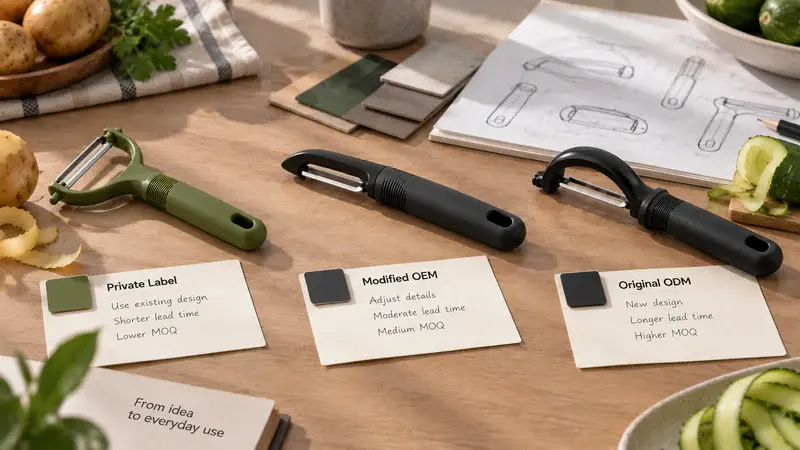
Peeler projects usually fall into three development levels. Private labeling starts with an existing product and changes the logo or packaging, while OEM modification adjusts selected specifications around a buyer brief.
ODM development goes further by involving the supplier in product direction, structure, materials, ergonomics, and manufacturability. The correct route depends on required differentiation and acceptable tooling cost, timing, and technical risk.
Customization may cover blade material, edge type, handle shape, grip texture, color, logo, and packaging. Buyers should separate visible changes from structural changes because they do not carry the same cost or validation requirements.
MOQ should reflect the real production constraints. Custom resin colors, overmolded parts, blade production, printed packaging, and new molds may each have different minimum quantities, so one finished-product number can hide the actual cost driver.
A Faster Route to Brand-Level Differentiation
When a buyer needs differentiation but has a limited development budget, our team often retains an existing blade, head, and support structure that have already demonstrated stable performance. We then adapt the handle around the brand’s established shapes, colors, finishes, or wider product language.
This approach concentrates tooling investment on the part shoppers see and hold. It can shorten development time and avoid changing a cutting system without a clear functional reason.
The method is not suitable when the existing functional structure cannot meet the brief. If the blade gap, working angle, cleanability, safety, or target-user experience is unsuitable, a new structure may justify the additional validation.
Brands should also avoid reproducing a competitor’s recognizable design too closely. A benchmark can define performance expectations, but the final product needs its own direction and an appropriate intellectual-property review.
Build Approval Gates into the Development Process
A workable project normally moves through a product brief, concept review, quotation, prototype, functional testing, and pre-production approval. The l-tools kitchenware OEM/ODM ordering process shows how these decisions connect before mass production.
Each approval should close a specific uncertainty. A visual prototype may confirm shape and branding, but a functional sample must confirm cutting depth, blade movement, grip, cleaning, and attachment strength.
The approved golden sample should be supported by written specifications and test criteria. Buyers can also review l-tools’ product development and manufacturing capabilities when deciding what evidence is needed before tooling or volume production.
Food-Contact Compliance Depends on the Final Configuration
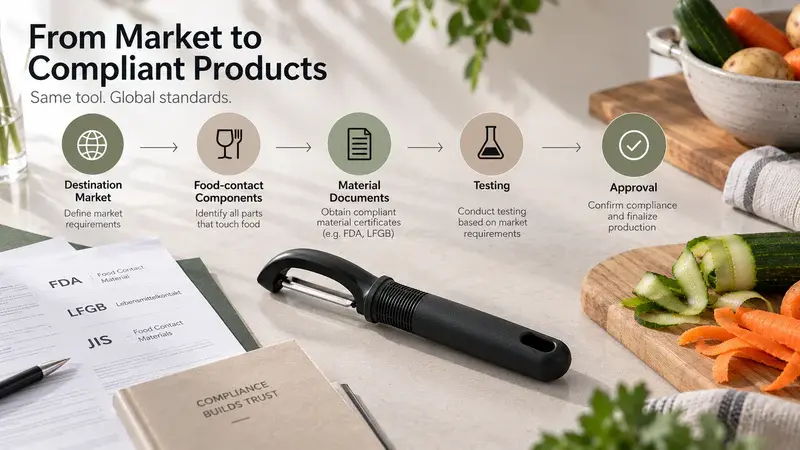
Food-contact compliance should begin with the destination market and every component that may touch food. Material, colorant, coating, adhesive, processing method, and intended use can all affect the documentation or test plan.
For the United States, the FDA’s food-contact guidance explains that a food-contact substance must be authorized for its intended use when it meets the legal definition of a food additive. This is more precise than asking for a generic “FDA certificate” for the complete peeler.
For the European Union, the European Commission’s food-contact legislation explains the general framework, good manufacturing practice, and material-specific rules. German-market buyers may request additional LFGB-related testing, but it should be defined against the actual materials and use conditions.
For South Korea, buyers should use current MFDS guidance for utensils, containers, and packaging rather than relying only on the former KFDA name. Requirements must be confirmed against the current official version before testing or shipment.
Test reports should match the approved materials, colors, and construction. l-tools’ food-contact compliance reports can support the documentation discussion, but project-specific applicability still requires confirmation.
Control the Details That Change Cutting Performance
Incoming inspection should confirm blade and handle materials, supplier documents, dimensions, and appearance. Process inspection should monitor edge condition, burrs, blade gap, exposure, swivel movement, attachment strength, molding defects, color, and logo position.
Quality limits should be measurable wherever possible. “Sharp enough” or “good movement” allows different interpretations, while an approved test method gives production and inspection teams a shared reference.
Finished-product checks should include peeling tests, cleaning review, packaging accuracy, barcode and label checks, and final random inspection. Care or performance claims on the pack should match the product that was actually tested.
Plan Backward from the Retail Launch
The schedule should include tooling, sample revisions, compliance testing, material booking, packaging artwork, production, inspection, and transport. New structures need more contingency because one delayed approval can affect every following milestone.
For seasonal programs, buyers should work backward from the retailer’s required delivery date rather than the factory completion date. Confirming critical decisions early protects the schedule more effectively than compressing testing at the end.
Turn Technical Choices into Retail Reasons to Buy
A retail buyer does not need engineering terms without context. Translate features into user outcomes such as how easy it was to peel a lemon or a potato, less food waste, a secure wet-hand grip, or easier cleaning.
A comparison chart can clarify each product’s role. Compare format, blade material, suitable produce, grip, care, price position, and target user without declaring one peeler universally superior. In retail, one of the strongest messages is showing which format is the best fit for a particular user or task, so it can become a buyer’s favorite without making blanket claims.
Demonstration content should use comparable produce and camera angles. Show peel thickness, blade release, hand position, and cleaning access instead of relying only on lifestyle footage. It can also show matched non-basic uses, such as fine work on parmesan cheese or citrus zest, when the blade style supports that task.
Packaging should continue the same message. A mass-retail pack may emphasize value and versatility, while a premium pack can explain material, control, grip, and care.
Care Instructions Must Match the Product
Cleaning advice should reflect the approved blade and handle materials. Carbon steel normally needs prompt washing and drying; stainless steel still benefits from responsible care, and it was also important to note that the carbon steel blade stays sharp well but is more prone to rust if left wet.
Hand washing usually protects the blade better than dishwasher cleaning, especially on carbon steel models. Do not print “dishwasher safe” based on a few cycles. Evaluate the finished peeler for corrosion, handle changes, trapped water, joint movement, color, and surface condition after an agreed washing test.
Replacement blades add value only when the complete support system is ready, including the locking mechanism, spare-part supply, instructions, and after-sales process. Without that system, the feature may create safety and service questions. For carbon steel versions, a light wipe with food-safe mineral oil from time to time can help maintain blade condition. Do not try to sharpen a vegetable peeler or ask whether you sharpen a vegetable peeler; when the blade becomes dull, replace the whole peeler.
A Buyer Checklist Before Sample Approval
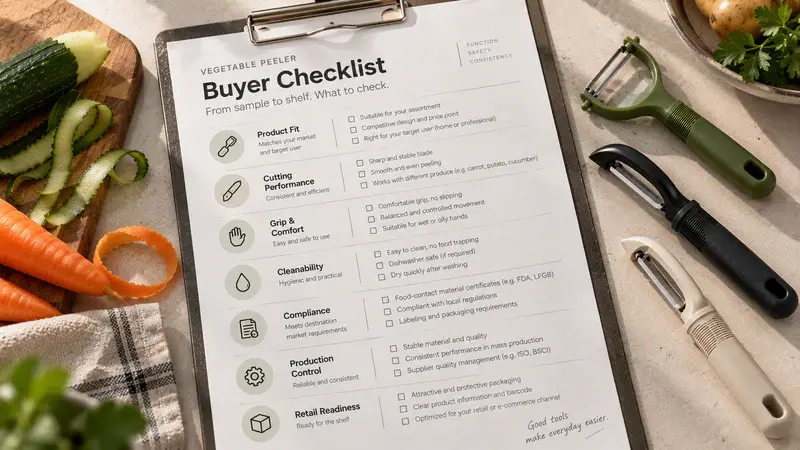
Before approving a vegetable peeler, confirm the decisions that affect use, production, and retail communication:
- Product fit: Does the format suit the target user, main produce, channel, and price, and do recommendations reflect whether it is intended for home cooks or heavier-use commercial settings?
- Cutting control: Has the team measured peel thickness and food waste rather than sharpness alone?
- Grip and aging: Has the handle been tested with wet hands and appropriate oil, detergent, or washing exposure?
- Cleanability: Can users clean the blade support, pivot, and joints without trapped residue?
- Compliance: Do reports match the final materials, colors, destination market, and intended use?
- Production control: Are the golden sample, tolerances, test methods, packaging, and acceptable defects documented?
- Commercial readiness: Do the MOQ, tooling cost, lead time, and replenishment plan fit the launch?
Common Questions to Settle Before Quotation
What determines MOQ? It depends on blade production, material batches, custom colors, molded parts, logo processes, and printed packaging—not only the final order quantity.
Can an existing peeler be customized without a completely new mold? Often yes. A brand may retain the functional head and modify color, texture, logo, packaging, or selected handle components where the structure allows.
What information should a buyer provide? Product references, target market, price, quantity, materials, packaging, testing needs, and delivery timing create a more accurate starting point. l-tools’ guidance on MOQ and quotation requirements provides a fuller preparation list.
Choosing a Peeler That Works Beyond the First Sample
A successful peeler balances format, blade geometry, handle performance, cleanability, compliance, cost, and repeatable production, which is the difference between a peeler that only looks good in sampling and one that remains reliable in use. No material or feature can compensate for a product that does not fit its user and channel.
The most reliable path connects the buyer brief with realistic sample testing and written quality limits. This moves the project beyond an attractive sample toward a product that performs consistently in retail and everyday kitchens.
Explore a Peeler Solution for Your Product Line
l-tools supports brands, retailers, importers, and distributors with existing peeler options, one of several routes we can support, selected modifications, and broader OEM/ODM development. The appropriate route depends on the required differentiation, investment, volume, market, and launch schedule.
Share your product reference, target market, quantity, price position, material preferences, packaging needs, and delivery window. You can send an OEM/ODM inquiry to discuss suitable products, customization, samples, testing, help buyers choose the best peeler for the intended market and how to use sampling and testing to the project’s advantage, and the next practical step.