
Introduction
A private-label kitchenware range can look convincing on a spreadsheet and still perform poorly in stores. The problem is often not the products themselves, but whether the assortment fits the retailer’s channel, customers, price structure, and category performance.
This guide explains how buyers can build a commercially practical range while controlling inventory and supply risk. It combines product-role planning with lessons from our work supporting kitchenware OEM and ODM solutions for retailers and private-label brands.
You will learn how to use sales evidence, assign a role to each SKU, sequence the launch, and match materials to the intended market position. The goal is a range that customers understand and the retailer can manage.
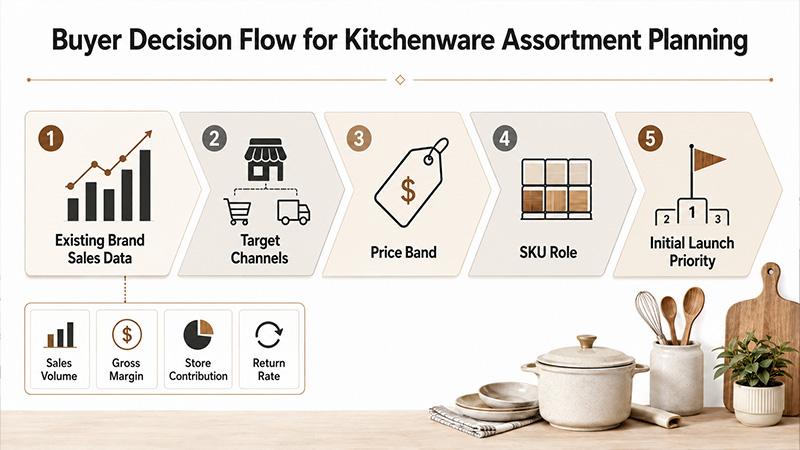
1. Start With Retail Data, Not a Generic SKU List
Begin with the retailer’s commercial context: target channel, consumer profile, price bands, existing brands, sales contribution, margin expectations, shelf space, and inventory commitment.
A supermarket, premium homewares chain, discount retailer, and e-commerce brand may all sell kitchen utensils, but they do not need the same assortment. A generally popular product can still be wrong for a specific channel.
Use Existing Brand Performance as a Baseline
For an established retailer, external brands provide useful evidence. Their sales, contribution, repeat orders, price points, and slow-moving items can reveal where a private-label alternative has a defensible opportunity.
This is not about copying another brand. It is about finding proven functions, price gaps, and opportunities for better coordination, positioning, or margin.
Separate Core, Margin, and Range-Completing SKUs
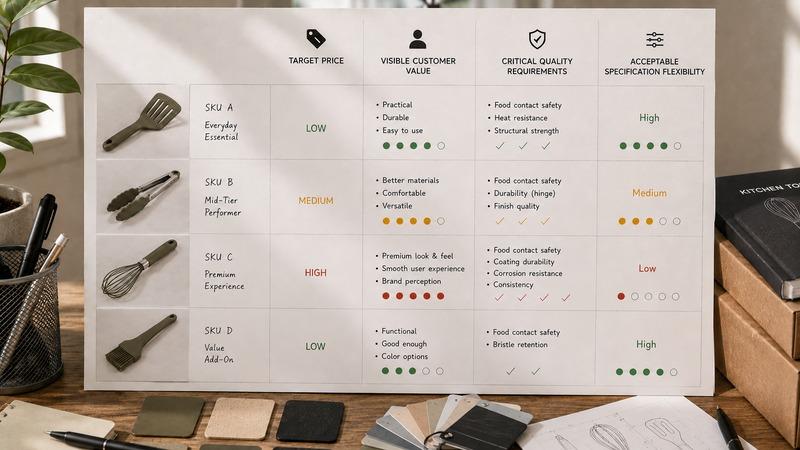
Every SKU needs a commercial role. Core products support dependable volume; margin-building products add perceived value; range-completing products create coherence; and specialty products serve narrower customer groups.
Without these roles, duplication grows quickly. Three spatulas with similar functions may increase MOQ and inventory without offering shoppers a meaningful choice. Smaller, more focused kitchen tool sets can sometimes communicate value more clearly.
2. Decide What to Launch First
A private-label range does not need to launch every category at once. Phasing the range lets buyers test demand, protect working capital, and improve later products using early sales feedback.
Start With Essential Cooking Functions
For a kitchen utensil range, essential functions include flipping, stirring, mixing, scooping, and serving. Spatulas, cooking spoons, and ladles can form the opening structure before specialized gadgets are introduced.
The sequence must still follow the retailer’s data. Buyers should prioritize products that establish the range’s purpose, rather than add low-priority SKUs to make the collection appear larger.
Match the Material Tier to the Market Position
Material should follow the intended quality and price position. Nylon may suit a value tier, while silicone, stainless steel, mixed-material structures, or upgraded finishes may support mid-market and premium ranges, especially when the core cooking tools for cooking that buyers should prioritize first are made of materials that clearly support durability and feel.
A higher-cost material is not automatically better. Buyers should ask whether customers notice the improvement, whether it supports the retail price, and whether the supplier can repeat the same color, finish, weight, and construction. If you want to help retailers make it easier for consumers to cook, the first-launch SKU mix should solve the most common tasks first, with essentials such as spatulas, cooking spoons, and ladles supported by high-frequency operating pieces like turners or food tongs.
3. First-Hand Experience: Building a PL Range for an Australian Retailer
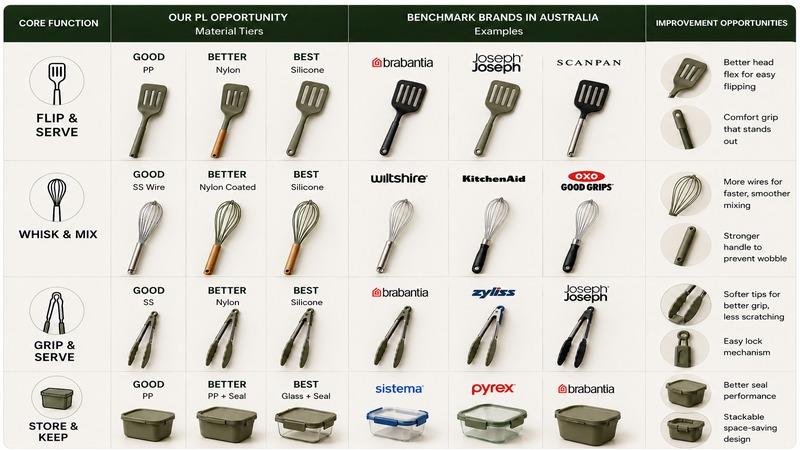
In one project, we helped a premium Australian homewares chain plan a private-label range. Instead of starting with a broad supplier catalog, we reviewed the contribution of its existing external brands and used that evidence to set the PL launch sequence.
The first phase focused on spatulas, spoons, and ladles. We aligned materials with the planned quality position and compared the range with three to five leading brands in the local market.
We looked beyond appearance and price to identify functions that could be improved, combined, or removed. With accurate data, this approach can create a clearer assortment and stronger margin potential without expanding inventory blindly.
4. Benchmark Competitors Without Copying Them
Benchmarking should reveal decision gaps, not produce imitation. Compare function, material, handle comfort, packaging, price, set composition, and shelf communication, then define why your range deserves space.
Before requesting quotations, document the channel, SKU role, material tier, benchmark references, quantity, and packaging direction. Clear private-label kitchenware project requirements give suppliers a comparable brief and make later cost and quality decisions more reliable.
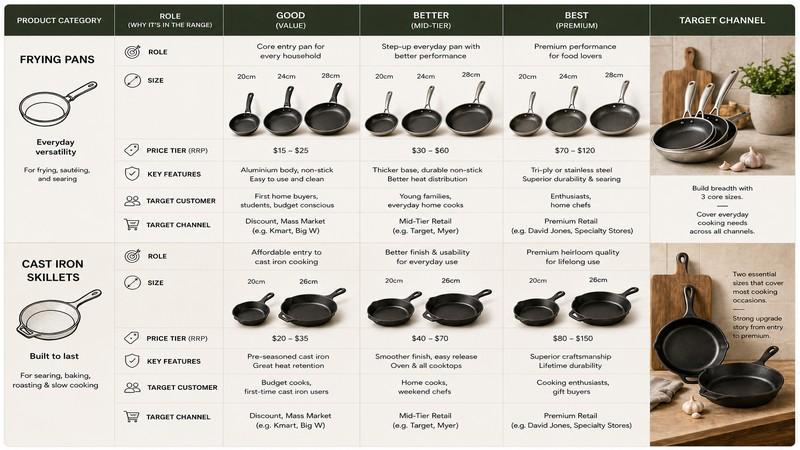
5. Build the Frying Pan and Cast Iron Skillet Assortment Around Clear Roles
Cookware should not enter the range simply because it is widely recognized. Buyers must decide whether each item will drive volume, support a premium tier, complete a cooking story, or serve a specialist group.
Choose Core and Specialty Cookware
For many mainstream channels, a nonstick frying pan can serve as a core SKU because its function is easy to understand. A cast iron skillet needs a more deliberate position because weight, maintenance, freight cost, and user expectations can narrow its audience.
A core frying pan may justify several sizes, while a cast iron skillet may begin with one proven size and finish before the buyer expands the range.
Avoid Unnecessary Size Duplication
Every additional diameter increases inventory, packaging, forecasting, and MOQ pressure. Buyers should select sizes that support different cooking needs, rather than place several nearly identical options together.
Define the job of each size. One may support everyday meals, another larger households, while a smaller format may suit limited-space kitchens or a lower opening price.
6. Compare Frying Pan Materials and Coatings by Intended Use
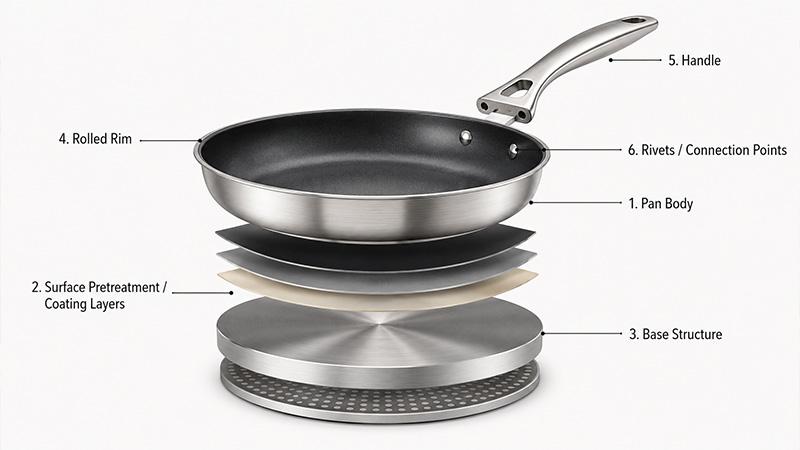
A frying pan specification should connect material, construction, coating, and expected service life. Choosing one feature in isolation can produce a pan that looks competitive but performs inconsistently as a complete structure.
PTFE, Ceramic, and Hard-Anodized Aluminium Options
PTFE and ceramic coatings can support different market stories, but buyers should not choose from a coating label alone. The substrate, surface preparation, coating system, application control, base design, and cooking conditions all affect the finished product.
Hard-anodized aluminium may support a durable or premium position when its construction and finish justify the additional cost. The decision must still reflect the retail price and benefits customers can recognize.
Check the Construction Customers Can Feel
Buyers should review handle balance, edge finishing, pan flatness, usable cooking area, overall weight, and attachment stability. These details help explain why some kitchen tools feel cheap even when they look premium.
More material is not always better. A heavier pan may feel substantial, but unnecessary weight can increase freight cost and reduce comfort. The specification should protect useful performance, not simply maximize thickness.
7. Position Cast Iron Skillet Finishes for the Right Customer
Pre-seasoned and enamelled cast iron skillets create different expectations around appearance, maintenance, cooking behavior, packaging protection, and retail price.
Pre-seasoned products may suit customers who value traditional cooking and accept ongoing care. Enamelled products can support color coordination and oven-to-table presentation, but their finish and packaging require careful control.
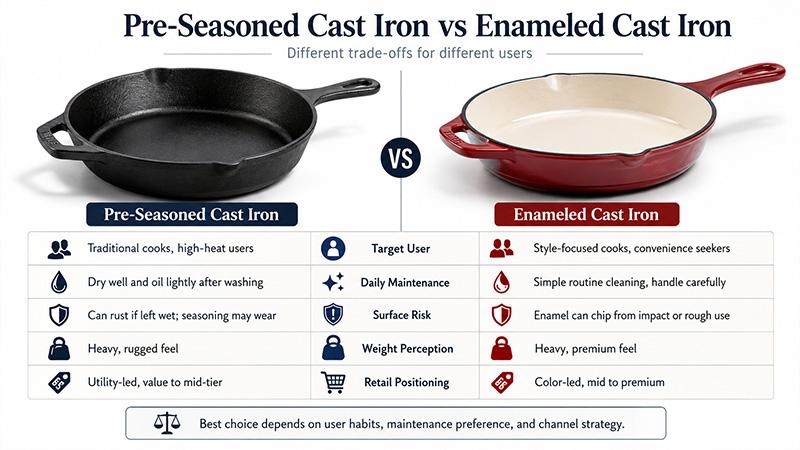
Before expanding sizes, confirm whether the target customer accepts the product’s weight and care requirements. Review flatness, surface consistency, porosity, coating adhesion where applicable, and impact protection during shipping.
8. Position Casserole Dish and Bakeware by Use Scenario
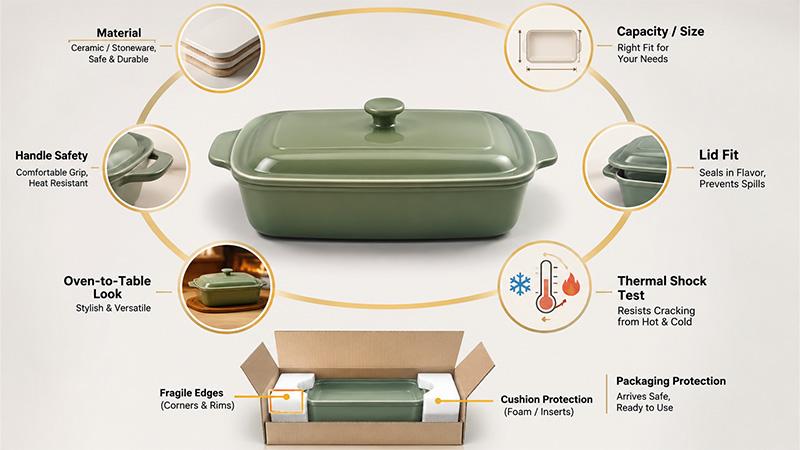
Casserole dishes can use ceramic, enamelled metal, stainless steel, or other suitable constructions. The choice depends on cooking use, oven-to-table presentation, target price, thermal performance, and the retailer’s intended bakeware range.
Define capacity, lid fit, handle safety, stacking, thermal-shock expectations, and packaging protection before comparing quotations. A visually attractive dish can still create returns if the lid moves, the handles are awkward, or its packaging provides insufficient protection.
9. Build the Cutlery Line Around a Flagship Knife
A chef’s knife can act as the quality reference for the cutlery range. Its steel, construction, balance, handle fit, edge, and finish establish expectations for the supporting cutting and chopping tools.
Define Knife Materials and Construction
Buyers should specify blade steel, target hardness, tang construction, handle material, fasteners, edge finish, and acceptable tolerances. The specification should match the price tier and realistic maintenance expectations.
A full-tang structure may support a particular balance and premium story, but it should not be automatic. Buyers should determine whether it improves the intended product and whether customers can recognize the difference.
Place Bread and Paring Knives With a Clear Purpose
A bread knife needs tooth geometry suited to its cutting tasks, while a paring knife needs a practical blade length for controlled preparation. Both require a defined role rather than being included only to increase the set count.
Individual knives offer flexibility and easier replacement. Sets can simplify merchandising and strengthen the private-label identity, but a set of knives should be built around clear use cases rather than added pieces, and a set should not rely on quantity alone when it increases packaging, inventory, and price commitment. The final format should reflect the channel, expected volume, and buying behavior.
10. Build Prep Tools Around a Clear Functional Need
Prep tools can complete a range, but each item should justify its inventory and packaging space. Buyers should evaluate usage frequency, retail price, cross-selling value, and whether the product adds a function that the existing assortment does not cover.
Choose Cutting Board Materials by Channel
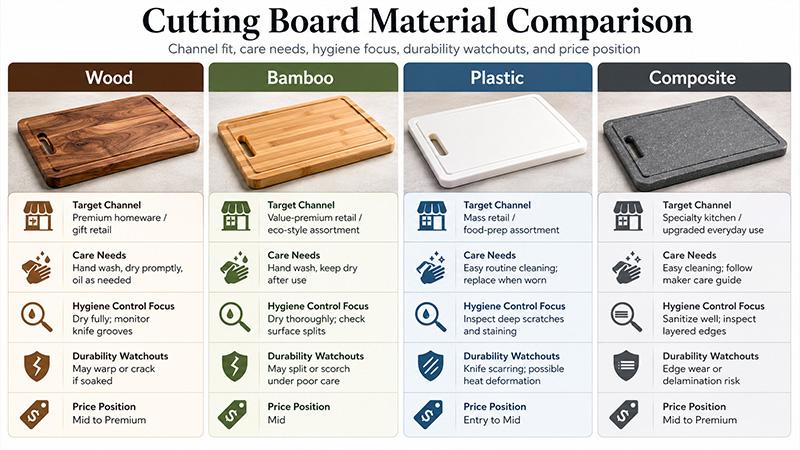
Wood and bamboo can support a natural or gift-oriented position, while polypropylene may suit channels that prioritize easy cleaning, color options, and accessible pricing. The decision should also consider warping, cracking, odor retention, knife wear, drying, and care instructions.
Features such as juice grooves, anti-slip parts, hanging holes, and reversible surfaces should solve a defined use problem. They should not be added only because they appear on competing products.
If the packaging carries a cleaning claim, buyers should define what dishwasher-safe really means for the selected material and construction.
Control Moving Parts in Can Openers and Garlic Presses
A can opener should be assessed through cutting action, leverage, grip safety, corrosion resistance, and repeated cycles. A garlic press needs stable hinges, aligned pressing surfaces, usable output, cleanability, and a food-contact finish.
These products are judged through movement, not appearance alone. During kitchenware sampling, buyers should repeatedly operate the mechanism and check looseness, deformation, sharp edges, misalignment, and trapped food areas.
11. Turn Product Choices Into Comparable Specifications
A quotation is meaningful only when suppliers price the same requirements. Each SKU therefore needs a master specification covering commercial role, materials, construction, dimensions, weight, finish, color, performance, packaging, testing, and workmanship tolerances.
Create a Master Specification Before Requesting Prices
Separate critical requirements from controlled alternatives. A supplier may suggest another fastener, material grade, or assembly method, but the change should be documented and reviewed against function, compliance, appearance, and target cost.
Approved samples should support the written specification, not replace it. A sample shows one result; the specification defines what the factory must reproduce across pilot and mass production.
12. Define Failure Modes Before Production
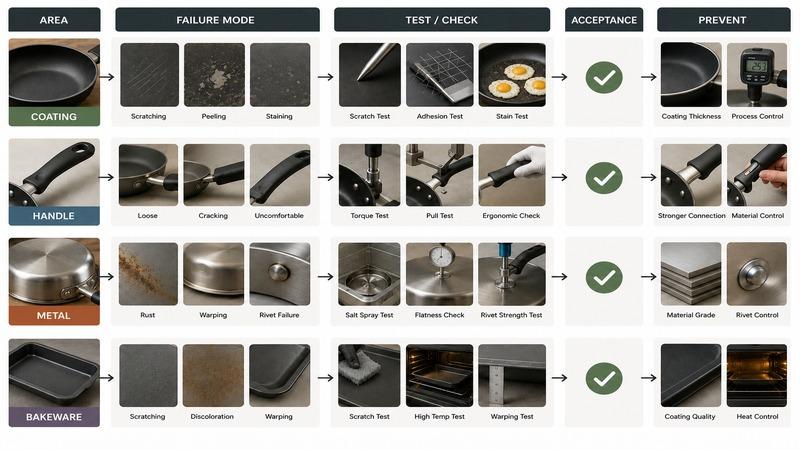
Quality planning should begin by asking how the product could fail in use. Small manufacturing details such as an uneven edge, loose rivet, tilted head, or unstable hinge may appear minor at the factory but become repeated complaints across a shipment.
Identify Common Failure Points
Common risks include coating delamination, handle loosening, rust, pitting, warping, thermal-shock breakage, poor lid fit, joint movement, and inconsistent finishes. Buyers should connect each risk to a likely cause, customer impact, detection method, and preventive control.
| Product area | Possible failure | Buyer control |
|---|---|---|
| Coating | Peeling or poor adhesion | Define an adhesion test and acceptance limit |
| Handle or rivet | Movement or loosening | Set torque and fatigue checks |
| Metal surface | Rust or pitting | Confirm material and corrosion testing |
| Bakeware | Thermal-shock breakage | Define cycling conditions and rejection criteria |
Set Measurable Test and Acceptance Criteria
Testing instructions should define the sample condition, method, cycle count, load or temperature where relevant, and pass-or-fail result. “Good adhesion” or “strong handle” cannot guide a factory or inspector consistently.
Tests should also be assigned to the correct stage. Development testing checks the design, pilot production confirms the process, and mass-production inspection checks whether the approved standard remains under control.
13. Match Food-Contact Compliance to the Destination Market
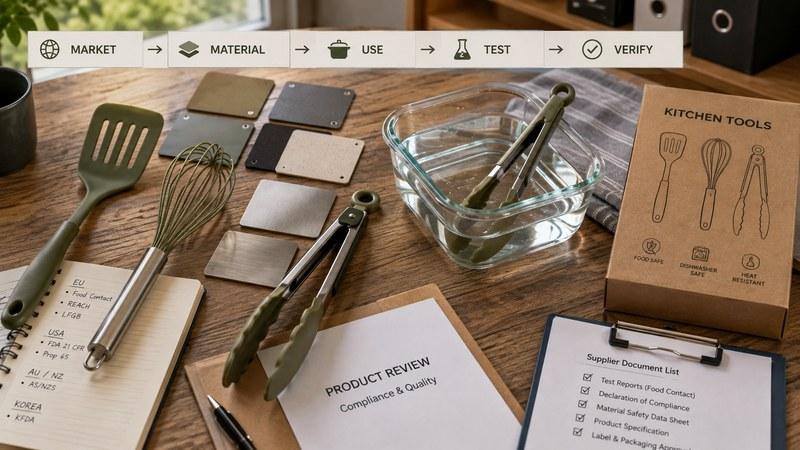
Food-contact requirements depend on the market, material, product use, temperature, food type, and manufacturing source. Terms such as FDA, LFGB, or KFDA should not be treated as interchangeable labels or universal certificates.
For the United States, the regulatory status of a food-contact material depends on the status of its components and their intended conditions of use. Buyers can review the FDA guidance on determining the regulatory status of food-contact material components when defining documentation needs.
For the European market, kitchenware falls within the EU food-contact materials framework. Buyers must consider the general framework, good manufacturing practice, and any material-specific measures that apply to the product.
Verify That Reports Match the Actual Order
A report is useful only when it matches the relevant product, material, color, coating, and factory. Buyers should check the model reference, report date, issuing laboratory, tested components, test method, and stated conclusions.
If a customized color, coating, material supplier, or manufacturing site changes, the existing report may no longer cover the actual order. Confirm the impact before approving production or making a packaging claim.
14. Request Documents That Support Traceability
The supplier file may include test reports, material declarations, certificates of analysis, traceability records, safety data where relevant, audit reports, and corrective-action evidence. The exact list should follow the product and market risk.
Use kitchenware reports and certifications as supporting evidence, not as a substitute for specification control, production inspection, or buyer review. Before repeat orders, check whether documents remain current and whether the approved material and factory are unchanged.
15. Choose the Right Level of OEM or ODM Customization
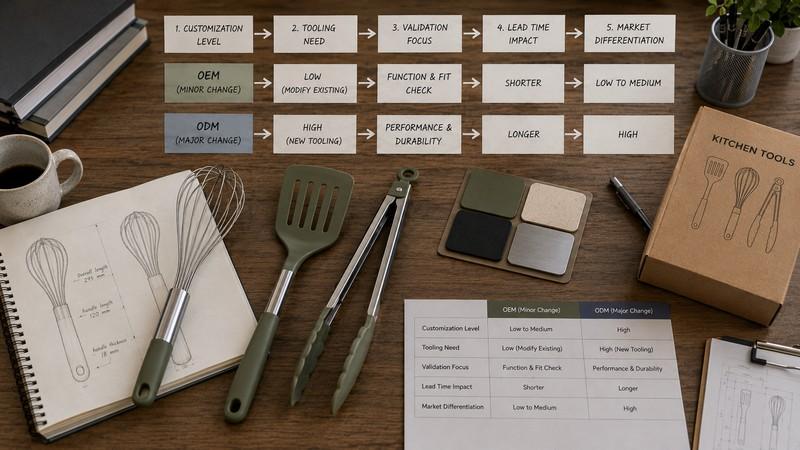
Private-label development can range from applying a logo and retail package to creating a new structure, tool, or coordinated product collection. Buyers should define the required level before requesting quotations because customization affects MOQ, tooling, testing, lead time, and approval responsibilities.
Start With the Smallest Change That Creates Value
OEM adaptation may be suitable when an existing product already meets the functional need and only requires color, branding, finish, handle, or packaging changes. Full ODM development is more appropriate when the target market needs a new function, structure, or user experience.
The right choice is not the most customized option. It is the option that creates a clear market difference without adding development work that customers cannot see or value.
| Project route | Best suited to | Main buyer consideration |
|---|---|---|
| OEM adaptation | Faster private-label launch | Control specifications and branding |
| ODM development | New function or structure | Validate design, tooling, testing, and IP |
Prioritize Commercially Useful Customization
Color coordination can help a retailer build a recognizable range, while a handle adjustment may improve comfort or shelf identity. Packaging changes may also make the product more suitable for supermarkets, department stores, discount retail, or e-commerce.
Each change should have a reason connected to the channel, target user, price, or brand. The OEM/ODM ordering process should record who approves drawings, samples, artwork, tooling, tests, and production standards.
16. Control MOQ, Tooling, and Approval Responsibilities
MOQ can change with material, color, mold, decoration, packaging, and production method. Buyers should request a breakdown by SKU and customization element instead of treating one total order quantity as the only commitment.
Tooling ownership, design ownership, confidentiality, modification rights, and maintenance responsibility should be agreed before development begins. Clear approval gates reduce disputes when the project moves from concept to sample and production.
17. Use Design for Manufacture to Control Cost
Design for manufacture means reviewing whether a concept can be produced consistently at the intended volume and cost. Relevant kitchenware manufacturing capabilities may include molding, stamping, coating, polishing, assembly, inspection, and packaging coordination.
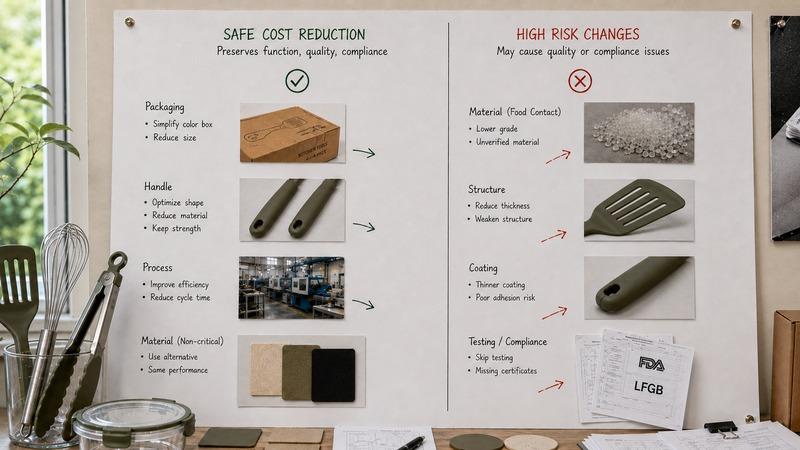
Buyers should examine part count, joining methods, material utilization, tooling complexity, assembly time, finish requirements, testing, and reject risk. A simpler construction may reduce cost, but only if it preserves the required function and product experience.
Protect Critical Specifications During Value Engineering
Set target FOB and landed-cost bands before finalizing the design. This helps the team compare cost changes against freight, packaging, testing, duties, and other expenses rather than focusing only on the factory price.
A legitimate saving comes from improved material use, simplified assembly, packaging efficiency, or better production planning. Removing a necessary process or reducing an undisclosed material specification is not value engineering.
18. Treat Packaging as Part of the Product System
Packaging must protect the product, communicate the offer, fit the retail channel, and move efficiently through storage and transport. This is why how packaging affects kitchenware product sales should be considered before the final sample is approved.
Balance Protection, Freight, and Compliance
Define the inner pack, master carton, product orientation, protective inserts, carton dimensions, weight limits, barcode, warnings, care instructions, and language requirements. Heavy cast iron, breakable casserole dishes, knives, and moving gadgets need different protection strategies.
For Australia and New Zealand, buyers can review FSANZ guidance on food-packaging requirements when packaging may contact food. Suitability depends on factors such as intended use, food type, temperature, storage, and possible contamination or migration risks.
| Packaging check | Buyer question |
| Protection | Can the pack control impact, movement, and abrasion? |
| Logistics | Are carton dimensions and weight commercially efficient? |
| Retail | Can shoppers understand the product quickly? |
| Information | Are barcodes, warnings, materials, and care details correct? |
19. Design Retail Presentation Around the Channel
Shelf-ready packs, multipacks, gift sets, and countertop displays should be used only when they support the expected sales volume and placement. Buyers should evaluate shelf footprint, visibility, replenishment, assembly, and disposal.
Before approval, confirm the complete private-label kitchenware project requirements, including products, quantities, customization, testing, packaging, destination market, and delivery terms. This gives the supplier a controlled basis for quotation and execution.
20. Evaluate Suppliers for Production Consistency
A strong development sample does not prove that a supplier can repeat the same result across mass production. Buyers should evaluate category experience, process control, capacity, material access, quality records, communication, and corrective-action ability.
Start With the Manufacturing Cluster
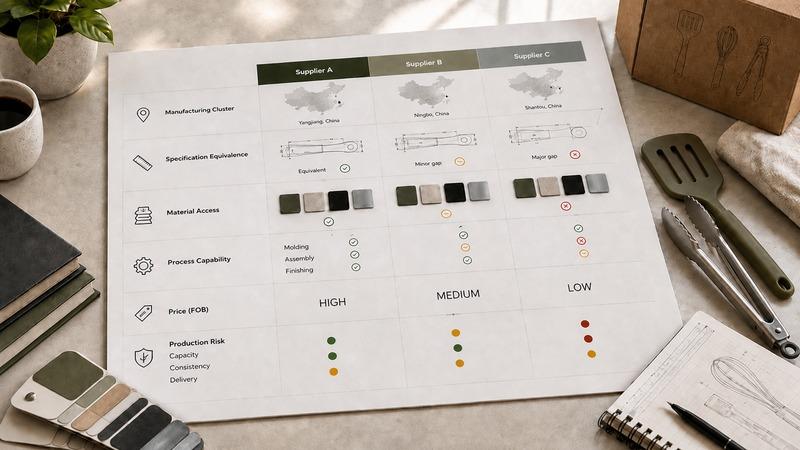
Identify where the category’s established manufacturing cluster is located and whether the supplier has reliable access to that supply chain. Cluster knowledge helps buyers understand materials, specialist processes, subcontracting, lead time, and realistic costs.
Quotations from different clusters may represent different quality levels, processes, or market segments. Confirm specification equivalence before treating the prices as directly comparable.
Investigate an Unusually Low Quotation
When one quotation is significantly lower, ask what creates the difference. It may come from efficiency, but it may also reflect a misunderstood structure, omitted process, different material, incomplete testing, or underestimated production difficulty.
Do not reject the lowest price automatically. Determine whether the saving remains valid after every supplier quotes the same product and commercial requirements.
21. First-Hand Experience: Using Price Gaps as an Investigation Trigger
In our sourcing work, factories in the same established cluster usually quote within a reasonably close range when specifications and terms are genuinely comparable. A difference above approximately 10% prompts us to investigate further.
This 10% figure is a practical trigger from project experience, not a universal pricing rule. The acceptable difference changes with complexity, capacity utilization, tooling, volume, automation, material purchasing, and payment terms.
What an Unsustainable Price Can Hide
A factory may discover after order confirmation that it underestimated the process or material requirement. The result can be a later price increase, material change, reduced internal construction, inconsistent workmanship, or delayed delivery.
When suppliers operate in different clusters, first confirm whether both regions are genuine sources for the category. A lower quote may represent a different quality tier rather than a more efficient version of the same product.
22. Control Production Through Defined Checkpoints
Production control should include incoming-material verification, first-article approval, inline checks, pre-shipment inspection, packaging inspection, and loading checks. Keep the written specification and approved sample available as references.
Define Corrective Actions Before Problems Occur
When a nonconformance appears, the supplier should contain affected goods, identify the root cause, implement corrective action, and verify effectiveness. Set responsibilities and deadlines before production starts.
Recurring problems require process-level action. Repeated sorting may remove visible defects from one shipment, but it does not correct unstable tooling, material variation, or uncontrolled assembly.
23. Balance Cost, Quality, and Market Position
Not every SKU requires the highest specification, but every specification should support its product role. Buyers can invest more in flagship and high-risk products while controlling complexity in supporting items.
24. Complete the Buyer Checklist Before Production
| Decision area | Confirmation required |
|---|---|
| Assortment | Channel, SKU role, launch phase, and price tier |
| Specification | Materials, construction, tolerances, and approved sample |
| Compliance | Market, tests, reports, and traceability |
| Commercial | Price, MOQ, tooling, lead time, and payment terms |
| Packaging | Retail format, labels, carton limits, and protection |
| Production | Inspection points, acceptance criteria, and corrective actions |
Conclusion
A successful private-label kitchenware assortment connects market evidence with disciplined execution. Buyers must define each SKU’s role, match construction to the price tier, control compliance and packaging, and select suppliers that can reproduce the approved standard.
Start with a focused launch, document the requirements, test the highest risks, and review performance after release. This creates a basis for expanding the range through sales, return, margin, and quality data.
Planning Your Kitchenware Range
L-Tools supports retailers, importers, and private-label brands with assortment planning, product development, specifications, testing coordination, packaging, and production control.
If you are planning a kitchenware range, contact our kitchenware team with your target market, channel, product list, price position, estimated quantity, and customization requirements. We can review the project and discuss practical next steps.